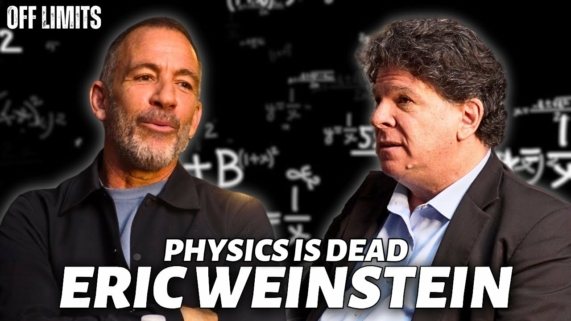
Eric Weinstein drops bombs on the physics establishment. In this explosive episode of OFF LIMITS, Bryan Callen sits down with the legendary mathematical physicist to discuss why modern physics may be dead, how string theory hijacked academia, and why his “Theory of Everything” took him his entire life to conceive.
Weinstein opens up about:
• The flawed incentives in academia and peer review
• Why string theorists “referee their own games”
• The shocking intellectual dominance of one man that changed physics forever
• How a viral documentary finally gave his work the spotlight
• Why he believes humanity won’t survive without interstellar travel
Transcript
00:00:00
Eric Weinstein: The key question is what is the observer?
00:00:03
Bryan Callen: What is the observer?
00:00:03
Eric Weinstein: What is the-
00:00:04
Bryan Callen: Not who?
00:00:04
Eric Weinstein: Well, that’s the thing. I mean, one of the old jokes is, you know, who, who’s the observer? Is it your father? Was his father the observer be- is it passed down here?
00:00:14
Bryan Callen: Yeah.
00:00:14
Eric Weinstein: It- it’s a weird way in which you’re talking technically, technically, technically, and then you say this thing and it’s like, then the observer makes an observation and a measurement and you’re thinking-
00:00:23
Announcer: May challenge current theories-
00:00:23
Eric Weinstein: How did a human get into that story?
00:00:25
Bryan Callen: Yeah
00:00:26
Announcer: And could be considered the most glorious. [upbeat music]
00:00:31
Bryan Callen: Um, I am very excited because, you know, we were talking, we’ve been good friends for a long time, and, uh, this guy who has this YouTube channel, uh, said Eric Weinstein is groundbreaking with his theory of everything. And I know you’ve been working on this quietly. We’ve talked about it, but this is kind of your first, the first time you’ve been public, publicly acknowledged. And before we get into anything, I will say that your, the c- the physics community, I don’t know about the math community, but the physics community is high school politics. I mean, the amount of sort of like, “Well, I just, I mean, his theory’s, you know, got holes in it. I mean, I wouldn’t really take it seriously.” There’s, there’s just so much back and forth, and there’s so much disagreement. Um-
00:01:27
Eric Weinstein: No, there isn’t.
00:01:27
Bryan Callen: There isn’t? [laughs]
00:01:29
Eric Weinstein: No.
00:01:29
Bryan Callen: No? Okay.
00:01:30
Eric Weinstein: No.
00:01:30
Bryan Callen: It’s-
00:01:30
Eric Weinstein: I mean, it’s in fact very interesting that, um, very often what you get is you get a small number of views that get amplified, right? And so, you know, uh, it’s a little bit the same thing with like what journalists do, is that a journalist will frame a story and then you’ll watch the entire world see that thing through that frame.
00:01:54
Bryan Callen: Mm-hmm.
00:01:54
Eric Weinstein: Right? Or, you know, if I, if I were to tell you, um, if, I don’t know, like a tell in somebody’s speech and I said, “You know, every time, uh, he says ‘uh’ twice, he’s thinking about that guy he killed in the parking lot.” And then suddenly the guy says, “Uh, uh”-
00:02:13
Bryan Callen: Mm
00:02:13
Eric Weinstein: … and everybody has a, “You know, he’s doing it again.” People are really bored, and they’re not actually dialed in or plugged in. So one of the things that I find fascinating is that the physics community has to figure out why it’s not listening to anything other than an, in, in deepest research, quantum gravity research, and in particular one theory of quantum gravity above all which has had 40 years to ship a product and cannot, and that’s something called M theory or string theory. And the big sin in physics is [laughs] that you’ve got a theory that has no rightful claim on being the only game in town, protected by this massive sort of inexplicable support from, oh, I don’t know, uh, traditional media and, um, from universities that write these press releases that a- any one of us would be embarrassed if, if our research, uh, y- you know, were described that way. So you, you find somebody’s just done research in string theory, and you bring up the press release that’s la- you know, lauding it, and that person says, “Yeah, yeah, it’s the university. I can’t stop them. They have to hype it.” So there’s a very weird situation in which the, I don’t even think we’re having a physics conversation. I think that physics at its deepest level is almost dead.
00:03:46
Bryan Callen: Really?
00:03:46
Eric Weinstein: Yeah.
00:03:47
Bryan Callen: But so, so string theory has nothing to show for itself?
00:03:53
Eric Weinstein: I wouldn’t say that at all.
00:03:54
Bryan Callen: Okay. But, but-
00:03:55
Eric Weinstein: I would s-
00:03:55
Bryan Callen: … you’re saying that they h- they were, they were the ball hogs.
00:03:59
Eric Weinstein: Yeah.
00:04:00
Bryan Callen: Yeah.
00:04:01
Eric Weinstein: I would say that-
00:04:02
Bryan Callen: And anybody who had an alternative theory was kind of like-
00:04:05
Eric Weinstein: Uh, w-
00:04:06
Bryan Callen: … side-eyed and pushed out of the game.
00:04:07
Eric Weinstein: Let’s imagine that you had one team in the NBA, okay, uh, that was different, and it was called the referees. And the referees dressed in vertical black and white stripes and carried whistles around their necks, and they were the only people allowed to adjudicate their own games.
00:04:28
Bryan Callen: Yeah.
00:04:29
Eric Weinstein: That’s sort of the situation with string theory is, is that it’s the appearance of a new team, a new kind of doing physics called the referees, and if you play them, you have to deal with their refereeing of your game against them.
00:04:42
Bryan Callen: Because they will attack you, what? They, they-
00:04:46
Eric Weinstein: They got control [laughs] of sort of refereeing who’s up and who’s down.
00:04:53
Bryan Callen: But how do they do that? So, so Michio Kaku or any of these string theorists, they get the, the bulk of the grants. What is it that they’re doing to keep other theories at sort of at bay?
00:05:03
Eric Weinstein: Well, first of all, my, my feeling about this is one of the things that they’re doing is happening right here, right now.
00:05:10
Bryan Callen: So I’m not a big supplement guy, but I’ve been, uh, drinking Vinia coffee and Vinia tea. What is that? Basically, Vinia is a compound made from red grapes. Sounds crazy, right? But check this out. It is clinically proven to improve blood flow. Basically, Vinia is basically a circulation superfood backed by real science, all right? Uh, you’ve got 60,000 miles of blood vessels in your body. That’s enough to wrap around the moon, okay? And your circulation system is like a highway system, and right now a lot of people are stuck in traffic, okay? So Vinia contains a powerful polyphenol found in red grapes that boosts your nitric oxide levels, and nitric oxide is what helps your blood vessels dilate. And Vinia, check this out, Vinia is clinically proven to increase that dilation by up to 70%, all right? And- You, you can check with anybody you want, that is a good thing. So the folks at Vinia are offering a 90-day risk-free trial. If you don’t feel the difference in physical energy and mental sharpness, they will refund every pi- penny and even cover the return postage. Here’s the best news. Visit vinia.com\callen to get Vinia’s special buy two get one month free offer. Now for about a dollar a day, you too can experience Vinia’s proven results, plus get 10% off any Vinia purchase when you click the link in the description. So go to Vinia, V-I-N-I-A .com/callen. I’ve been taking it, I’ve been drinking the tea, I’ve been drinking the coffee, and I love it. Um, and, uh, you know, all I gotta hear is clinically proven, and I’m in, especially if it increases your nitric oxide levels. Either way, with all those blood vessels, I want dilation. And once again, Vinia is clinically proven to increase that dilation by 70%. So check it out, hit me in the comment section, let me know what you think. I’m curious, I wanna know. So far I’m loving it. So, um, there it is, vinia.com/callen. And now back to the podcast.
00:07:18
Eric Weinstein: We’re not having a discussion about physics, we’re having a discussion about sociology.
00:07:21
Bryan Callen: Ah.
00:07:21
Eric Weinstein: And we’re having a discussion with them at the center. So your first point is, is that this guy Curt Jaimungal released a three-hour, I don’t know what you call it, and there’s no, there’s no precedent for it, a documentary on my theory. And immediately we’re talking about, well, what does the community say about it? The community is back and forth. No, it really isn’t. More, more or less the community has ignored it for 40 years. And we’re talking about it from the point of view of why is that? And it’s a human thing. So instead of talking about the cool stuff that we should be talking about, which is what does the theory say that the, that’s insane, and why do you think it’s true, and, and what do you think the support for it is, uh, we’re having a discussion about the sociology of peer review and refereeing and how fields get captured by dominant groups who can’t produce. And so I’m just saying that whatever it is that they do, they’ve made everything about them. So I’m happy to come back to that-
00:08:22
Bryan Callen: Yes
00:08:22
Eric Weinstein: … ’cause I think it’s super interesting.
00:08:23
Bryan Callen: Yeah.
00:08:25
Eric Weinstein: But if you don’t mind, did you see this video? What did you, what did you make of it?
00:08:30
Bryan Callen: I, I, I wanted to let you… I, I don’t make anything of it because I don’t know enough. What, what… I guess what I would ask is this about that video. What was it that he saw in that video that caused him to make that video? What was it about, ’cause I know you had met him, but what was the, um… ‘Cause you’ve explained your theory of everything to me in layman’s terms over dinner a couple of times, but, you know-
00:08:55
Eric Weinstein: Never without alcohol, I might add.
00:08:56
Bryan Callen: Never without alcohol.
00:08:57
Eric Weinstein: Yeah.
00:08:57
Bryan Callen: Some good red and white wine, sir.
00:08:59
Eric Weinstein: Yeah, yeah.
00:08:59
Bryan Callen: And might I add some excellent food, [laughs] whether it’s via Veneto or Scopa. But, um, can you, can you tell me, did he tell you what that eureka moment was for him where he went, “This is… I haven’t heard this before”?
00:09:14
Eric Weinstein: Oh, this is crazy. He ring- rings me up or sends me a WhatsApp message, something, and he says, “Hey, if you have a little bit of time, there’s something I really wanna show you.” So we get on a Zoom call and he, he takes control of my screen, and then he starts showing me his understanding of my theory. And it’s been very strange because for 40 years, more or less, I’ve been inside my own head, and I have the opportunity to sort of break out little bits of the theory, but more or less, nobody has an attention span. Imagine you’re trying to tell somebody about the ring cycle, right? [laughs] And they’re like-
00:09:56
Bryan Callen: You’re pretty good at it though. You c- you, you do teach me some things, some parts.
00:09:59
Eric Weinstein: But this is the thing, like, what the hell’s, what the hell’s wrong with everybody?
00:10:02
Bryan Callen: Yeah.
00:10:02
Eric Weinstein: It’s, it’s funny. Imagine working on one thing for four decades and not being able to get people to sort of grasp what it is that you’re proposing.
00:10:17
Bryan Callen: Yeah.
00:10:18
Eric Weinstein: It’s… You know, I, I, I don’t think there’s a parallel in most lives. And, and I believe it’s totally consequential. I think when Elon Musk talks about going to Mars, he doesn’t really wanna go to Mars. Nobody smart wants to go to the Moon or Mars as a humanity diversifying thing. I think he thinks that that’s motivating to engineers. What he really wants to do is to go interstellar, and that’s why he says ad Astra. And it’s confusing because no chemical rocket company is gonna get humans interstellar.
00:10:46
Bryan Callen: What is the difference?
00:10:48
Eric Weinstein: Um, so if the nearest star is four light years away, and you go the fastest humans have ever gone, I think it takes you 100,000 years to get there, and recorded history is pretty brief, so, you know, no chance you’re gonna do it on a generation ship.
00:11:07
Bryan Callen: Yeah.
00:11:08
Eric Weinstein: Um, and then you find out there’s no, there’s no, nothing to do at the first star. [laughs]
00:11:12
Bryan Callen: Yeah.
00:11:12
Eric Weinstein: Everything is very far away.
00:11:14
Bryan Callen: Yeah.
00:11:14
Eric Weinstein: And, you know, my take on this is that, um, this is hugely consequential. We don’t recognize that everything is decided ultimately by the final layer, which is some version of math or physics. So my feeling, and this is the reason that there’s a heaviness about me, it’s not that I enjoy talking about depressing stuff. As you know, we like talking about wine and music and dance and art and all sorts of things. Um, if we don’t get out of here and diversify onto many planets, I don’t see long-term survival of our species, and that means everything you love about this place from, from mangoes to Mozart-
00:11:56
Bryan Callen: Mm
00:11:57
Eric Weinstein: … uh, is under the control of a tiny number of human beings who should not have nuclear and biological weapons. So I was just over the moon that somebody finally- You know, put in this kind of work. And, and it’s not like I agree with everything that he said, but it, it’s, it’s clear that he understands a great deal of what it is that I’m saying more than anyone else
00:12:21
Bryan Callen: That’s, that’s amazing. And he’s a physicist or is he… He’s a layman physicist, I think.
00:12:26
Eric Weinstein: He’s clearly got some technical background and he don’t think-
00:12:29
Bryan Callen: Yeah, what’s his name?
00:12:30
Eric Weinstein: Kurt Giemungel.
00:12:31
Bryan Callen: Kurt Giemungel.
00:12:32
Eric Weinstein: And his, and his channel is called-
00:12:33
Bryan Callen: Shout out to Kurt
00:12:34
Eric Weinstein: … yeah, Theories of Everything. And the genesis of this is that he and, and I wound up at this conference called Ark that Jordan Peterson, I think, asked me to come to. And I wasn’t speaking, so I was spending time just talking to people, and Kurt was there, a- and we were sitting in the lobby. And he says, “What’s going on, man? Like, I never really understood your theory.” And I said, “Well, you know, in part, we’ve stopped asking the really big questions in physics. We’ve, we’ve…” Everything has become a question about do you have a renormalizable theory of gravity, which is not the main issue in physics at all.
00:13:13
Bryan Callen: Mm.
00:13:15
Eric Weinstein: And I said, “You know, the old questions are why are there three generations of particles? Why is there three copies of matter? You know, like, think about it as plastic, wood, and metal. Every particle comes in three-
00:13:28
Bryan Callen: Mm
00:13:28
Eric Weinstein: … uh, varieties of, of Lego, if you will. Um, why is nature left right asymmetric? Because the weak force, uh, you can t- knows its left from its right when the, the other forces don’t. Why are there 16 particles in a generation? Why do they have the properties they do? These are the old problems that before 1984 everybody viewed as the problems in physics. And then mysteriously in, in the mid-1980s, one, one individual completely reoriented the field. And I s-
00:14:04
Bryan Callen: Is this Ed Witten?
00:14:04
Eric Weinstein: This is Ed Witten, yeah. And everybody who came up afterwards is sort of unaware that, like, physics changed character. It’s, it’s just a discrete… You remember when, like in Bewitched, Darrin gets replaced by… become like Dick York and Dick Sargent? They’re two different actors who were playing and there’s no comment that something changed.
00:14:27
Bryan Callen: Yeah.
00:14:27
Eric Weinstein: Um, this is what-
00:14:28
Bryan Callen: Yeah, that’s right. I remember that, yes.
00:14:30
Eric Weinstein: Right? It’s very disturbing.
00:14:31
Bryan Callen: Yes. Yes.
00:14:33
Eric Weinstein: Um, so-
00:14:34
Bryan Callen: Nothing to see here
00:14:35
Eric Weinstein: … nothing-
00:14:35
Bryan Callen: Move the fuck-
00:14:36
Eric Weinstein: What? Right
00:14:37
Bryan Callen: I think, I think the o- original guy got sick.
00:14:39
Eric Weinstein: Maybe.
00:14:40
Bryan Callen: Yeah.
00:14:40
Eric Weinstein: But just to not comment on it. So the whole field changed character and became incapable. And-
00:14:46
Bryan Callen: What a great analogy
00:14:48
Eric Weinstein: … and so what I… I don’t know where that came from. It’s-
00:14:51
Bryan Callen: But, but string theory never spoke to you. Did, did, did, did, did you ever learn about string theory? Do you wanna, do you have a rudimentary or pretty me- i-intermediate understanding of string theory or, or more-
00:15:02
Eric Weinstein: When it came out, um… It’s a funny, funny, bizarre story, which is that I changed my major in college from physics to math to avoid this thing, and I did not know… So the problem is, is that I clearly do this change in my major between my freshman and I think in my sophomore year, but it’s as a response to something that hadn’t happened yet. So I have a time inconsistency problem in my origin story-
00:15:37
Bryan Callen: Mm
00:15:37
Eric Weinstein: … because the great breakthrough in string theory happens in 1984, called the Green-Schwarz anomaly cancellation. And, uh, Ed Witten gets very involved in this immediately afterwards and gives a talk at Penn. And that talk convinces me that the physics community is about to, to collapse. Like, leaving Afghanistan to the Afghan army and the Taliban is just instantly overruns everything.
00:16:07
Bryan Callen: And, and, and in, in the sense that this is the new blood and everything you’ve learned up till there is, is a lie or not true?
00:16:13
Eric Weinstein: Just he, he gave one lecture at Penn that was so completely bewildering and brilliant and so confident, where he just told us everything that you’ve ever worried about, here it is in string theory. It’s in this line, it’s in this term, et cetera, et cetera.
00:16:27
Bryan Callen: You, you once took a piece of paper at dinner and wrote an equation down, and that was Ed Witten’s explanation of the universe.
00:16:34
Eric Weinstein: Uh, that may have been the string action and… But the problem was that this happens later than I changed my major. And so one day, I’m reading a book by a guy named Peter Woit called Not Even Wrong. I’m on the toilet, and I’ve never really told the story about changing my major in response to Ed Witten because it’s time inconsistent, sort of reveals that I’m not telling the truth. And I see in the book it says, “Witten’s first lecture in string theory actually was before the Green-Schwarz cancellation and was delivered at a grand unification workshop.” And I said, “Oh my God. Tell me that this didn’t happen in Philadelphia, Pennsylvania.” At the University of Pennsylvania at a conference organized by Paul Steinhardt. And I thought, oh my God, I accidentally, as a 17-year-old kid, was in the audience of Ed Witten’s first string theory lecture before the flood, just totally by accident. And I see this thing-
00:17:40
Bryan Callen: Were you able to follow it at 17?
00:17:42
Eric Weinstein: Uh, I was able to follow the fact that he paralyzed the entire auditorium. One individual made everyone, uh-
00:17:54
Bryan Callen: All physicists probably. Uh
00:17:55
Eric Weinstein: … everyone was terrified of this human being. Nobody had seen something give a lecture like this.
00:18:01
Bryan Callen: Jesus.
00:18:01
Eric Weinstein: This was not human.
00:18:03
Bryan Callen: Jesus.
00:18:04
Eric Weinstein: Right? And so you’ve got the 6’4″-
00:18:08
Bryan Callen: Strange guy
00:18:08
Eric Weinstein: … awkward-
00:18:09
Bryan Callen: Very tox- very toxic, you know, kind of like a, “Oh.”
00:18:11
Eric Weinstein: Yeah. Right?
00:18:12
Bryan Callen: “Hi.” Just a brilliant guy, but he talks, “I appreciate your attempts to understand the theory of the universe, but I find your intellect- [laughs] He’s, he- … wanting” He’s the kinda guy [laughs] who laughs behind his fingers. He’s like, any grown man who’s like [laughs]
00:18:25
Eric Weinstein: Well, look, I don’t wanna make fun of the affectations.
00:18:34
Bryan Callen: No.
00:18:35
Eric Weinstein: Because he- but he’s been very aggressive. And the thing that he’s really aggressive about that I, I can’t stand, and won’t stand for, is that he says that there are no other theories.
00:18:45
Bryan Callen: He says that?
00:18:46
Eric Weinstein: Oh, absolutely.
00:18:47
Bryan Callen: Wow.
00:18:48
Eric Weinstein: Like, you, you can check out a podcast-
00:18:49
Bryan Callen: Wow
00:18:49
Eric Weinstein: … called The Universe Speaks in Num-
00:18:51
Bryan Callen: Who does he think he is, Einstein? That’s my little joke to the layman, because Einstein was, uh, very cocky. But keep going.
00:18:57
Eric Weinstein: What?
00:18:58
Bryan Callen: Einstein was, he was kinda arrogant.
00:19:01
Eric Weinstein: I was-
00:19:01
Bryan Callen: He said, “If light doesn’t bend, God’s wrong,” something like that. I don’t remember.
00:19:06
Eric Weinstein: Mm.
00:19:06
Bryan Callen: Sorry.
00:19:07
Eric Weinstein: There’s [laughs] there’s not enough alcohol for this conversation.
00:19:09
Bryan Callen: Yeah, I, I can’t believe you’re not writing this stuff I’m saying down.
00:19:11
Eric Weinstein: Yeah, yeah.
00:19:11
Bryan Callen: But, uh, go on.
00:19:12
Eric Weinstein: Um-
00:19:12
Bryan Callen: I do, I do agree with you
00:19:14
Eric Weinstein: … so W- Witten, yeah, W- Witten was on this podcast called The Universe Speaks in Numbers, and he’s asked, “Well, were you ever tempted by other approaches?” He says, “I don’t even know what you mean by other approaches.” So the, the host is sort of flummoxed, and throws some things out. He says, “Those aren’t other approaches. Those are only words. There’s just string theory. Everything else is just words.”
00:19:35
Bryan Callen: Jeez. Jeez.
00:19:35
Eric Weinstein: And I’m just, like, thinking, maybe you got sick the first day they taught remedial, remedial scientific ethics. You can’t do that as a leader of a field. You’re not allowed to declare victory like that.
00:19:48
Bryan Callen: Right, especially when there’s nothing to show for it.
00:19:50
Eric Weinstein: Well-
00:19:51
Bryan Callen: Right? I mean-
00:19:51
Eric Weinstein: … again, there’s, there’s mathematics to show for it. But again, here we are talking about strings. And it’ll keep happening, right? And whether it’s you or me, it doesn’t matter. It, it was woven into the story. So another, in order to get back to actual physics, we have to un-weave the story of Ed Witten. And, and I-
00:20:11
Bryan Callen: And this is what Jaipul was saying about your theory of everything, wasn’t it?
00:20:15
Eric Weinstein: Jaimungal.
00:20:15
Bryan Callen: Jaimungal, I’m sorry.
00:20:16
Eric Weinstein: Yeah. Um, well, I think what he said at the end was, um… Well, I mean, he s- he said something that would be embarrassing for me to say, but I, I could play it for you to give you an idea of what his assessment-
00:20:36
Bryan Callen: I’d like you to play it for me.
00:20:37
Eric Weinstein: All right. So the, the, let me just say that this is more or less Curt’s assessment after having put in 250 hours into a three-hour documentary.
00:20:51
Bryan Callen: And by the way, just so you guys know, we’re gonna break down, in layman’s terms, Eric Weinstein’s theory of everything, but just, we’re just, this is just the appetizers, okay? Just the appetizers before the main course. Roll tape. Let’s watch this.
00:21:04
Curt Jaimungal: Thank you to Eric Weinstein. It’s an avant-garde and creative theory. Curt here, several months later. This has been so long in the making. Geez, you have no idea. Anyhow, I wanted to say that I mean what I just said. I may have said this before in The Iceberg, and if I haven’t, I should have, because it bears repeating. I haven’t seen a theory like this come from any single individual ever, not one that’s this fleshed out, or has this amount of unexampled connections within itself, as well as to what’s known as the theoretical physics backbone that we talked about earlier. And by the way, this is what I do for a living. I interview people on what theory they have of reality, whether it’s of consciousness, or it’s physics-based, or logic-based, or what have you. So again, thank you to Eric, and thank you to you for watching this. I hope you enjoyed it.
00:21:55
Bryan Callen: Wow, and he’s talked to a lot of physicists.
00:21:59
Eric Weinstein: A, in particular-
00:22:00
Bryan Callen: A lot of them
00:22:00
Eric Weinstein: … a lot of string theorists too.
00:22:01
Bryan Callen: Yeah.
00:22:02
Eric Weinstein: And so, you know-
00:22:03
Bryan Callen: Wow
00:22:03
Eric Weinstein: … in part, I’m just in this very funny position where I now decide that I’m an entertainer because here’s a joke.
00:22:12
Bryan Callen: No, I know.
00:22:12
Eric Weinstein: What’s the difference between a physicist and an entertainer? An entertainer has legal rights.
00:22:18
Bryan Callen: [laughs] Well, you, you h- I, I know, and I know you, and I love you, and I, one of the things we always talk about is your, you do live, it’s a lonely existence because you live in your own head, and you’re dealing with ideas and things that very few people could really appreciate or understand, including the creativity as a comic. You know, I, I’m about to release my next special, and-
00:22:39
Eric Weinstein: Congratulations.
00:22:40
Bryan Callen: Thank you. And, and but, but at least I’m always getting affirmation. I’m, I’m out there. They’re laughing. I’m building it. They’re laughing. You know, I, I do the special. I, I get, I know how it’s gonna be received at least a little bit because I’m, I’m getting that kind of appreciation.
00:22:53
Eric Weinstein: Sure.
00:22:54
Bryan Callen: After four decades of working in relative solitude-
00:22:58
Eric Weinstein: And abuse
00:22:59
Bryan Callen: … and abuse.
00:23:00
Eric Weinstein: Yeah.
00:23:00
Bryan Callen: And it’s such an act of faith too because when, when you have a world where there’s only, when somebody like Ed Witten, e- et cetera, et al, are saying that this is the only theory, everything else is a lie-
00:23:10
Eric Weinstein: Right
00:23:11
Bryan Callen: … y- the a- the, the act of faith it must take to continue on-
00:23:15
Eric Weinstein: It’s-
00:23:16
Bryan Callen: … is, because what if nobody ever, like, sees it? That’s why you get this guy like Curt Jaimungal who, who now takes all that time to actually understand it, and highlight it, and put it out there. How has that been received?
00:23:30
Eric Weinstein: Tell me.
00:23:32
Bryan Callen: Yeah.
00:23:32
Eric Weinstein: You know, it’s like-
00:23:33
Bryan Callen: Yeah
00:23:33
Eric Weinstein: … the, the community doesn’t want to react to it, and by react, I mean something very sp- special. Like, y- you saw this thing with Terence Howard and myself that Joe asked for.
00:23:46
Bryan Callen: Yes, you were so nice to him. Maybe too nice.
00:23:53
Eric Weinstein: There was… I never wanna critique somebody if I can’t steel man them first.
00:24:00
Bryan Callen: Mm-hmm.
00:24:01
Eric Weinstein: There’s something wrong with a community that wants to pretend that a Harvard PhD and an MIT post-doc can’t be steel manned. Is this the first theory in the history of mathematics and physics that can’t be steel manned? Like, that’s a really bizarre question.
00:24:19
Bryan Callen: Yeah.
00:24:19
Eric Weinstein: So, one second. I, I think about it this way. What are the odds that somebody with my profile would work 40 years and there’s nothing to recommend what they work on? Like, zero. There’s nothing good that can be said about it. I can tell you that Terrence Howard’s idea of sticking six, uh, pentagonal housings for propellers through the edges of a regular tetrahedron is an ingenious idea for a drone. I don’t need Neil deGrasse Tyson to pat me on the back. I don’t have to call up my friends in an aerospace department. I can say, “If nobody else has had that idea,” he figured out that 108 degrees inside of a pentagon is almost 109.47, which is what you get for the interior angles of a tetrahedron. And he, he took that tiny discrepancy and he said, “That can be hel- handled at an engineering level.” And he built a drone with six degrees of freedom, so it has pitch, yaw, and roll, and it also has X, Y, and Z spanning something called the affine group. Now, my feeling-
00:25:32
Bryan Callen: Terrence Howard did that?
00:25:33
Eric Weinstein: Yeah.
00:25:33
Bryan Callen: I mean, that’s impressive. [laughs]
00:25:35
Eric Weinstein: Yeah. And, uh, I’m gonna catch all this nonsense off the internet, which is like, “That Charlotte and Terrence Howard, you were too nice. He had nothing.” And another, another group of people is gonna say, “You were such an arrogant prick.”
00:25:48
Bryan Callen: [laughs] Of course, you can’t win.
00:25:49
Eric Weinstein: Of course. But that’s… But my point is in neither of those things. There essentially are no theories that can’t be steel manned.
00:25:57
Bryan Callen: Right. Of course.
00:25:59
Eric Weinstein: Right. So-
00:25:59
Bryan Callen: A great author, the difference in a great novel, the reason that The Brothers Karamazov is a great novel is because Ivan, who is the atheist, is very hard to argue with.
00:26:09
Eric Weinstein: Mm.
00:26:10
Bryan Callen: But The Grapes of Wrath, great novel, but not be considered a good novel because you never get the point of view of the orange growers. The people that own the orange groves, we never see them. They’re just these demons that are milking the poor Dust Bowl migrants, but it would’ve been a great novel-
00:26:26
Eric Weinstein: You’re gonna ruin Upton Sinclair for me, for sure.
00:26:28
Bryan Callen: I know. This is actually Steinbeck. It’s Steinbeck.
00:26:30
Eric Weinstein: No, I know, but-
00:26:30
Bryan Callen: Yeah, yeah. Yeah. But, but, but you mean The Jungle?
00:26:33
Eric Weinstein: Yeah.
00:26:33
Bryan Callen: Uh, yeah, uh, exactly. But it’s the same thing. There’s on- the, the bad guy’s so bad, but any great movie is the, the bad guy gives you a monologue, and you get his point of view.
00:26:44
Eric Weinstein: Oh, well the-
00:26:44
Bryan Callen: Started out as a kid
00:26:45
Eric Weinstein: … this is, this is my take on Sorkin’s, uh, version-
00:26:48
Bryan Callen: Of A Few Good Men?
00:26:50
Eric Weinstein: Colonel Jessup has as good of a point-
00:26:54
Bryan Callen: Absolutely
00:26:54
Eric Weinstein: … as Lieutenant Kaffee. Right out-
00:26:56
Bryan Callen: We need all the walls, son. Yeah.
00:26:58
Eric Weinstein: Well, it, it’s… But it’s undone by a flaw, right? So he, he gives this final soliloquy. He’s like, uh… He says something about, “You sleep under the bank- blanket of freedom that I provide,” not that we provide.
00:27:13
Bryan Callen: That’s right.
00:27:13
Eric Weinstein: And so this is-
00:27:14
Bryan Callen: Yeah
00:27:14
Eric Weinstein: … Moses’ sin, where Moses takes responsibility for bringing water from the stone for which he’s prohibited to enter Israel.
00:27:21
Bryan Callen: That’s right.
00:27:21
Eric Weinstein: And so, you know, in a weird way, we don’t remember that the reason that A Few Good Men is a great film, and a, and a, and a brilliant play really, is that Jessup and Kaffee are evenly matched. It’s not that one has the right point-
00:27:36
Bryan Callen: That’s right
00:27:36
Eric Weinstein: … and one has the wrong point.
00:27:36
Bryan Callen: That’s exactly right. And that’s such a good point because we want… We ultimately, viscerally, I, I, I, I sided with Jessup. My… The, the man side of me was like, “Yeah, that guy’s a bitch,” you know? But hold on, he still… You, you, you killed him. And-
00:27:51
Eric Weinstein: Well, the thing is, I wanted somebody on that wall. I needed somebody on that wall that wasn’t him.
00:27:56
Bryan Callen: Yes, but, but… Well, I, I don’t mind having Jessup on that wall, but you, you, you have to remember that, that the reason that we don’t have a warrior class that takes precedence all, over all the other classes is because the warrior class is there to protect our gentler spirits, the people that actually can’t handle the hazing and things like that. I mean, you, you can’t make the protectors the end all and be all. The protectors are there to allow for what would be considered, I suppose, civilian rule. W- the, the argument would be you have the most powerful army in the world in some ways because you have a powerful and strong and creative culture. You can’t have a powerful, strong, creative culture if it’s just a Spartan culture. You need Athens. You need Athens to protect. You need Spartans to protect Athens, I suppose, is the way I looked at it.
00:28:49
Eric Weinstein: Wouldn’t you think of Jessup as likely to be a cultured man in a narrow vein, where he probably read Marcus Aurelius? Like, there’s no question in my mind that Jessup is a thinker, and the weird thing is, is that he’s cheated of war. He’s forced to stay on this base in this tense situation that is not actually hot.
00:29:10
Bryan Callen: I would say that you, you… I don’t know that he’s a cultured man, but I think that in order to be a warrior, you need not be confused about the gray area between right and wrong, good and evil. Your enemy is your enemy, and you’re in the business of killing or imposing your will or neutralizing your enemy. Um, it’s a, it’s a nasty business.
00:29:31
Eric Weinstein: I think it’s-
00:29:31
Bryan Callen: But you need a born enforcer.
00:29:33
Eric Weinstein: I think the problem is he’s cheated of war, and he, he’s in an, in a military edging situation where he has to eat his breakfast within, uh, you know, in, in, in the crosshairs of a Cuban who’s trained to kill him, but nothing’s actually happening.
00:29:49
Bryan Callen: I, I, I would agree with that. I would agree with that. Um-
00:29:53
Eric Weinstein: And so in fact, part of the problem is he’s saying, “Look, I know who I’m supposed to be, and there’s just no war for it.”
00:30:01
Bryan Callen: Yeah. Yeah, that’s, that’s, uh… It’s kind of like a, a Ferrari engine with no racetrack, you know?
00:30:08
Eric Weinstein: That’s right.
00:30:08
Bryan Callen: But you know what Freud said about that? I think it was, um… I can’t remember if Freud was having a correspondence with, uh, can’t remember the philosopher. And, and, and he said, uh… Oh, God, who was it? It was… I think Freud said, “If you don’t allow man to go to war, he’ll go to war on himself.”
00:30:24
Eric Weinstein: Mm.
00:30:24
Bryan Callen: You know, you, you, you… And, and, and then the idea was that men don’t go to war for hate. They don’t go to war because they hate the enemy. They go to war because they love what they’re protecting. And if you wanna get young men to fight valiantly-
00:30:40
Eric Weinstein: Mm-hmm
00:30:40
Bryan Callen: … if you wanna get young men to, uh, die for a cause-
00:30:43
Eric Weinstein: Right
00:30:44
Bryan Callen: … you need, you need symbols for them to march under. You need slogans.
00:30:49
Eric Weinstein: [laughs]
00:30:49
Bryan Callen: You need that sort of… You need something that they can get behind, and it’s usually love of country. Uh-
00:30:57
Eric Weinstein: Or-
00:30:57
Bryan Callen: Or-
00:30:58
Eric Weinstein: Well, entertainment, and then I, I think that one of the s- this one of the-
00:31:00
Bryan Callen: I don’t know if that sustains.
00:31:02
Eric Weinstein: It’s a very interesting question.
00:31:03
Bryan Callen: Yeah.
00:31:03
Eric Weinstein: So PJ O’Rourke has a beautiful passage where he says that, uh, someone experienced what used to be called the drunk delight of battle before we decided that war was a bad thing. [laughs]
00:31:16
Bryan Callen: The drunk delight of battle.
00:31:18
Eric Weinstein: Delight of battle.
00:31:18
Bryan Callen: Yeah.
00:31:18
Eric Weinstein: Yeah, yeah.
00:31:18
Bryan Callen: Well, that’s… But, but when, when they, the, the young men marched off to the Civil War, and certainly World War I-
00:31:24
Eric Weinstein: Yeah
00:31:25
Bryan Callen: … not so much World War II, but certainly World War I, they were… They… It was… They were, they were, they had plumes in their hats, and they were excited to go to war. It was valiant. There was something… You know, any young warrior thinks of themselves as on the side of right, and there’s, there’s a, there’s a romance to it.
00:31:42
Eric Weinstein: Well, but the-
00:31:43
Bryan Callen: The problem is war mocks that.
00:31:45
Eric Weinstein: Yeah.
00:31:45
Bryan Callen: And when you, when you, when you… If you was to talk to somebody who’s been in war, war makes a mockery of whatever you thought was right and wrong or whatever you thought was good guys, bad guys kind of stuff.
00:31:53
Eric Weinstein: Well, the cer-
00:31:53
Bryan Callen: It’s certainly about honor and courage and all those things.
00:31:56
Eric Weinstein: So certain kinds of warfare are incredibly demoralizing. So the Bouncing Betty that was developed, I think by the Germans, um, was feared because of the kind of injury that it inflicted.
00:32:07
Bryan Callen: Yeah.
00:32:07
Eric Weinstein: Something that would kill you would be different than something that would-
00:32:10
Bryan Callen: That would maim you, yeah
00:32:11
Eric Weinstein: … in a, in a particular way. And, you know, in a, in a weird way, I think that dueling, uh… in a way that was unlikely to be fatal. So the two people could fire at each other and, uh, experience the thrill of not, of likely not dying.
00:32:30
Bryan Callen: Right.
00:32:31
Eric Weinstein: Or, you know, dueling-
00:32:31
Bryan Callen: Right
00:32:31
Eric Weinstein: … to first blood.
00:32:32
Bryan Callen: Yeah. In fact, they used to shoot kind of over each other’s, you know, line of fire.
00:32:36
Eric Weinstein: Well, there’s something called de loping. I mean, now that you bring it up, it’s a word that I never get to use, uh, where you fire your shot into the ground. You throw it away-
00:32:45
Bryan Callen: Mm
00:32:46
Eric Weinstein: … saying, “I have no desire to kill you, but I have no desire to cower either.”
00:32:50
Bryan Callen: Yeah. Yeah. That’s, uh-
00:32:53
Eric Weinstein: So, you know, this was… Well, this… A- and this is why the, the manly world of the man-o-sphere is all [censored] up because in essence we’ve got a bunch of people trying to figure out how to be men in a, in a time that has had a lot of peace since 1945.
00:33:07
Bryan Callen: Well, this is Texas, my friend.
00:33:09
Eric Weinstein: Yeah.
00:33:09
Bryan Callen: This is, this is, uh… You know, I trained-
00:33:12
Eric Weinstein: This is Texas
00:33:12
Bryan Callen: … with all these guys. Well, I mean, you, you moved to Texas. You’ve got a co- p- p- copy of the Constitution in your back pocket. You grow an aggressive beard. You get better at jujitsu. You’ve got a freezer full of game meat. Your-
00:33:23
Eric Weinstein: And tell me something.
00:33:23
Bryan Callen: Yeah.
00:33:24
Eric Weinstein: When, when a, a guy with an AR-15 shows up in Uvalde, what do the men do-
00:33:32
Bryan Callen: I-
00:33:32
Eric Weinstein: … with the guns?
00:33:33
Bryan Callen: Well, in Texas you’re supposed to rehearse that scenario, and you rehearse it not just with live rounds, but with dummy rounds. So if you get a… if something jams, you learn how to expel your magazine.
00:33:43
Eric Weinstein: Right.
00:33:44
Bryan Callen: It’s all simulation.
00:33:44
Eric Weinstein: But what I’m trying to say is is that a mom took off her heels to hop the fence and rescued her kids from an active shooter situation because Texas wasn’t Texas.
00:33:53
Bryan Callen: Right. [laughs] That’s right.
00:33:55
Eric Weinstein: Right?
00:33:56
Bryan Callen: Well, yeah. Yeah.
00:33:57
Eric Weinstein: So we all, we all, we’ve, we’ve all learned this w-… Boy, from, from where I come from, you talk like that, it’s a short ride.
00:34:03
Bryan Callen: Right.
00:34:04
Eric Weinstein: Well, mostly that’s, that’s TV. Now, I’m not saying that that’s-
00:34:07
Bryan Callen: Well, I have a joke about that, which is-
00:34:10
Eric Weinstein: Tell me
00:34:10
Bryan Callen: … you know, carrying a gun, which I could do in Texas, it… frankly, it’s a little heavy.
00:34:14
Eric Weinstein: You will.
00:34:14
Bryan Callen: It’s a little heavy, and it’s also digs into my, my, my spleen when I’m sitting down. And also, I’m not responsible, so I have a, I have a house full of children. And, and the joke, but it’s true, is I, within three days if I started carrying a gun, I would go, “Where is my gun?” You know? Which is not a good [laughs] question to ask when you’ve got kids in the house. So, you know, Texas, not Texas, or most of us figure, ah, it’s just a lot to carry. [laughs] It’s just heavy. After a while you just become paranoid, and chances are it’s not gonna come to that and stuff like that. Now, yes, I do practice shooting-
00:34:52
Eric Weinstein: Yeah
00:34:52
Bryan Callen: … because in my mind I wanna be the guy who can be like, “Get down. Goosh, goosh, goosh. It’s okay, everybody.” Problem with that also is I’ve had a lot of warriors and police officers and guys who’ve been inoculated to the stresses of combat-
00:35:03
Eric Weinstein: Right
00:35:04
Bryan Callen: … tier one operators who say-
00:35:05
Eric Weinstein: Right
00:35:05
Bryan Callen: … “Hey, Bry, here’s the problem. If you’ve got a gun and there’s an active situa- uh, shooter situation and you’re squeezing off rounds, the cop’s gonna shoot you thinking you’re the guy.” There’s a lot of things that you haven’t thought about.
00:35:15
Eric Weinstein: You have never considered.
00:35:17
Bryan Callen: Never considered.
00:35:17
Eric Weinstein: And, and you’re gonna figure it out the first time you need it.
00:35:20
Bryan Callen: Another guy did this to me. He said, uh… I said, “Well, if I’m with, with my kids in a mall, I wanna be able… What’s a good gun to carry?” And he just stopped and he said, “If you’re in, at the ma- if you’re with your kids at the mall, huh? What’s a good gun? What do you, what do you… How do you see this playing out?” I go, “If I see a guy with a gun and I got my kids there, I wanna, I wanna take him out before he takes me out.” And he said, “Yeah. Okay. Well, go ahead. Show me what you would do.” And he… I, I go, “Just…” I go, “What do you mean?” He goes, “Just draw and shoot.” So I, I go to draw and shoot. He grabs both legs and he starts pulling both legs in two different directions. He said, “Your kids are gonna be holding on you, pulling you one way, and the other kids are gonna be pulling the other. Either way they’re gonna be holding on to you.”
00:35:57
Eric Weinstein: Just saying, I think of-
00:35:57
Bryan Callen: You didn’t think about that, did you?
00:35:58
Eric Weinstein: … of the drywall problem.
00:36:00
Bryan Callen: All of it.
00:36:00
Eric Weinstein: Yeah, yeah.
00:36:01
Bryan Callen: And I, and I went, “Oh, man. I never thought about that.” He goes, “Yeah. You wanna get serious about this, you gotta train for it like anything else.”
00:36:06
Eric Weinstein: Well, this, this, this is the, this is the problem I think. And by the way, this is why I’m really enthusiastic about this force on force, uh, simunition.
00:36:15
Bryan Callen: Yeah, done it.
00:36:16
Eric Weinstein: Because they’re actually converting your firearm into a de facto Airsoft and-
00:36:23
Bryan Callen: No, I haven’t done the Airsoft, but I did do a scenario where there are screens, and they have an electric, uh, like literally a taser on your back, and if you get shot you get tased.
00:36:33
Eric Weinstein: Where there’s pain penalty. Yeah, yeah.
00:36:34
Bryan Callen: Dude, my, my cortisol… I got addicted to it though, ’cause my cortisol, my adrenaline was through the roof.
00:36:39
Eric Weinstein: This is the problem with fetishes.
00:36:42
Bryan Callen: [laughs] All right. We’ve, we’ve already digressed. I need to get back to-
00:36:46
Eric Weinstein: Sure
00:36:46
Bryan Callen: … Eric Weinstein’s theory of everything. Well, so, so this guy makes this video. I wanna know, can you give us-
00:36:52
Eric Weinstein: Well-
00:36:53
Bryan Callen: Is there any way you can… Yes
00:36:54
Eric Weinstein: … before-
00:36:55
Bryan Callen: ‘Cause I know that my producer Dylan is chomping at the bit. He wants to know the secrets to the, to the-
00:37:00
Eric Weinstein: Is he in the chair or you?
00:37:01
Bryan Callen: It-
00:37:01
Eric Weinstein: I say screw Dylan.
00:37:02
Bryan Callen: I love it. I love it. You’re right.
00:37:04
Eric Weinstein: Okay.
00:37:05
Bryan Callen: You’re right.
00:37:05
Eric Weinstein: Um-
00:37:05
Bryan Callen: You free me.
00:37:07
Eric Weinstein: [laughs]
00:37:07
Bryan Callen: You… Eric Weinstein, you are my wings.
00:37:08
Eric Weinstein: And you complete me. Um, listen, what happened was that while Kurt and I were sitting outside of this conference, Kurt would say, “Okay, how does your theory handle the three generation problem? Why are there three copies of matter?” I said, “Here it is in five minutes.” So I gave him the answer. Then he said, “Well, how does it handle the cosmological constant problem?” So I gave him the answer. Then he said, “Okay, why are there 16 particles in a generation?” Gave him the answer. “Why SU3 cross SU2 cross SU1?” The, the, the groups, the symmetries that generate the forces. Everything was about five minutes. And so he’s like, “How is this possible?” And I said, “I don’t honestly know what’s going on.” Um, he, he clearly has background in mathematical physics, uh, I think from the University of Toronto. He says that on his program. I don’t know what… I don’t think he has a PhD. I don’t think he had an advisor. I also didn’t have an advisor. Um, I, I did have a, I did get a PhD, but I, I think he probably stopped before. And then he got curious, and then he disappeared. And then out of nowhere he appears, and he’s got this mockup of my theory on his screen.
00:38:23
Bryan Callen: So he took a couple of months to go down that rabbit hole.
00:38:27
Eric Weinstein: Oh, yeah.
00:38:28
Bryan Callen: Wow. Man.
00:38:30
Eric Weinstein: And then he just like, oh, he’s like, “Holy cow.”
00:38:33
Bryan Callen: It checks out.
00:38:38
Eric Weinstein: And now it’s… Okay, so now you’ve got two non-professors roaming around the internet who are, are seeing sort of the same thing.
00:38:49
Bryan Callen: Two?
00:38:50
Eric Weinstein: Well, me-
00:38:51
Bryan Callen: Right
00:38:51
Eric Weinstein: … and him.
00:38:51
Bryan Callen: And Kurt.
00:38:52
Eric Weinstein: Yeah. And the community still isn’t listening. And I, you know, and I, and I’m trying to say to the community in some sense, you’re in receivership. You’re in intellectual receivership. Ever since you caught the quantum gravity, uh, flu and you’ve been talking about nothing other than the one true theory, and there’s no other game in town, and we all have to quantize gravity because this is the holy gra- all of this is total nonsense. And it, it, it really began 1983, ’84 with one individual who was just so intellectually dominant that he steered the entire field towards his set of questions.
00:39:36
Bryan Callen: With that one speech, University of Pennsylvania.
00:39:39
Eric Weinstein: No. That was the… I… That was the s- the thing where I s- look, I’m in my freshman year, I guess, at Penn. So very, it’s very unusual-
00:39:49
Bryan Callen: Right
00:39:50
Eric Weinstein: … it’s more unusual for a freshman to be at a physics seminar than it is for me to be 16 or 17.
00:39:56
Bryan Callen: Right.
00:39:57
Eric Weinstein: But I’m young. I have no idea where I am. I’m going to seminars thinking that this is, like, normal, which I guess it wasn’t. And I see this thing where I s- you know, Edwin at the seminar famously says, “As every quantum field theorist knows, the operator product expansion,” this, that, and the other thing, blah, blah, blah. And the guy next to me turns to me and he says, “I’ve been a quantum field theorist for 40 years. I don’t know any of this shit.”
00:40:26
Bryan Callen: [laughs]
00:40:26
Eric Weinstein: That’s how profound it was.
00:40:27
Bryan Callen: God.
00:40:28
Eric Weinstein: Right?
00:40:29
Bryan Callen: God. Witten. He still around?
00:40:32
Eric Weinstein: Oh, yeah.
00:40:32
Bryan Callen: Where is he at?
00:40:33
Eric Weinstein: He’s, I think, forcibly retired from the Institute for Advanced Study because they have a seven, uh, uh, re- retirement age at 70. Um, he has not been as dominant recently.
00:40:44
Bryan Callen: Have you tried to contact him?
00:40:46
Eric Weinstein: You know, he and I had two and a half, three conversations that really mattered where each time we went up against each other, and some bizarre thing happened. Because I, I don’t, I don’t know a fraction of what that guy knows, and I can’t do a fraction of what that guy can do. But I do know what I believe. And normally what he does is he, he, uh, he just says, “Well, you know, as every grade school child knows,” and then he says something, and people don’t wanna look dumb, so they say, ” [laughs] Of course.” And I say, “No, that’s not true,” ’cause I’m autistic. So in, in 1985, he tried to prove-
00:41:33
Bryan Callen: [laughs]
00:41:33
Eric Weinstein: … that something called a Kaluza-Klein theory couldn’t exist because the weak force’s asymmetry precludes it due to something called the Atiyah-Hirzebruch theorem. So I went to his office in ’85 and I had a conversation with him, and I said, you know, we’re having… Everything was going great, great guns. I was gonna go to Princeton, become his student. And he said, uh, “What are you interested in?” I said, “Well, you know, you, you wrote this article on, and I have an argument that you haven’t contended with, uh, about why Kaluza-Klein theories can’t exist.” And he completely blew his stack.
00:42:08
Bryan Callen: Really?
00:42:09
Eric Weinstein: Yeah.
00:42:11
Bryan Callen: Interesting. That, that, that always feels like insecurity to me.
00:42:16
Eric Weinstein: Unclear, you know?
00:42:17
Bryan Callen: Unclear is right. But, but can you… What i- where do you deviate? What is it that you are saying that other physicists are not saying, especially quantum gravity?
00:42:28
Eric Weinstein: First of all, I’m not a physicist.
00:42:30
Bryan Callen: I know.
00:42:30
Eric Weinstein: I’m an entertainer.
00:42:30
Bryan Callen: I know. But, but you’re a little more than that, Eric. You’re a little more than that, but I appreciate it. But no, you’re, you’re, you’re a little more than that. And you’re, um, [laughs] just a theoretical mathematician-
00:42:42
Eric Weinstein: Well-
00:42:42
Bryan Callen: … dealing with things that are just ridiculous, so.
00:42:44
Eric Weinstein: Just trying to get by.
00:42:45
Bryan Callen: Uh, just, you’re just a guy from trying to get from point A to point B here, here. I think it was J- who was the, uh- Coburn, uh, the, the old, the old, uh, who played bad guys, James Coburn
00:42:54
Eric Weinstein: James Coburn
00:42:55
Bryan Callen: And he said, “I don’t play bad guys. I just play a regular guy trying to get from point A to point B the best way I know how. And if I gotta take a couple shortcuts, so be it.” [laughs]
00:43:05
Eric Weinstein: That’s a great-
00:43:06
Bryan Callen: Way to describe a bad guy, right? So you’re, uh, just trying to get from point A to point B.
00:43:11
Eric Weinstein: Yeah
00:43:11
Bryan Callen: You’re just an entertainer. Can you give us … Is there any way to explain this to us?
00:43:16
Eric Weinstein: Yeah, there, there is.
00:43:17
Bryan Callen: There is.
00:43:17
Eric Weinstein: There is.
00:43:17
Bryan Callen: Really?
00:43:17
Eric Weinstein: Sure.
00:43:18
Bryan Callen: Where I could understand it?
00:43:19
Eric Weinstein: Yeah.
00:43:19
Bryan Callen: Okay. Can, can you give me what your rebuttal is and then give me … Yeah, give me a, give me an
00:43:24
Eric Weinstein: Well, let me just sort of give you the main ideas. So I just gave a talk at UC San Diego in the cosmology physics seminar, and I gave a formula for the dark energy. Now, in Einstein’s setting, he worked on something called the space of metrics. So imagine that you know who Einstein is, you know that general relativity is his great work, but you’re probably confused. You think E equals MC squared is his major innovation, which it isn’t.
00:43:58
Bryan Callen: It’s not?
00:43:58
Eric Weinstein: No.
00:43:59
Bryan Callen: Hm.
00:43:59
Eric Weinstein: No, there’s something called the Einstein field equations, which looks like capital G mu nu plus lambda times little G mu nu equals some constant times T mu nu. So if you’ve never-
00:44:11
Bryan Callen: Oh, I got it.
00:44:11
Eric Weinstein: Well, I’m just saying.
00:44:12
Bryan Callen: [laughs] Yeah.
00:44:13
Eric Weinstein: Well, but that should be your first clue something-
00:44:15
Bryan Callen: I’m going into a seizure right now.
00:44:17
Eric Weinstein: Well, but that’s the first indication that if I say that and you have a reaction, because I view you as a very generally interested person, something has to have gone terribly wrong if you think E equals MC squared is Einstein’s big deal.
00:44:35
Bryan Callen: Yeah.
00:44:37
Eric Weinstein: So just keep in mind that the things that I’m going to say after that have to do with the fact, think about physics as a giant mansion in which we give people this really weirdo guided tour where we don’t let them visit almost any rooms. So I can go into any airport, uh, in the United States, and there’ll be somebody talking about the multiverse and entanglement and Schrodinger’s cat, but there won’t be anyone talking about why is SU3 the symmetry of the strong force, which is much more of an important, you know, question in some ways than, th- than you’d have any idea gathering from the fact that nobody talks about it.
00:45:18
Bryan Callen: Right.
00:45:18
Eric Weinstein: Or the three, three generations of matter. You probably have never heard that there are three generations-
00:45:22
Bryan Callen: No
00:45:22
Eric Weinstein: … of matter.
00:45:23
Bryan Callen: No.
00:45:23
Eric Weinstein: So this careful curation both inside the field, where you’re trying to tell everybody the only holy grail is to quantize gravity, we are gonna make Einstein submit to the will of Bohr, um, that’s the holy grail. That’s a curation inside the field where we lead beginning graduate students through this particular mindset so that they won’t be able to make progress for reasons that I don’t understand. And then we do this other thing with the, with the lay public, which is that we talk ad nauseam about entanglement and the double-slit experiment a- a- and, and things of that nature, and Schrodinger’s cat, and as a result, nobody knows actually any physics. So I’m gonna say things which will sound unfamiliar, but don’t blame the messenger. I’m, I’m just telling you. Einstein formulated his theory on something called the space of Lorentzian metrics. So I want you to think about that as, as if we were in Italy and you’re in Pisa. If you have a problem with a term in Einstein’s equation, it’s a little bit like your tower is leaning. If you see there as being a leaning Tower of Pisa, you’re likely to think, “Boy, they screwed up the tower.” When you find out that there are other leaning, a- all the towers in Pisa lean, you start to think, “Oh, maybe it’s the soil.”
00:46:51
Bryan Callen: Mm-hmm.
00:46:52
Eric Weinstein: So what I’m proposing is that we move Einstein’s structure away from this thing that you’ve never heard of, the space of Lorentzian space-time metrics, and put it somewhere else called the inhomogeneous gauge group. Now, because you didn’t know about the space of Lorentzian metrics, I’m not gonna be able to talk to you so easily about that. What that really is is a choice. So every [snap] instant of time [snap] that has a place and a time-
00:47:19
Bryan Callen: Mm-hmm
00:47:19
Eric Weinstein: … is called a space-time event.
00:47:21
Bryan Callen: Mm-hmm.
00:47:22
Eric Weinstein: And at that space-time event, I’ve got three rulers, um, in, in space, one watch that tells me how fast time is going. So that’s four instruments. And then I’ve got six protractors, X versus Y, X versus Z, Y versus Z, and then weirdo protractors, time versus X, time versus Y, time versus Z. And that set of 10 objects, the three rulers, one watch, three regular protractors-
00:47:51
Bryan Callen: Is the address of the time
00:47:51
Eric Weinstein: … and six… That is a space-time metric at a space-time event.
00:47:56
Bryan Callen: Okay.
00:47:56
Eric Weinstein: So-
00:47:58
Bryan Callen: That’s its address
00:47:59
Eric Weinstein: … Einstein said, “Okay, nature chooses one set of rulers, protractors, and watches, uh, according to this formula.” And I’m saying, “No, no, no, I think nature’s working over the space of all possible rulers, all possible watches, and all possible protractors.” And that means that if you take our four dimensions that we think we’re in, so the three that we intuit, the extra one of time that Einstein told us to add, and now we add three rulers, one watch, three normal protractors, and three weird time versus space protractors, you get 14. My claim is you and I are actually in a 14-dimensional conversation. We don’t perceive it that way-
00:48:44
Bryan Callen: So you’re, you’re adding three dimensions to Einstein’s-
00:48:47
Eric Weinstein: I’m taking the four dimensions that Einstein gave us and instead of-
00:48:51
Bryan Callen: Which was, which were space-
00:48:54
Eric Weinstein: X, Y, Z, and T.
00:48:56
Bryan Callen: Okay.
00:48:56
Eric Weinstein: So three of space, X, Y, and Z, and one of time.
00:48:59
Bryan Callen: Okay.
00:49:00
Eric Weinstein: And I’m saying now I want you to think about the instruments that we would use to measure those dimensions as dimensions themselves. So now, if you think about how you’d wanna go to Alpha Centauri, um, this table is probably a wood or pseudo-wood table. However, it’s possible that it could be a display screen, and if so, I would be able to do this. This was introduced, I think, around 2000-
00:49:34
Bryan Callen: Seven maybe? No
00:49:35
Eric Weinstein: … six.
00:49:36
Bryan Callen: No, it’s six
00:49:36
Eric Weinstein: 2003, something like that-
00:49:37
Bryan Callen: Yeah, six, yeah
00:49:37
Eric Weinstein: … at a TED Talk.
00:49:38
Bryan Callen: Right, I remember.
00:49:39
Eric Weinstein: You can hear the audience gasp, and it’s called multi-touch gestures, and this particular one is called pinch to zoom. So in part, my suspicion is that w- space time is a model. It’s not the territory. This is something psychonauts and people who take a lot of psychedelic drugs talk about, the map is not the territory.
00:49:58
Bryan Callen: Right.
00:49:59
Eric Weinstein: So think about general relativity and the standard model-
00:50:02
Bryan Callen: Mm-hmm
00:50:03
Eric Weinstein: … as the map, and we’ve been so long in a world where the map of our, our physical world isn’t changing, that we now think we live in space time. We don’t realize that space time is a model, and that model is almost certainly not right.
00:50:16
Bryan Callen: So it’s a virtual reality in a way.
00:50:18
Eric Weinstein: It’s a distortion of reality that is the best distortion that we can work with mathematically.
00:50:25
Bryan Callen: This whole thing we’re doing now.
00:50:27
Eric Weinstein: You and I are doing a thing in the territory, but if you had to make a map of the territory, somebody would start talking about world lines through space times. Imagine Brian Keating was a point, [laughs] you know? Or whatever.
00:50:39
Bryan Callen: Yeah.
00:50:40
Eric Weinstein: And at that point, you’re idealizing things.
00:50:43
Bryan Callen: I, I’m so… I, I gotta tell you, I don’t even know how you even started conceiving of this. I don’t even know how you start with this. I, I, I, I, I, I can’t fathom how your brain works, that you’re 14 dimensions. You’re… I, I just… It’s impossible for me to even understand how you got here. Honestly.
00:51:00
Eric Weinstein: But Brian, if I started describing a problem in modern-day Turkey-
00:51:05
Bryan Callen: Yeah
00:51:06
Eric Weinstein: … I know you very well, and what you’d do is you’d say, “Well, look, I think in many ways this problem has to do with the transition from the Ottoman Empire through Ataturk to a modern Muslim state, uh-
00:51:20
Bryan Callen: Right
00:51:20
Eric Weinstein: … in Asia Minor or whatever.”
00:51:21
Bryan Callen: Yeah.
00:51:22
Eric Weinstein: And-
00:51:22
Bryan Callen: So you’re starting with a model, a rudimentary model.
00:51:24
Eric Weinstein: So, so I’m trying to say somebody starts with a problem.
00:51:26
Bryan Callen: Yeah.
00:51:26
Eric Weinstein: Like, what are you curious about the physical world? Do you wanna go to the stars?
00:51:31
Bryan Callen: Personally, I, I don’t concern myself with that stuff, but, you know. Y- but I’m c- I’m curious about plenty, yeah.
00:51:38
Eric Weinstein: Well, but, but why are we talking? Like, what do you think this place is? What do you think we’re made of?
00:51:44
Bryan Callen: That’s the, the, the nostalgia for getting closer to the truth-
00:51:49
Eric Weinstein: Right
00:51:50
Bryan Callen: … seems to be as human as it gets. We all… None of us wanna be lied to. We all wanna get closer to what’s-
00:51:55
Eric Weinstein: Well-
00:51:56
Bryan Callen: … actually happening here
00:51:56
Eric Weinstein: … not true. We do wanna be lied to.
00:51:57
Bryan Callen: Well, probably, probably because it’s, uh, a lot more comfortable. But you’re right about that. But really none of us like to be lied to really. I mean, at the end of the day, I’d like to be the one who kn- I mean-
00:52:09
Eric Weinstein: Uh, I wanna find out that the truth loves me just as much as the lies-
00:52:12
Bryan Callen: [laughs]
00:52:12
Eric Weinstein: … that I wish were true. [laughs]
00:52:14
Bryan Callen: Yeah, or I’d like to know that the truth is something benevolent.
00:52:17
Eric Weinstein: Yeah, yeah, yeah, sure.
00:52:18
Bryan Callen: Right? That there’s, there’s a point to this. And when you talk about there, there being a point to this-
00:52:22
Eric Weinstein: Right
00:52:22
Bryan Callen: … the point is something good at the end of that day.
00:52:25
Eric Weinstein: Well, so maybe you wanna know God.
00:52:27
Bryan Callen: I think so.
00:52:28
Eric Weinstein: Yeah.
00:52:28
Bryan Callen: I do.
00:52:28
Eric Weinstein: And so my claim is is that in general you end… When a child goes through that chain of why questions-
00:52:35
Bryan Callen: Mm
00:52:36
Eric Weinstein: … they either accept a because as an answer or they become a theoretical physicist or a mathematician.
00:52:42
Bryan Callen: [laughs] That’s great. That’s so true. That’s, that, that is-
00:52:47
Eric Weinstein: So I think that the natru- the natural state of a human is mathematics and physics, and everyone who is not a mathematician or physicist needs to explain when did this become uninteresting to you?
00:53:02
Bryan Callen: When did this become uninteresting?
00:53:03
Eric Weinstein: Yeah. Here you are in a miracle. You don’t even know what you are. If I asked you, you know, about, and I won’t I promise, but if I asked you, like, about the particles in your body, how much understanding do you have of the quarks, the protons, the neutrons, the gluons?
00:53:24
Bryan Callen: None.
00:53:25
Eric Weinstein: So at some point, you’re like, “Too rich for my blood. I’m out.”
00:53:31
Bryan Callen: Yeah.
00:53:31
Eric Weinstein: So the-
00:53:31
Bryan Callen: But, but, but the, m- understanding the meaningful difference between things is really the difference between being a person of knowledge and wisdom in a lot of ways. I mean, it, it, you know, you, you, we… Knowing what the difference is, you, you have to work at that sometimes. You, you, you have to have at least a rudimentary understanding of music to really appreciate Mozart and Beethoven and the difference between Bach and, and Schum, Sch, uh, whoever it might be, Schuler or whatever, whoever it is.
00:54:01
Eric Weinstein: Schubert, Schumann.
00:54:02
Bryan Callen: Schubert. Yeah, Schubert. Like, whatever it is. But, um, you know what I mean?
00:54:05
Eric Weinstein: Yeah.
00:54:05
Bryan Callen: Like, the, the, the, the, the, like, Thelonious Monk, why is he, why was he such a great pianist?
00:54:10
Eric Weinstein: He wasn’t.
00:54:10
Bryan Callen: Why was Coltrane… Well, okay, so there you go. But you know that.
00:54:13
Eric Weinstein: He was a great composer.
00:54:15
Bryan Callen: Okay. And when you hear Leonard Bernstein break down Beethoven, it’s fascinating because he says the same thing about Beethoven.
00:54:21
Eric Weinstein: Well, he’s nasty about Beethoven.
00:54:22
Bryan Callen: He’s nasty, but he had this God-given understanding of the form. And when you hear that, you go-
00:54:27
Eric Weinstein: Oh, sorry
00:54:28
Bryan Callen: … wow.
00:54:28
Eric Weinstein: See, I didn’t know you were familiar with this. This is, like, a crazy thing where he says basically that on all sorts of metrics, Beethoven is meh.
00:54:36
Bryan Callen: Rudimentary. He’s, he’s, he’s rudimentary.
00:54:39
Eric Weinstein: And then he-
00:54:39
Bryan Callen: Da, da, da, da, da, da.
00:54:40
Eric Weinstein: And he comes up with-
00:54:41
Bryan Callen: That guy was a mess. Yeah
00:54:42
Eric Weinstein: … he comes up with some conclusion at the end that there’s one thing that makes Beethoven special, which is, like, every note has a purpose or something.
00:54:49
Bryan Callen: Yeah, knowing what, knowing what that next perfect note is. So, so he… I don’t understand the form of it. It was this instinct, this intuitive understanding.
00:54:55
Eric Weinstein: Have you ever heard his crazy introduction of Glenn Gould?
00:54:59
Bryan Callen: No, but I’ve-
00:54:59
Eric Weinstein: The Brahms Second Piano Concerto?
00:55:02
Bryan Callen: No, but I’ve seen it I’ve seen it
00:55:06
Eric Weinstein: You’ve seen him discussing this?
00:55:07
Bryan Callen: No
00:55:07
Eric Weinstein: This is frightening
00:55:08
Bryan Callen: I’ve seen Gould, though, um, wrestle with that, I think, and maybe I heard him talking about that.
00:55:14
Eric Weinstein: I think it’s recorded.
00:55:16
Bryan Callen: Yeah
00:55:16
Eric Weinstein: And my, my recollection’s been, uh, all of a sudden it’s years-
00:55:18
Bryan Callen: I saw a documentary on… There’s a documentary on Gould
00:55:20
Eric Weinstein: So, so apparently Bernstein comes out and says, “You might wanna know why I’m addressing the audience tonight. It’s very rare that a conductor does this, but I have such respect for the soloist, Glenn Gould, that I am here to tell you that I completely disagree with his interpretation of the piece.” [laughs]
00:55:38
Bryan Callen: Bernstein was something else, man.
00:55:40
Eric Weinstein: And then he says, “Now, the normal thing to do is to pretend to feign a conflict and all- allow a junior conductor to take over so that I don’t have to be in conflict with my soloist. But so high is my esteem for Mr. Gould, that I’ve decided to conduct this against my own better judgment in the fashion that he has specified, and I’ll let you be the judge.” I was like-
00:56:04
Bryan Callen: Wow
00:56:05
Eric Weinstein: … what?
00:56:06
Bryan Callen: Wow.
00:56:06
Eric Weinstein: Well, this is when things mattered.
00:56:08
Bryan Callen: They mattered.
00:56:09
Eric Weinstein: Right? And, and like-
00:56:11
Bryan Callen: Yeah
00:56:11
Eric Weinstein: … you can imagine somebody who’s like, “Enough words. Get to the music.” [laughs]
00:56:17
Bryan Callen: For all you antisemites out there, by the way, uh, Gould and Bernstein were Jews, and so is this guy, so you guys are so smart. Y- it must be… You know what? The fix must be in.
00:56:26
Eric Weinstein: Actually, I changed my name. I changed my name from, from McConnell for business reasons. [laughs]
00:56:31
Bryan Callen: Eric McConnell. [laughs] I don’t know if he’s that Scottish.
00:56:34
Eric Weinstein: [laughs]
00:56:34
Bryan Callen: This is weird. Yeah, yeah, the fix is in. Um, uh, that’s, that, uh, and, and one of the things that bothered Beethoven is he couldn’t compose a feud, I guess. He was just always falling short of composing that feud. You know, um-
00:56:50
Eric Weinstein: Feud
00:56:50
Bryan Callen: … yeah, he wanted to compose a fight.
00:56:53
Eric Weinstein: Hmm. Oh.
00:56:53
Bryan Callen: He, he, he, and, and he felt like he was always falling short.
00:56:55
Eric Weinstein: Oh, you mean feud. Okay.
00:56:56
Bryan Callen: Yeah. The, YouTube, um, Bernstein breaking Beethoven down, it’s so great-
00:57:01
Eric Weinstein: I see
00:57:01
Bryan Callen: … and it’s so worth it. And I took, what I loved about it is I’m constantly, I’m editing my special now and-
00:57:06
Eric Weinstein: Yeah
00:57:07
Bryan Callen: … I mean, I can’t, I just hate myself in general. I walk around feeling… I, I was walking, I was in Austin, and I was walking around f- hating myself and feeling kinda shitty about myself and, uh, [laughs] and a- I w- I’m with my wife and we’re walking by this guy. I’m wa- I’m admiring his guitar.
00:57:25
Eric Weinstein: Right
00:57:25
Bryan Callen: They’re playing right there, and I’m walking on 6th Street, and in the middle of his playing, he gets off stage, walks up to me, stops playing. It’s a, it’s a packed house, and he just goes, “You are my favorite comic. You make me laugh so-“
00:57:40
Eric Weinstein: Aw.
00:57:40
Bryan Callen: And I was admiring him and feeling bad about myself. I’m walking with my head down with the posture of a jumbo shrimp, and this guy comes over and shakes my hand. He’s all full of sweat, gives me a kind of a bro hug, and I just went, “You know, man, you know-
00:57:55
Eric Weinstein: It’s-
00:57:55
Bryan Callen: … I’ll never complain about a damn thing in life,” ’cause I, here I am just hating everything I do, and this, and I, and this guy got off stage to say he, in, in the middle of his playing. So at least I’m moving some people, you know? So-
00:58:06
Eric Weinstein: This just happened to me at a place called The Recording Club with a fabled drummer whose last name I can’t say without butchering it. Uh, Vinnie Colaiuta, uh, whose name checked on, uh, Frank Zappa’s, uh, Joe’s Garage.
00:58:22
Bryan Callen: Hm.
00:58:23
Eric Weinstein: And legendary drummer because of his, I think, polyrhythmic and odd time signature ability. And I went into this, to this recording club, and somebody said, “You know Vinnie’s drumming right now.” Like, you’ve gotta be kidding. And I said, “C- can I see?” He says, “Sure.” So I go into the actual studio. Now, there’s something about interrupting somebody when they’re recording and actually walking into their sonic space, and Vinnie sees me, and there’s an intruder in his space, and he throws down the drumsticks. And he gets up and like, “I have screwed up so badly this time. I am the worst worm in human history.” And he comes over and he says, “Eric Weinstein?” I said, “You have any idea who I am?” I said, “You’re Vinnie Colaiuta?”
00:59:13
Bryan Callen: [laughs] That’s great.
00:59:13
Eric Weinstein: And he’s, like, doing, I’m just like, “Dude, you’re you.”
00:59:16
Bryan Callen: Yeah. Yeah.
00:59:16
Eric Weinstein: You know, it’s just, and it’s, it’s weird because when, when you appreciate niche people-
00:59:21
Bryan Callen: Yeah
00:59:21
Eric Weinstein: … like I’m very devoted, for example, to this guy Ryan Williams, who’s a, a scooter trick guy who does, uh-
00:59:30
Bryan Callen: Man
00:59:30
Eric Weinstein: … stuff off ramps.
00:59:31
Bryan Callen: I know Ryan.
00:59:32
Eric Weinstein: Yeah. You know Ryan?
00:59:33
Bryan Callen: Yeah. He did our, he did our podcast.
00:59:34
Eric Weinstein: Oh, you know, when we went to-
00:59:35
Bryan Callen: Yeah
00:59:35
Eric Weinstein: … when Joe invited us for the UFC, we-
00:59:37
Bryan Callen: Yeah, he’s a great guy
00:59:38
Eric Weinstein: … we said hi to him.
00:59:38
Bryan Callen: Yeah, he did our podcast, uh, Fighter and the Kid. Yeah.
00:59:41
Eric Weinstein: Like him, Kai Lenny, all of these death-defying athletes, I just, I wanna say thank you for l- making me able to get up in the-
00:59:47
Bryan Callen: Well, you gotta, you gotta do Andy Stumpf’s podcast. Have you seen Andy Stumpf? Have you seen what he does in that squirrel suit?
00:59:55
Eric Weinstein: I-
00:59:55
Bryan Callen: His world record was just broken. I just-
00:59:57
Eric Weinstein: I hate and love and hate and love squirrel suits
00:59:59
Bryan Callen: Why don’t you take a look at his POV as he’s, as he’s diving through-
01:00:05
Eric Weinstein: The needles?
01:00:05
Bryan Callen: … stu- dude.
01:00:06
Eric Weinstein: Ah.
01:00:07
Bryan Callen: At where the ground is clear.
01:00:09
Eric Weinstein: Ah.
01:00:09
Bryan Callen: And he get, he, you can’t miscalculate-
01:00:10
Eric Weinstein: You can’t
01:00:11
Bryan Callen: … or you will, you will get a nasty carpet burn that you’re not gonna walk away from. I mean, you know, he’s-
01:00:19
Eric Weinstein: One or two people survive their collisions with, with-
01:00:21
Bryan Callen: Yeah, one or two, and they’re never the same. One guy got caught in a tree. Enjoy that shit.
01:00:25
Eric Weinstein: Yeah. Uh, yeah, yeah, yeah.
01:00:26
Bryan Callen: Well-
01:00:26
Eric Weinstein: Okay. Well, okay, well, the, the-
01:00:27
Bryan Callen: Anyway, back to… Yeah
01:00:28
Eric Weinstein: … yeah, well, the fascinating thing about this-
01:00:30
Bryan Callen: Yeah
01:00:31
Eric Weinstein: … is that the reason that you don’t start this, this sport is is that you recognize that once, once you’ve tried skydiving, you need to do a squirrel suit. Once you do a squirrel suit, you need to fly closer and do proximity flying. Once you do proximity flying, you’re trying out new courses under weirder conditions.
01:00:49
Bryan Callen: Yeah.
01:00:49
Eric Weinstein: And effective, your hedonic treadmills-
01:00:51
Bryan Callen: You gotta keep, you gotta keep the, the, the juice going. You gotta keep upping the ante
01:00:56
Eric Weinstein: And that’s, that’s what I think kills people-
01:00:58
Bryan Callen: Yeah
01:00:58
Eric Weinstein: … in that sport.
01:00:58
Bryan Callen: It is, and they, they die. Go back to, we’ve been, we’ve, we’ve, this is called-
01:01:02
Eric Weinstein: Sorry
01:01:03
Bryan Callen: … the Trump weave.
01:01:05
Eric Weinstein: [laughs]
01:01:05
Bryan Callen: Let’s go, let me take you back for a second.
01:01:07
Eric Weinstein: Yeah.
01:01:07
Bryan Callen: You have, so your, your, the, the delineation between your theory and Einstein’s theory- And he was working on the theory of everything before he died, is that there are 14 points, not 11 points.
01:01:19
Eric Weinstein: I’m taking Einstein more seriously than Einstein.
01:01:22
Bryan Callen: Mm.
01:01:23
Eric Weinstein: And I’m saying that what he called space time is a four-dimensional sliver of a 14-dimensional space, and that something that he, he used to generate his equations, which was actually technically discovered by David Hilbert, which is like a, a penalty function for how good or bad a configuration of physical states is, called a Lagrangian or an action, and he used this thing called now the Einstein-Hilbert action, and my claim is is that it’s much closer to a combination between that action and something called the Chern-Simons action. Chern-Simons action is trapped in dimension three. It only works in dimension three really.
01:02:14
Bryan Callen: Mm.
01:02:14
Eric Weinstein: And I’m making the argument that Einstein showed us how to take a four manifold and make it behave as if it were a three-dimensional space. So in a weird way, which unfortunately without a whiteboard I can’t really explain it, he figured out how to take curvature and feed it back into the space of derivative operators using something called a contraction. Years later, uh, SS Chern and Jim Simons of Renaissance Hedge Fund fame, figured out how to take in dimension three curvature and feed it back into derivative operators using something else called a Hodge star operator, and in fact, what you need to do is you need to take the Chern-Simons idea, but also the Einsteinian contraction idea and marry the two ideas in order to get, uh, the right gravity theory. So effectively, what I’ve said is, “Look, the problem isn’t the equation so much per se. It’s, it’s not the tower, it’s Pisa that’s the problem. It’s the soil, not the engineering.”
01:03:22
Bryan Callen: Mm.
01:03:23
Eric Weinstein: And so I’ve tried to lift this thing and put it down in a new home, and in, in the process, you know, I’m, I’m sort of down- downselling it. I am changing the equations. I’m changing the Lagrangians. This is new. It’s not something that we already know. But it, it’s not disconnected from our history, and for whatever reason, um, the community can’t sit still to steel man it before figuring out what it wants to say is wrong, and I just don’t… I, I genuinely don’t grasp how Curt Jaimungal can have spent 250 hours producing a three-hour documentary and nobody in the official c- nobody in the priestly community can figure out word one as to what to say.
01:04:12
Bryan Callen: Well, it’s complicated stuff, and you’ve gotta have a real background. You know, as you’re talking, I’m wondering is one of the instruments that you are taking into account the observer?
01:04:23
Eric Weinstein: Yeah.
01:04:23
Bryan Callen: Consciousness?
01:04:24
Eric Weinstein: Yeah, yeah.
01:04:25
Bryan Callen: It has to be, right?
01:04:25
Eric Weinstein: Well, no, it’s not consciousness.
01:04:27
Bryan Callen: It’s the observer.
01:04:27
Eric Weinstein: The key question is what is the observer?
01:04:30
Bryan Callen: What is the observer?
01:04:30
Eric Weinstein: What is the-
01:04:31
Bryan Callen: Not who?
01:04:31
Eric Weinstein: Well, that’s the thing. I mean, one of the old jokes is, you know, who’s the observer? Is it your father? Was his father the observer be- is it passed down here-
01:04:41
Bryan Callen: Yeah
01:04:41
Eric Weinstein: … it, it’s a weird way in which you’re talking technically, technically, technically, and then you say this thing and it’s like, “Then the observer makes an observation and a measurement,” and you’re thinking, “How did a human get into that story?”
01:04:52
Bryan Callen: Yeah.
01:04:54
Eric Weinstein: Um-
01:04:54
Bryan Callen: Well, the observer’s a difficult… I mean, let’s just dissect that for a second because you have the ability as an individual to actually observe yourself. I mean, y- y- you’re able to-
01:05:07
Eric Weinstein: Really?
01:05:07
Bryan Callen: Well, y- you know, one of the things that meditators of the Vedanta and, you know, these kinds of things practice is, is observing what is happening. So their meditation would be something like, “I’m going to sit quietly and I’m going to just see what happens. So I’m going to watch the thoughts come into my mind.”
01:05:26
Eric Weinstein: Mm.
01:05:27
Bryan Callen: “I’m going to, I’m gonna watch my emotions, my body go through its emotions. Uh, something might, uh, my face will get hot. My heart will beat faster. I’m going to observe my physical body in this, as a cloud of sensation.”
01:05:41
Eric Weinstein: Mm.
01:05:41
Bryan Callen: Which you can do, and you can get very, very good at stepping out of that and watching all of that phenomena. So if you have anxiety, you can treat it almost like, um, uh, the same thing as when you burn your finger a little bit. It’s just, it’s just data. You just interpret the raw data of said thing. Now then, then the question becomes who’s, who’s doing the observing? And we, we tie our identity so closely to our emotions, our physical body, and our minds, our thoughts, our memories, but what if there’s somebody else watching all of that? When in fact there is. And if, if you have any doubts about the power of that kind of exercise, see 1963 when that Buddhist monk was protesting, uh, I think his name wa- the, the president of South Vietnam, who was a staunch Catholic, and protesting that president’s treatment of Buddhists in his own country, and he lit himself on fire.
01:06:38
Eric Weinstein: Perfectly still.
01:06:39
Bryan Callen: And didn’t move. And I think it was David Halberstan from The New York Times who said, “He just keeled over. I just heard the air expel from his lungs.” Uh, and as his acolytes were crying. But that’s a guy who had already left his body. That’s a guy who was watching himself and had already left behind this avatar. So back to the observer, that’s a hard thing to pin down.
01:07:06
Eric Weinstein: That’s a really, that’s a really beautiful illustration of a very tough point. Don’t think I’ve ever heard that.
01:07:11
Bryan Callen: Mm. Well, that’s, that’s, that’s the, this is where we get into this sort of the conversation about the observer.
01:07:18
Eric Weinstein: Well, see, the problem is that there are different kinds of observations. So the n- the next problem that I’m going to hit you with is, okay, so you have a robot. You aren’t a robot. You have something that has a metacognitive perch, and you observe your robot, the breathing, the, how flush your, your cheeks feel, et cetera, from your metacognitive perch. But now the question is, can you now observe your process from that perch and do the same trick that you did to your cheeks? Or does that thing resist observation? This is something I’ve discussed with Sam Altman, whether or not consciousness, uh, beyond large language models has to do with defeating a recursion property where who, how do you observe the observer observing the observer observing? You know, that’s a huge problem because if that doesn’t self-terminate, it’s like, uh, you-
01:08:07
Bryan Callen: Well, you know, Sam Altman studies Vedanta. So Sam Altman is very much in this camp. And, and, and, and if you, your guru or your goodbye or whatever it is will tell you that later on as you start to cultivate the observer, I think it’s called shakti, you, you will then, you will then very subtly start practicing observing the observer. [laughs]
01:08:33
Eric Weinstein: All right.
01:08:33
Bryan Callen: This is where we, the, to your point.
01:08:35
Eric Weinstein: Well, so my claim is is that either you’re gonna do something which is to in- introduce something called a recursion limit, which is what stops-
01:08:43
Bryan Callen: We get, we get to the point where the mirrors-
01:08:44
Eric Weinstein: Well, if I ask you what is one divided by three to infinite precision as a, as a fraction, uh, sorry, as a decimal-
01:08:51
Bryan Callen: Never ends
01:08:51
Eric Weinstein: … you’re supposed to say, “I’ve given you 12 digits and it’s enough already.”
01:08:55
Bryan Callen: Yeah.
01:08:56
Eric Weinstein: Uh, otherwise the computer breaks. Now, that, or you could try to say, “Look, I’m going to observe the process of generating that fraction and let that be the observation.” So I don’t know how this gets settled, but ultimately, the, there’s, there are multiple problems of observation in human life. And some of them are biochemical, some of them are physical. And my claim is is that gravity is the observer. That is-
01:09:22
Bryan Callen: Gravity is the observer
01:09:23
Eric Weinstein: … yeah, that a choice, an Einsteinian choice of three rulers, one watch, and six protractors is the act of observing the 14 dimensional space.
01:09:37
Bryan Callen: A choice-
01:09:38
Eric Weinstein: Yeah
01:09:38
Bryan Callen: … of, of, of using those-
01:09:40
Eric Weinstein: You may not know which ones you’ve chosen, but you see, one, well-
01:09:46
Bryan Callen: How is that gravity?
01:09:48
Eric Weinstein: So imagine that Einstein has already convinced the world who follows general relativity that the choice of a Lorentzian metric is what generates gravity. That’s something that y- you can blame me for not being a good explainer, but that is what’s in the world currently. My claim is if you think about this room, you might be led into error saying, “What’s the temperature in the room? Oh, it’s 68 degrees Fahrenheit.” Well, is it 68 degrees Fahrenheit everywhere in the room? How would you sample the various temperatures that are in the room? So imagine that you had, for example, a string of thermometers, and you had the string somehow arrayed through the room. You’d get a different reading at every point, and there might, there’d be some variation.
01:10:42
Bryan Callen: Mm-hmm.
01:10:43
Eric Weinstein: Maybe you’d have a sheet of thermometers, and depending upon how high, low, bent, curved, you’d get a bunch of readings across the sheet. Well, that’s effectively what I’m saying is is that you have some four-dimensional object which seems to generate the universe, and then you have a choice of how to attach three watches, three rulers, one watch, and six protractors to that.
01:11:05
Bryan Callen: You have a choice of how to measure it.
01:11:07
Eric Weinstein: Right. Well, no, how to, how, how to get a collection of measuring devices. You have different measuring… Like, this could be a foot, this could be a foot.
01:11:16
Bryan Callen: Mm.
01:11:17
Eric Weinstein: You know, you have to decide what a foot is in the X direction and what a foot is in the Y direction.
01:11:20
Bryan Callen: It’s funny, when you write a script, you’ve gotta decide, uh, what point of the story do you wanna start?
01:11:25
Eric Weinstein: Yeah.
01:11:25
Bryan Callen: I don’t know if that’s an analogy, but the, the, the, it’s, you’ve gotta kinda say why on this day have we started the story now, you know?
01:11:32
Eric Weinstein: Okay. Well, if you wanted to do it in screenwriting, you might say that according to Save the Cat!, there are 40 beats in a film on average, and each beat is a measure of the change in the emotional cadence of a screenplay.
01:11:45
Bryan Callen: I just, you’re just such a polymath, and I can’t believe you read Save the Cat!. See what I’m saying? The guy just knows, like, literally, you, you wanna talk about anything and he’s… [laughs] Blake Snyder, oh, and yeah, by the way, Save the Cat!. Um, that’s your-
01:12:01
Eric Weinstein: Well-
01:12:01
Bryan Callen: It’s, I, it’s-
01:12:02
Eric Weinstein: Well, no, but you’re, I’m just trying-
01:12:03
Bryan Callen: Yeah
01:12:03
Eric Weinstein: … to meet you where you are.
01:12:04
Bryan Callen: No, no, no, I know, and I get it. I get it. But, but, but, um, so-
01:12:11
Eric Weinstein: So my, my claim is-
01:12:11
Bryan Callen: S- so gravity, let’s go back to gravity is-
01:12:13
Eric Weinstein: So gravity is a choice of rulers, watches, and protractors. And I’m saying, no, no, no, look at all of the rulers, all of the watches, all of the protractors on the four-dimensional space. Take them in their totality, not just the ones that Einstein say get picked out by the equation.
01:12:33
Bryan Callen: How do you choose all those? How do you, I mean, where are they? Why, why did you come up with all, a, a bunch of different ones?
01:12:42
Eric Weinstein: Well, this is what I’m trying to say about your temperature reading is that if you look at your Nest thing on the wall-
01:12:49
Bryan Callen: Yeah
01:12:49
Eric Weinstein: … and it says 68 degrees, where’s that sensor?
01:12:52
Bryan Callen: You’re suggesting that there are, that there are different temperatures in this room, yeah.
01:12:56
Eric Weinstein: Right.
01:12:57
Bryan Callen: Yeah.
01:12:57
Eric Weinstein: So it’s a little weird that we’ve chosen one.
01:13:01
Bryan Callen: But you’ve figured out a way, at least according to your equations, to measure all the temperatures in the room.
01:13:07
Eric Weinstein: Well, n- no-
01:13:09
Bryan Callen: Get an approximation
01:13:09
Eric Weinstein: … I’m saying, first of all, that the particles that we are are not dancing on a four-dimensional stage. They’re dancing on a 14-dimensional stage. And, you know, if you and I both go to a, a- We both take our daughters to see Taylor Swift, okay? I’m behind a post and you’ve got floor seats.
01:13:36
Bryan Callen: Yeah, that’s right. Damn right.
01:13:37
Eric Weinstein: [laughs]
01:13:38
Bryan Callen: Sorry, I just like to assert dominance-
01:13:40
Eric Weinstein: I-
01:13:40
Bryan Callen: … ’cause I don’t like a smarty pants
01:13:41
Eric Weinstein: You always do.
01:13:41
Bryan Callen: So if anywhere I can get a little edge, but keep going, I’m right there. Yeah.
01:13:45
Eric Weinstein: So-
01:13:45
Bryan Callen: She’s waving to me probably.
01:13:46
Eric Weinstein: So [clears throat] you ask me, “How was the show?” Like, “Lousy.” “How was the show?” “It was awesome.”
01:13:54
Bryan Callen: Yeah.
01:13:54
Eric Weinstein: Same show, but somehow we sampled that show from two very different places. Or for example, in a d-
01:14:01
Bryan Callen: Such a great way to put it, because if I’m in a plane flying over Belize-
01:14:05
Eric Weinstein: Yeah
01:14:05
Bryan Callen: … versus being i- on the ground in Belize-
01:14:08
Eric Weinstein: Right
01:14:08
Bryan Callen: … it’s just two very different… I mean, it’s just, I, I, when I look at a piano, it’s a box until it’s touched the right way, and then it’s a piano.
01:14:17
Eric Weinstein: Well, you know, you could think about another version of this, the Matrix. Um, I think it was during, maybe it was the Matrix s- first sequel. You had the computer compose the scenes with enough three-dimensional information that they could then try lots of different virtual cameras going through the scene. So the scene always happened the same way-
01:14:42
Bryan Callen: Mm
01:14:44
Eric Weinstein: … but there were so many different possibilities-
01:14:46
Bryan Callen: Yeah
01:14:46
Eric Weinstein: … for how to record it.
01:14:47
Bryan Callen: Yeah.
01:14:49
Eric Weinstein: And so in e- in effect-
01:14:50
Bryan Callen: It’s where you’re standing and the question you’re asking, right?
01:14:52
Eric Weinstein: Well, the, the claim is is that that scene existed with three dimensions worth of information, and the final cut of the film was one choice of a traveling path of a camera, of a virtual camera. So effectively, we’ve been blinded from our 14 dimensional reality, if I’m correct, by the fact that this appears always as four dimensions. So if you imagine that you’re in a… Let’s say you’re in a submarine, and you’ve got a periscope. A periscope is a device from taking data from the above surface world and creating a two-dimensional image-
01:15:30
Bryan Callen: Yeah
01:15:30
Eric Weinstein: … that you can see.
01:15:31
Bryan Callen: Yeah.
01:15:31
Eric Weinstein: So you can point it at a polar bear, or maybe there’s an orca-
01:15:34
Bryan Callen: Sure
01:15:34
Eric Weinstein: … dorsal fin, and there’s a ice, a glacier calving or whatever. All of those things are choices about how to point the periscope. We don’t know what’s making this choice effectively, but I believe that what’s going on is is that you and I are dancing in four d- 14 dimensions, and we’re taking some four-dimensional slice and saying, “That’s reality.”
01:15:57
Bryan Callen: And is that because of our limited visual and, and sensory apparatuses?
01:16:02
Eric Weinstein: I don’t think so. I think it’s fundamental.
01:16:05
Bryan Callen: It’s fundamental than that.
01:16:06
Eric Weinstein: Yeah.
01:16:06
Bryan Callen: So what I’m saying is that, uh, on Earth we-
01:16:08
Eric Weinstein: We, we are, we, we are the composite of a four and a 14 dimensional space.
01:16:15
Bryan Callen: We are a composite of that. But then why are-
01:16:17
Eric Weinstein: First of all, when I say we-
01:16:18
Bryan Callen: Yeah, yeah
01:16:18
Eric Weinstein: … I’m, uh, there’s a general issue that I have with physics, which I don’t know how to get around, which is is that I believe that we get very narcissistic when it comes to physics. We want physics to be about us at a deep level.
01:16:32
Bryan Callen: Yeah.
01:16:33
Eric Weinstein: And I see no indication that physics is about us. So we experience it. We are made of it. It, it is everything that we know, but it doesn’t seem to deeply care about us. And so what I’m claiming is that the mathematics that lead to this world, as I understand it, it starts off with four dimensions, but with no rulers, no protractors, and no watches. And then it grows the space of all possible rulers, watches, and protractors. So four begets 14 out of itself.
01:17:12
Bryan Callen: Mm-hmm.
01:17:12
Eric Weinstein: So I call this endogenous dimensions. It’s not extra dimensions you’re slapping on. The four dimensions contain the blueprint for the 14. So think about a-
01:17:21
Bryan Callen: It’s almost a model for the 14. [clears throat]
01:17:24
Eric Weinstein: Would you say that a fertilized egg is almost a model for a blastosphere? And then would you say that a blastosphere is-
01:17:34
Bryan Callen: Yeah, that’s a… Well, it’s a little bit like I could take a piano and scatter it on the ground and call it a piano. Technically it is, but it’s not until it’s, it’s, it’s in, in its form and it knows how to be touched the right way. Uh, y- y- I, I guess-
01:17:50
Eric Weinstein: There are very few things that construct themselves.
01:17:53
Bryan Callen: Yes, that’s right.
01:17:54
Eric Weinstein: So-
01:17:54
Bryan Callen: Aristotle said that. If, if… Something about if wood making was in nature, then ships would occur in nature. I mean, if, if, if the, if the wood making was inherent to the wood, then ships would exist.
01:18:08
Eric Weinstein: Well, this is why the unmoved mover is like a boundary condition.
01:18:11
Bryan Callen: Right. Right.
01:18:12
Eric Weinstein: And so what I’m claiming is I’m not here to solve or try to solve or pretend to solve why is there something rather than nothing. That’s way above my pay grade. My, my quest was what is the minimal something that one has to assume to get everything?
01:18:30
Bryan Callen: What is the minimal something? Yes.
01:18:32
Eric Weinstein: The minimal something appears to be four degrees of freedom. So roughly speaking, um, treble, mid, bass, and reverb, or salty, sweet, sour, and bitter. Any four degrees of freedom. You know, l- let, let’s get more John and a little bit less Ringo.
01:18:50
Bryan Callen: Isn’t that sort of Francis Bacon’s thing, though? Wasn’t Bra- Bacon’s, um, contribution the idea that you can understand the universe using models, using rudimentary models? So if this works this way on this small scale, that’s probably how the entire universe works. I mean, wasn’t that the beginning of that, or is that… Am I off? [clears throat]
01:19:09
Eric Weinstein: I don’t really know.
01:19:10
Bryan Callen: Okay, good, good, good.
01:19:11
Eric Weinstein: [laughs]
01:19:11
Bryan Callen: I like it. Eric, I’ll, I’ll educate you on Francis Bacon, but-
01:19:14
Eric Weinstein: Oh
01:19:14
Bryan Callen: … but models, modeling-
01:19:15
Eric Weinstein: As a Jew, I have to avoid bacon.
01:19:17
Bryan Callen: [laughs] That’s a good point. But modeling and models are-
01:19:21
Eric Weinstein: Although I hear it’s delicious
01:19:23
Bryan Callen: … you know, it’s very… [laughs] Yeah, listen, I’m gonna force some bacon down your throat. I’ll disguise it as sushi.
01:19:27
Eric Weinstein: [laughs]
01:19:28
Bryan Callen: Um, you know, th- but th- th- that’s, that’s, uh- That is sort of… You’ve gotta start with a model to explain how the rest of the whole shebang works. It’s all we have.
01:19:42
Eric Weinstein: Well, to be blunt about it-
01:19:44
Bryan Callen: Yeah
01:19:44
Eric Weinstein: … I don’t know where this is gonna end up. Assume that I’ve made a terrible, catastrophic error and I’m boring your audience, uh, with what is effectively a bizarre Ahab-like tale of chasing a whale.
01:20:00
Bryan Callen: Mm.
01:20:00
Eric Weinstein: Um, you know, then it’s interesting because it’s interesting that a guy can spend 40 years avoiding all sorts of things that would’ve brought, you know, mu- much more advantage to his family just to do this. But let’s assume for the moment that it’s actually sane. I don’t think there’s a comparable experience. Most things have a precedent. So you’ll notice that nobody searches for land masses anymore.
01:20:28
Bryan Callen: Mm.
01:20:28
Eric Weinstein: It was very interesting that in Gilligan’s Island, the theme song says, “The ship sunk ground on the shores of this uncharted desert isle.” Like, what do you mean uncharted desert isle?
01:20:38
Bryan Callen: Yeah.
01:20:39
Eric Weinstein: So the last land mass, do… I love this question, and then maybe I’ve used it on podcasts before, but do you know what the last land mass to be found was?
01:20:46
Bryan Callen: I don’t think so.
01:20:47
Eric Weinstein: Isn’t that an interesting question? Do you know when?
01:20:50
Bryan Callen: I mean, it, uh, my guess would be something like Antarctica, which is an ocean. Right?
01:20:55
Eric Weinstein: It’s early 20th century.
01:20:57
Bryan Callen: But the Arctic. Yeah.
01:20:59
Eric Weinstein: And it’s some island, some sizable island off the coast of Siberia.
01:21:03
Bryan Callen: Yeah.
01:21:04
Eric Weinstein: So certain games come to an end. Nobody thinks, “I am going to be the first person to find new land on Earth.” This hasn’t happened yet. One of the problems with coming up trying to do a theory of everything, which again, is not a theory of everything, the technical trade name theory of everything refers to a complete set of rules for the universe, not a knowledge of what can be done with those rules. So imagine that you’re learning chess by observing people, and you’ve never seen, for example, a, an en passant move, and you’re like, “Wait a minute, I didn’t know that the pawn could do that.” And then you try it again, and you’re like, “No, no, no, it only can do that if it hasn’t moved previously,” or something like this. And then you see castling, and you’re like, “What is up with this crazy stuff?” And then you see somebody, uh, you know, a game time out because two people haven’t captured a piece and they’ve just been chasing each other around the chess board. So you learn more and more rules, and they get more and more exotic as you go out.
01:22:13
Bryan Callen: Right.
01:22:14
Eric Weinstein: When you finally know the last rule of chess so that you’re not gonna be surprised, every top player knows all the rules of chess. And there are even these things, I don’t know if you ever know about chess jokes. Chess jokes are when there’s a badly specified rule, and somebody will make up a position to show that that rule isn’t clear enough. Um, when you finally know all the rules of chess, you have a theory of everything for chess. It doesn’t mean you can play chess at all.
01:22:43
Bryan Callen: Mm.
01:22:44
Eric Weinstein: You, you, you might be lousy-
01:22:46
Bryan Callen: Yeah
01:22:46
Eric Weinstein: … but at least you’re not gonna be surprised. Wait, you moved-
01:22:50
Bryan Callen: Yeah
01:22:50
Eric Weinstein: … two pieces at once? Well, that’s just castling.
01:22:51
Bryan Callen: Yeah, yeah. In fighting that they talk about that, like a veteran’s seen all the looks. He’s seen every look. Like you’ve got your trips, you’ve got your judo, you’ve got your Sambo, you’ve got your Greco, you’ve got your freestyle wrestling, you’ve got your striking, you’ve got your kicking. You know, you’ve got your Muay Thai, you’ve got your Dutch kickboxing. The, you, the, you- you’ve seen a lot of looks. You’re not gonna fool a veteran, that all that fancy shit isn’t gonna work.
01:23:14
Eric Weinstein: Well, but y- y- look, it is-
01:23:16
Bryan Callen: It doesn’t mean you’re gonna be-
01:23:17
Eric Weinstein: … highly unlikely
01:23:17
Bryan Callen: … it doesn’t mean you’re gonna be a champion, but you can be effective
01:23:19
Eric Weinstein: … highly unlikely, but imagine that somebody says, “Oh, you’ve never seen the spinning nose before? You’ve seen elbows.”
01:23:24
Bryan Callen: Yeah. Yeah. [laughs]
01:23:27
Eric Weinstein: You know, it’s a go for broke move. It’s very-
01:23:28
Bryan Callen: That’s right
01:23:28
Eric Weinstein: … very rare.
01:23:29
Bryan Callen: That’s right. That’s right. It’s called the woodpecker.
01:23:31
Eric Weinstein: [laughs]
01:23:31
Bryan Callen: That’s it.
01:23:31
Eric Weinstein: Yeah, exactly.
01:23:33
Bryan Callen: Yeah. Um-
01:23:34
Eric Weinstein: So-
01:23:34
Bryan Callen: … we gotta, well, Dylan’s telling me we gotta wrap this up.
01:23:37
Eric Weinstein: Oh.
01:23:37
Bryan Callen: But I could talk forever.
01:23:39
Eric Weinstein: Let’s have another session where we actually talk more about this thing, what its import is. I’m sorry if I was digressive.
01:23:48
Bryan Callen: Not at all. It’s great.
01:23:49
Eric Weinstein: I would like to just say one thing, which is that both you and I have talked about feeling that neither the Democratic machinery nor the Trump machinery represents most Americans and what most people want for the country, ourselves, and our future. And I just think it’s very dangerous that in part, whatever just happened politically polarized the country to such an extent that that shared concept of America, um, is almost nowhere to be found because these sort of two camps drain all of the oxygen in the room from anything moderate and decent that isn’t focused on some sort of purity, whatever. And like right now, you and I are li- sort of in, in a world in which the podcasting thing that we both do is playing an outsized role. Um, very helpful for correcting the systemic distortions of mainstream and legacy media, but incredibly dangerous, uh, in terms of not presenting the forefront of thought, that effectively you’ll have choices that we make. And, you know, one of the things that I see and you see is that we know tons of people who are super interesting that aren’t on the podcast circuit, with points of view that if they were on the podcast circuit, you know, might change the world. But by virtue of the fact that you see the same people interviewed over and over again-
01:25:30
Bryan Callen: Yeah
01:25:30
Eric Weinstein: … and on the same topics-
01:25:32
Bryan Callen: Yeah
01:25:33
Eric Weinstein: … um, somehow somebody has to figure out how to use podcasting to explore the great unspoken for.
01:25:42
Bryan Callen: That’s the goal.
01:25:43
Eric Weinstein: Yeah.
01:25:43
Bryan Callen: That’s what I wanna do. I’d love to do it with you, you know, ’cause your guidance would be, you know…
01:25:49
Eric Weinstein: It’s not guidance. We’re two, two guys fumbling around. I mean, one of the things I just very much appreciate is that when I moved back to Los Angeles after 37 years away, you took it on yourself to be the one-man welcoming committee. And one of the things that you wanted to indicate to me is just how intellectually dynamic this supposedly vapid city is, which is an old belief of mine that basically it’s posing as the entertainment capital, but entertainment has to hire all sorts of geeks to get everything right. Plus it’s an aerospace, uh-
01:26:20
Bryan Callen: Yeah
01:26:21
Eric Weinstein: … city built on an oil field, and people just don’t see the actual city that has Caltech, UCLA-
01:26:28
Bryan Callen: Oh, yeah
01:26:28
Eric Weinstein: … and all of these just wonders-
01:26:31
Bryan Callen: Yeah
01:26:31
Eric Weinstein: … here. So it would be great fun to explore that with you. And I just-
01:26:35
Bryan Callen: I, I agree, Eric, because I think the liability of podcasts is that it’s very hard for a regular pod- a comedian, whoever it might be, myself and everything, to know when they’re being fed s- a, a lie or something that’s been rebutted by the mass consensus of science or whatever it might be. So you allow that person to continue to talk after they’ve made a claim, and we c- we kind of accept that claim without saying, “Hey, I know about this. Sorry, I gotta stop you. Where’d you come up with that conclusion?”
01:27:15
Eric Weinstein: Well, there’s-
01:27:15
Bryan Callen: “That bucks against everything.” And that’s where expertise actually does matter.
01:27:19
Eric Weinstein: Well, and just to riff, um, there’s that, but now there’s, like, a new really significant problem that I don’t know how to discuss, which is experts have allowed themselves to lie in relatively narrow areas of consequence. And the finding out that experts have this division between the esoteric and the exoteric. The exoteric is what they show the world, and the esoteric is what they privately believe. So, for example, scientists who are focused on COVID exoterically did not contradict the public health apparatus and, in particular, the attempt to localize the origin of COVID, um, to the wet market rather than to the Wuhan Institute of Virology. Why? Because, in general, everybody knew that their funding was potentially dependent on them falling in line. So you have these experts who are m- made precarious. Th- there’s a, a fad for saying, “Oh, they’re a bunch of cowards.” Okay, well, if you’re willing to take your kids out of school and to not make your mortgage payments. Like, these boys do not play nice, and they don’t mess around. They’ll just destroy your life and your ability to function.
01:28:40
Bryan Callen: That’s right.
01:28:41
Eric Weinstein: And what we’ve done is we’ve, we’ve allowed our scientists to lie to the public in a very narrow area to support the sort of out of control national security complex or this very large agreements on public health and all of these things. And in that world, we don’t realize, no, the experts are much less confused, but they are being squeezed. You don’t realize how precarious a virologist is. And by making our scientific class, which I consider to be our, our deadly ninja priests-
01:29:17
Bryan Callen: [clears throat]
01:29:18
Eric Weinstein: … um, precarious, they are no longer able to serve the public interest. What we’ve done right now with the Trump people coming in is that they have the attitude of, “What scientists?” Well, Fauci showed us that science is bullshit. And to my-
01:29:35
Bryan Callen: Throw the baby out with the bathwater, yeah.
01:29:36
Eric Weinstein: I mean, it’s a tremendous amount of baby and very little bathwater. And do I agree that the bathwater is fetid and h- horrific? Yeah, it’s terrible. And the way that you got there is that you allowed previous administrations to make science a worse and worse and worse career path for Americans who would stand up, who would be courageous, and who would say no. And so one of the things that I’m dying to do is to stop the idea that either there’s no problem with our experts. Clearly, there’s a problem with our experts. And the issue of, uh, are there no experts? Are you stupid? Do you really believe there are no experts? Do you really believe that wealth and power doesn’t get the best diagnostician when a family member is sick? Do you, do you not believe that these guys know who to hire-
01:30:34
Bryan Callen: Right
01:30:34
Eric Weinstein: … if, if their family member is kidnapped overseas? Yeah, there are experts everywhere, and you have a claim on them as an ordinary podcast listener, and you’re being driven to hate your own experts who serve you-
01:30:48
Bryan Callen: That’s right
01:30:49
Eric Weinstein: … so that you will punish them and punish them, and then they will just say, “Screw the public.”
01:30:53
Bryan Callen: That’s what I’m worried about.
01:30:54
Eric Weinstein: Yeah, I know.
01:30:54
Bryan Callen: I’m worried about the demonization of big pharma. Big pharma is… Th- they, they do a lot of things that are unethical, but you gotta know you can’t attack [clears throat] these things with a blunt instrument. You need to know how these things, these, the, the, you need to know how the US government actually works. It’s a very complicated organism. So when you take a sledgehammer to it-
01:31:15
Eric Weinstein: Yeah
01:31:15
Bryan Callen: … you might be getting rid of some very important stuff.
01:31:18
Eric Weinstein: Yeah.
01:31:19
Bryan Callen: I don’t wanna get rid of the Department of Energy. They’ve got scientists that track the weapons-grade uranium in the world.
01:31:25
Eric Weinstein: It’s not the Department of Energy. It’s the Department of Physics.
01:31:28
Bryan Callen: There you go.
01:31:28
Eric Weinstein: And we, we, we call it the Department of Energy because Carter, I think, created it-
01:31:31
Bryan Callen: Okay
01:31:31
Eric Weinstein: … out of the AEC.
01:31:32
Bryan Callen: Exactly.
01:31:33
Eric Weinstein: We called-
01:31:33
Bryan Callen: They’re pretty much apolitical people, a lot of them.
01:31:36
Eric Weinstein: Well, and then we, and then we-
01:31:38
Bryan Callen: They’re just doing their job
01:31:38
Eric Weinstein: … put somebody who having, you know, gender dysphoria issues in charge of our nuclear waste, which was a disaster, and that means that-
01:31:44
Bryan Callen: And a thief, by the way, a criminal.
01:31:45
Eric Weinstein: Ex- exactly.
01:31:46
Bryan Callen: Yeah.
01:31:46
Eric Weinstein: Well, when you, when you have to You can’t just go and buy women’s clothes as a, as a dude.
01:31:50
Bryan Callen: You can’t just wear them on the internet like that.
01:31:52
Eric Weinstein: Yeah, you have to steal them from, from-
01:31:53
Bryan Callen: For God’s sake
01:31:54
Eric Weinstein: … baggage carousels.
01:31:55
Bryan Callen: Yeah.
01:31:55
Eric Weinstein: But look, you know, another thing that… We have a friend that we mu- mutually love in Joe, and my feeling is that it’s now gotten to a point where Joe has to take responsibility for how powerful he’s become, and I don’t think he likes that because he, he still identifies-
01:32:14
Bryan Callen: It’s tough. Yeah
01:32:14
Eric Weinstein: … as the guy who just makes fart jokes into a, a webcam, which is how he got his, his start. So he built this thing from nothing, and now he’s inherited responsibility that I don’t think that he wants.
01:32:26
Bryan Callen: I feel that way about, like, Jack Dorsey and Zuckerberg, who were just trying to figure out a way to get people to communicate and stuff, and all of a sudden we’re saying, “Hey, you’re causing the people in, in Burma, the Rohingya, are being massacred using your Facebook technology by spreading false stories.” And, “Whoa, what’s your safety team gonna do about it?”
01:32:45
Eric Weinstein: Same thing with Elon.
01:32:47
Bryan Callen: What? Right? Same thing.
01:32:48
Eric Weinstein: Right? Same thing with Sam Altman.
01:32:49
Bryan Callen: It’s like, what? I didn’t know that was happening.
01:32:50
Eric Weinstein: All, all of these people and, and-
01:32:52
Bryan Callen: Frankenstein
01:32:52
Eric Weinstein: … but in our, in our situation, you know, one of the things that I think is really important is that sometimes Joe pushes back on me slightly when I’m not around. He’s always very kind. Um, but I think that we have to figure out some better way of adjudicating what’s serious and what isn’t. So, for example, the reason I did the Terrence Howard thing is that Terrence Howard has one incontrovertible genius level contribution to make, you know? And I was happy to take it. If he didn’t, I wouldn’t have done it.
01:33:23
Bryan Callen: Right.
01:33:23
Eric Weinstein: Um, but I was kind of just shocked, like I said, you know, on this thread, uh, “Hey, can you guys check out, like, the biggest thing in 40 years has happened to me,” and there wasn’t that much interest. Now you have a situation in which whatever Joe finds fanciful or, or interesting that day has an outsized influence.
01:33:44
Bryan Callen: Yeah.
01:33:45
Eric Weinstein: And I’m struggling with this myself. You know, I have focused on all sorts of ways in which heterodoxy actually has a really good point, and now I’ve got a bunch of people in power previously that I was talking to a lot, my friends, I think, still, who are not being informed by our best understanding of the world, that effectively we’ve… this has broken into loyalty clusters. Are you loyal to MAGA? Are you loyal to DEI? My feeling is, as an American, we’re not in America until I don’t have to kiss a ring and I don’t have to bend a knee and I don’t have to pretend that I can’t see what I can see, and I’m not, I’m not like-
01:34:27
Bryan Callen: You said, you said the strength of America is being able to give your, your leaders the finger.
01:34:31
Eric Weinstein: Yes. And, and, and I-
01:34:32
Bryan Callen: That’s where creativity comes from
01:34:32
Eric Weinstein: … in my opinion, it, it’s much better… There’s no reason to give a leader the finger who says, “Here’s the plan. Here’s what I think we’re gonna do. We need strong leadership. I need to hear now from the dissenting voices, what do you have?” I’m not seeing that, and this is terrifying to me. If dissent is not a part of MAGA, we’re toast, because dissent cannot be allowed into, inside of DEI. Both of these things are in danger of becoming authority cults.
01:35:05
Bryan Callen: Well, well, that’s right. I mean, loyalty, when loyalty is everything, you’re not going to get… You’re… What you’re gonna do, if you’re a ruler who demands total and complete loyalty, you’re gonna create a circle of liars around yourself.
01:35:18
Eric Weinstein: The… And partially what we’re seeing is we’re seeing the a- emergence of an idea that in order to show your, uh, freedom in the new world, you should find something taboo to do repeatedly. So the most mild form of this is to use the re- the word retarded, uh, every four seconds.
01:35:40
Bryan Callen: That’s true.
01:35:41
Eric Weinstein: And the much more disturbing thing is that you dip into Nazi ideology and you say, “You know, there’s a lot of great stuff in there, uh, that we’ve forgotten,” like Carl Schmitt’s friend-enemy dynamics, and the idea is that we need to keep people permanently polarized all the time, up, down, friend or enemy, left, right, no gray area. Th- this is a terrifying development.
01:36:09
Bryan Callen: It is. And if you don’t know how that repackaged terrible idea manifests itself, then you need to pick up a history book, but nobody has the attention span. And even then, it’s like, whose history? You know, and all this stuff. So it’s a big problem. I wonder if you and I could figure out a way to push back on that a little bit.
01:36:28
Eric Weinstein: Or to try to explore a different paradigm whereby… Like, I don’t view you as highly political. I don’t view myself as-
01:36:38
Bryan Callen: Just try to stay responsible to the evidence.
01:36:41
Eric Weinstein: Just-
01:36:41
Bryan Callen: I mean, I try
01:36:42
Eric Weinstein: … just try.
01:36:43
Bryan Callen: I have my bias, but I try.
01:36:44
Eric Weinstein: And you screw up.
01:36:45
Bryan Callen: All the time.
01:36:45
Eric Weinstein: As do I.
01:36:46
Bryan Callen: All the time.
01:36:46
Eric Weinstein: And so my feeling is, is that we need, we need to model something new in podcast space, and I don’t exactly know what, but I’d be, I’d be willing to give it a try with you.
01:36:55
Bryan Callen: I would be so honored.
01:36:56
Eric Weinstein: I’d be honored to.
01:36:57
Bryan Callen: I mean, just doing this, I could do this all day. I love it. I love it, and I really appreciate you coming out and doing this. I know you have to get your, to your kickboxing class, and I don’t wanna take time away from that. Why are you laughing?
01:37:09
Eric Weinstein: Pardon me?
01:37:10
Bryan Callen: Nothing.
01:37:10
Eric Weinstein: I’ve, I’ve given up on Muay Thai years ago.
01:37:13
Bryan Callen: Oh, you did?
01:37:13
Eric Weinstein: Oh, absolutely.
01:37:14
Bryan Callen: Okay. Now it’s just jujitsu. Now it’s just grappling-
01:37:17
Eric Weinstein: Well-
01:37:17
Bryan Callen: … or is it dance?
01:37:19
Eric Weinstein: Yeah. It, it’s violent ballet.
01:37:21
Bryan Callen: It’s violent ballet. I forgot about that. You should see his tour jeté. It ends with a wheel kick, and it’s fascinating. [laughs]
01:37:28
Eric Weinstein: Seventh position, yeah.
01:37:29
Bryan Callen: I gave it away. This is… We do this stuff underground. You guys aren’t privy to that kind of stuff.
01:37:34
Eric Weinstein: Brean, thanks for having me.
01:37:35
Bryan Callen: I, I just want more always, and, uh, your theory of everything is, uh… Well, I’m looking forward to, you know, to be continued-
01:37:45
Eric Weinstein: To be continued
01:37:45
Bryan Callen: … chapter two.
01:37:47
Eric Weinstein: Thanks, buddy.
01:37:48
Bryan Callen: Yeah.
01:37:51
Eric Weinstein: And could be considered impossible. [upbeat music] Thanks.