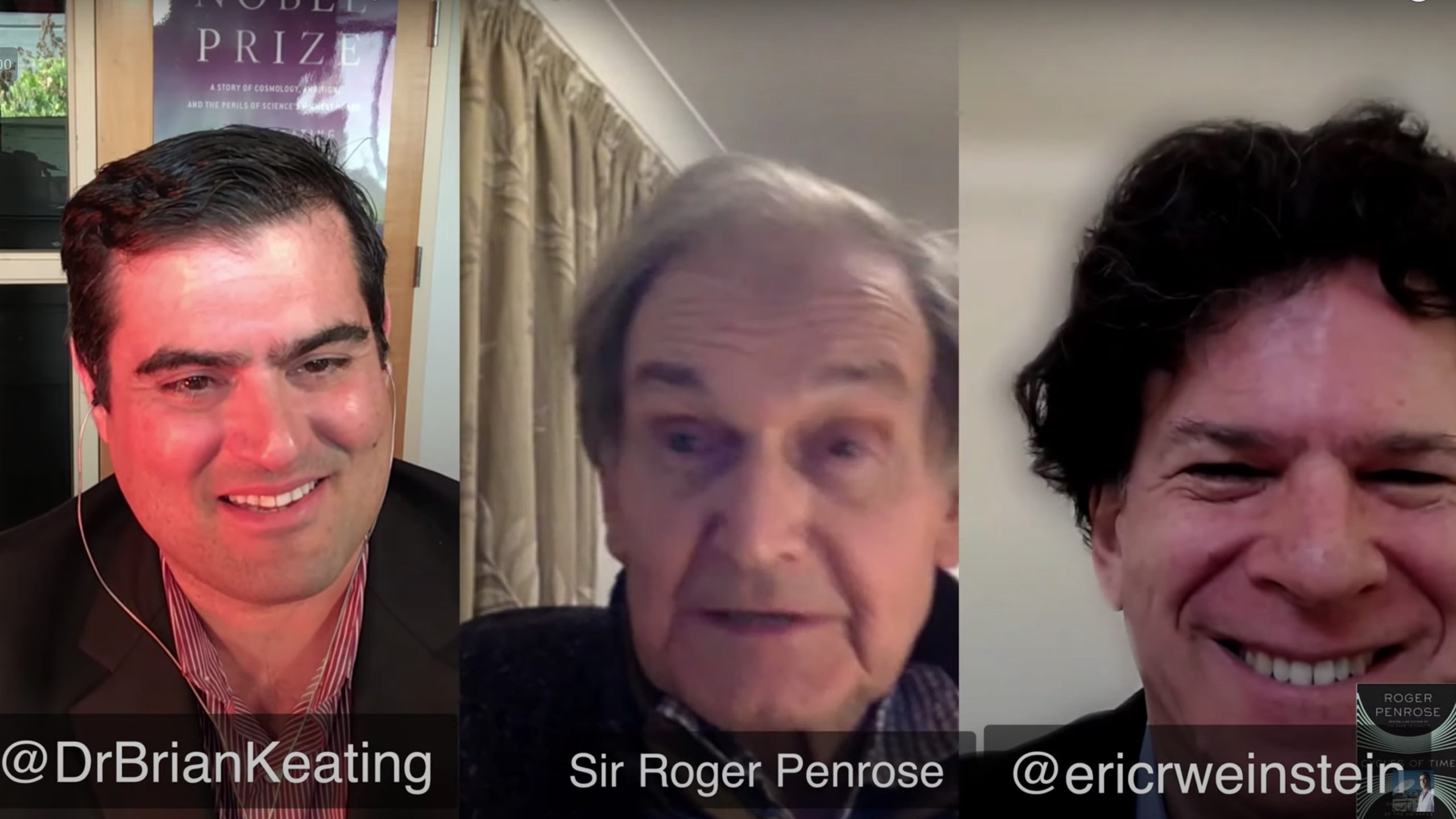
This is the first conversation (with Eric Weinstein) in 40 years on Geometric Unity.
In this rare, unscripted conversation, Eric Weinstein reveals the core of Geometric Unity, his decades-in-the-making theory. For the first time, Weinstein opens up fully about dark matter, the missing generations, peer review, and the potential flake of GU that quietly changed the world. This is the theory he believes is the answer.
Outline:
00:00 Introduction to Geometric Unity
06:50 Simplifying GU for Understanding
07:58 The Philosophical Implications of Physics
11:24 The Relationship Between Quantum and Classical
14:15 The Role of Generations in Physics
27:58 The Concept of Restricted Data
32:30 The Importance of Clear Communication
36:59 The Challenges of Explaining GU
38:14 The Value of Recognizing Contributions
49:34 The Story Behind the Seiberg-Witten Equations
1:06:12 A Critical View of Modern Physics
1:11:59 Establishing Criteria for Valid Theories
1:14:32 The Challenge of Quantization in GU
1:21:00 The Power of Non-Positive Definite Killing Forms
1:26:33 The Importance of Steelmanning in Science
1:32:11 Understanding GU
1:36:09 The Nature of Supersymmetry
1:37:30 Supersymmetry and Its Misunderstandings
1:46:30 Honoring Contributions in Physics
1:53:06 The Injustice of Peer Review
1:56:33 The Struggle for Recognition
2:06:02 The Academic Critique of GU
2:06:51 The Challenge of Communicating GU
2:23:05 Reactions to GU in Academia
2:52:57 The Future of GU Discussions
2:58:49 Reflections on the Journey of GU
Transcript
00:00:00
Curt Jaimungal: Why are you nervous?
00:00:03
Eric Weinstein: I… You’re formidable. Sean Carroll doesn’t make me as nervous as you do, and it- he’s hostile and you’re not. You’ve arrived. I’m nervous for the right reasons, because we’re actually gonna have a conversation, and I never have a conversation.
00:00:21
Curt Jaimungal: What is a core idea of geometric unity that if people knew more about it, it would get them as excited about GU as you are?
00:00:32
Eric Weinstein: That despite the fact… I mean, it’s a great question, first of all. Um, I believe it is the only claim of a theory that starts from essentially as close to nothing as you can in mathematics to try to derive everything we see. S- And b- because we see a world that is complex and baroque, like the standard model in general relativity, that process of development and unfolding has to be fairly lengthy, just the way human development from a single fertilized egg is. And I think w- what gets lost, and I think what, what you did beautifully, is to show that just because something has a simple starting point doesn’t mean that the theory remains simple. This concept of writing something down on a napkin that represents the entire world, uh, skips many steps if what you’re really trying to do is to understand where you are and who you are. And I think the fact that it starts basically from four degrees of freedom and a tiny amount of sectoral information, like which spin structure is active and how many temporal dimensions do you want, um, that’s it. That’s really the only starting point for geometric unity. And the only comparable claims that I know of would be Garrett Lisi saying, “Let’s start from the most complicated simple Lie group possible,” Peter Woit saying, “Let’s start from SU4, and we’ll quotient out by SU3 cross U1 to get, uh, the electrostrong group, and then we’ll try to figure out how to get an SU2 from a Wick rotation inside of a projective space,” or Stephen Wolfram saying, “Maybe this all comes out of a very simple cellu- cellular rule.” And I don’t think that any of those have actually gotten to the point where they can make the claim that that’s a, that’s a logical trend of development. So to me, that would be one way of answering the question. A- another way of answering it is, how much do you care about the actual particles of matter that make up everything? Like, do you care about the up quark, down quark, electron, tau particle? Do you care about the symmetries of nature? Where is this crazy SU3 cross SU2 cross U1 coming from? Why are there three generations? Why is this chiral and therefore asymmetric, left-handed, right-handed are different? And I’m, I guess one of the things I’m astounded by is the way that those questions when I was 17 were on the lips of every theoretical physicist. And through whatever process we went through, starting in ’83, ’84, those questions got relegated to not particularly interesting or relevant questions, which I think if you told me that you could get physicists to stop worrying about three generations, the famous who ordered that problem Isidor Rabi, I wouldn’t have believed you.
00:03:48
Curt Jaimungal: So two notes. Number one, you contacted me 48 hours ago and said you were coming to Toronto. I normally prepare for a podcast weeks in advance mentally and then also just studying, like, p- psychologically and then studying.
00:04:02
Eric Weinstein: Yeah.
00:04:03
Curt Jaimungal: So this is a teaser podcast which somewhat assumes people have watched some of the Geometric Unity iceberg so that we can go into some depth. As for greater depth, that will be in the non-teaser, which will be I don’t know how long from now, but it’ll, it’s upcoming.
00:04:20
Eric Weinstein: And I’ll, I’ll come back to Toronto for it because I’m… I can’t tell you how much that has impacted me. Like, for the first time, I’m having a real conversation about a real thing with another human being that I’ve spent my entire life talking about to myself and myself alone.
00:04:42
Curt Jaimungal: The second note-
00:04:43
Eric Weinstein: Yeah
00:04:43
Curt Jaimungal: … is that that first question about what is the greatest idea about geometric unity or, uh, some core idea that-
00:04:49
Eric Weinstein: Well, what would you, what, what would be impressive, I think, was sort of-
00:04:51
Curt Jaimungal: Yeah
00:04:51
Eric Weinstein: … or-
00:04:52
Curt Jaimungal: Comes from Richard B. Heal, if I’m pronouncing his last name correctly. He has a fantastic YouTube channel. I’ll place it on screen. He’s the one who did the, the Higgs particle video recently and did a spinner video recently. So plenty of this will be me also reiterating what you’re saying so that I can ensure that I’m following along.
00:05:10
Eric Weinstein: And I’ll try to make sure you get your act back like TCP/IP.
00:05:14
Curt Jaimungal: Okay. Let’s see. How would you summarize GU simply?
00:05:19
Eric Weinstein: Y-
00:05:19
Curt Jaimungal: [laughs] Okay, now let me, let me put a caveat to that.
00:05:23
Eric Weinstein: Yeah.
00:05:23
Curt Jaimungal: Again, on screen I’ll put a link to this video where I talk about the perils of explain like I’m five else you don’t understand it. I have a video where I say there are three factors here, much like there’s cost, speed, and quality in the business world.
00:05:37
Eric Weinstein: Very often there’s a-
00:05:38
Curt Jaimungal: There’s a trade-off
00:05:39
Eric Weinstein: … many, many things, whether it’s human relations or, uh, pedagogy or business, whatever, it’s here’s three things that you feel are essential. Choose any two.
00:05:48
Curt Jaimungal: Sure. Exactly. So I think for teaching-
00:05:51
Eric Weinstein: Yeah
00:05:52
Curt Jaimungal: … it’s succinctness, accuracy, and simplicity. So if you want something that’s simple and accurate, it’s going to take quite some time.
00:06:00
Eric Weinstein: Yep.
00:06:01
Curt Jaimungal: So that’s, say, an algebraic geometry textbook. It’s actually quite simple because it starts from Something rudimentary, but it takes a semester to go through.
00:06:11
Eric Weinstein: Right.
00:06:11
Curt Jaimungal: If you want something that’s accurate but succinct, you sacrifice simplicity, and that’s what– Sorry, yes. Accurate but succinct, you sacrifice simplicity. Yes. So let’s say, what is the standard model’s gauge group? So you can say it’s SU (3) cross blah, blah, blah, and then you can say it’s modded out by Z6. Super succinct. It’s not quite simple. So anyhow, I’m asking you to sacrifice some accuracy now.
00:06:37
Eric Weinstein: Okay. Oh, really? ‘Cause it, that would be great.
00:06:39
Curt Jaimungal: To tell GU in a simple and succinct manner.
00:06:48
Eric Weinstein: A… Life begins as a four-manifold, which begets… I’ve already failed.
00:06:58
Curt Jaimungal: [laughs] So someone said that in my ex-Explain Like I’m Five videos-
00:07:03
Eric Weinstein: Yes
00:07:04
Curt Jaimungal: … for, for Geometric Unity, I use the word engendered.
00:07:06
Eric Weinstein: Yeah.
00:07:06
Curt Jaimungal: And they’re like, “What five-year-old knows the word engendered?” So let alone manifold.
00:07:12
Eric Weinstein: Oh.
00:07:12
Curt Jaimungal: Now we’re not aiming at the five-year-old.
00:07:14
Eric Weinstein: Well, okay, here’s the, here’s the thing. You, most people, why do they care about fundamental physics? Because it’s existence. You’re here in this miracle place. You don’t know what you are. You don’t know where this is and you wanna know, like, God’s thoughts, and that’s the thing where when we talk about a crisis in physics or whatever, and people say, “Well, what about condensed matter?” Well, that’s not the part that scratches the philosophical itch of who am I, where am I, what is this? I wanna know before it’s all over, right? So the key thing is we are waves in a medium. The medium is called a bundle. It’s a very strange thing that you are a wave and nobody told you what the name of the medium is. You’ll have an entire, hear an entire conversation about the ether and, like, the bundle is probably the right concept of the ether, you know? And instead, s- for some reason, they stopped minting new words after ether. So we’re still discussing the ether, and we’re not discussing bundles. So if you’re a wave in a medium, the universe is a newspaper story. You wanna know where and when, who and what, how and why. Where is space? When is time? Put the two of them together, you have spacetime. Then there’s the who and what. Those are the bosons and fermions that make up the matter, in the case of the fermions, and the force and the other field, in the case of the bosons. So you have matter acting on force and force redirecting matter, whichever way that-
00:08:49
Curt Jaimungal: Sure
00:08:49
Eric Weinstein: … they’re interacting. And then how and why is what we would call the equations in the Lagrangian. And so that’s a pretty good idea about how to remember how a physicist thinks about reality at the deepest level. Tell me where it’s going on, tell me what the equipment and the players is, are, and tell me what the rules are and what the consequences are. So basically, geometric unity says that we have this wrong. Not wildly wrong in the sense of I can’t connect it. It’s very connected to what I’m claiming and what Einstein was claiming or the, what the authors of the standard model are claiming. But the first thing is that the arena is not spacetime. It’s a different kind of a gadget called a bundle, and one thing you can think about it is that there’s sort of two spaces in a bundle, not one space. And that gives you a little bit of an opportunity to say maybe if you, if, if you’re gonna sacrifice accuracy, let’s go for it. The quantum is happening on a 14-manifold, and the classical is happening on a four-manifold, and they’re not on the same space. They’re not native to the same space. So a lot of the attempt to say that you have to quantize gravity or which slit, which slit does the photon or electron go through in the double slit experiment, all these things come from the fact that you’re trying to answer a non-spacetime question in a construct called spacetime that because Einstein sort of wrote down the rules around 1913 through 1917, sometimes with Grossman, sometimes in rivalry with Hilbert, that story has confused us. We, it’s like having a Mercator projection of the world on your, on your wall and starting to think, “Well, that is the world.” No, it’s a distortion. Einstein distorted the world for his time, and geometric unity asserts that ultimately, if you want to not look at the map and you wanna look at the territory, you have to keep putting in a new map until finally, in the end, reality is its own exegesis. There, there’s, there’s no tool to look at it. So geometric unity says you’re not living on one space. You’re living on a relationship between two spaces, and in that relationship, you’ve put the quantum on one space, the classical on another, which decreases the amount of conflict between them. It also says, for example, that the classical world is by far the more important of the two worlds than the, than the quantum.
00:11:24
Curt Jaimungal: How does it say that?
00:11:26
Eric Weinstein: So, uh, look, I wanna riff with you differently than I can riff with anyone else, is I’m in the rare position where I’m talking to the only person who has actually talked about one of the great revolutions of our time that actually happened. And when you, when you did that show with Eva Miranda on geometric quantization, you took one of the three great developments in physics after the standard model, and you made it publicly accessible with, uh, Professor Miranda. So what is the situation? Isn’t it amazing we had a revolution called geometric quantization, and there’s no trace of it-
00:12:01
Curt Jaimungal: Yeah
00:12:01
Eric Weinstein: … in the pub- the public doesn’t know but for your channel that it exists. And if you wanted to say it in a really funny way, it’s that- Hamiltonian dynamics, one way of, there are two ways of basically figuring out the consequence of a rule. If you use the Hamiltonian formalism, it self-quantizes. There’s a thing called a symplectic form that generates how the world develops, and what we didn’t realize is it comes from something else. It’s the curvature tensor of a connection on a bundle over something called phase space. So we had this concept of phase space to figure out how classical fuse– uh, physics develops. And classical phase space births and bootstraps its own medium for quantum waves. So once you, once you know that, and it’s not perfect, but just we’re sacrificing a little bit of accuracy to say something, like, dramatic, meaningful, and punchy. If I tell you the classical theory, you have to figure out the consequences of it quan-quantum mechanically. But the, the quantum fetish that you see is kind of weird and wild. Um, yes, there are systems that don’t appear to be the quantization of any classical structure, but the standard model is a classical theory that then gets quantized, and it, in some sense, it figure– it bootstraps its own quantization. Once you give… Like, you’ll hear physicists say, “Once you’ve given the Lagrangian or the action, everything is in place.” It’s just a question of figuring out the consequences. Well, if that’s true and the action is classical, then what do you mean that you’re so focused on the quantum? So I, I, I guess… Look, it’s embarrassing, but I just think we have a quantum fetish, and we have a tiny number of people who convinced everyone to repeat the same statements about, “Well, you know, the, the world is quantum mechanical.” So if you say, “I think the classical is more important,” they don’t hear that as an informed statement. They hear that as you didn’t get the fact that the world is quantum. You, you still think that you live in a classical world. Or, for example, the fact that why does the classical world dominate? Why are we confused about the quantum world? Why isn’t it evident that it’s everything is quantum? It’s Feynman voting. Have I ever talked to you about Feynman voting?
00:14:28
Curt Jaimungal: No.
00:14:29
Eric Weinstein: Imagine that you have ten thousand people lost in a featureless landscape, and they’re trying to figure out which way to go, and you’ve got one cult of, like, a thousand people, right? So a small group of people, and they all, they all agree, and you say, “We’re gonna take a poll. We’re gonna add up. We’re gonna point in different directions, and then whatever the sum of the direction, we’re going to average out by the number of people, and we’ll go in that direction at that speed.” Well, the key point is, is that everybody who’s not in the cult is pointing in some different direction, and that’s randomly going to average out to going in no direction at all except for the cult, and they’re all going in the same direction. So in Feynman voting, the classical thing contributes a much more coherent picture of what should happen, and that’s why the classical world dominates even though it’s a minority perspective.
00:15:26
Curt Jaimungal: Okay. Why can’t you say that the action itself is not classical? You have an action-
00:15:31
Eric Weinstein: Mm-hmm
00:15:31
Curt Jaimungal: … and you can interpret it in two ways. One is a quantum way, and then another is a classical way.
00:15:38
Eric Weinstein: You can do that.
00:15:39
Curt Jaimungal: That the action itself is not, or the Lagrangian itself is not classical.
00:15:45
Eric Weinstein: I– This is logomachy. We’re arguing over words rather than substances.
00:15:51
Curt Jaimungal: Okay, let me be, let me-
00:15:51
Eric Weinstein: Wait, wait
00:15:52
Curt Jaimungal: … let me be semantically clear.
00:15:53
Eric Weinstein: Okay.
00:15:54
Curt Jaimungal: You can get classical observables-
00:15:56
Eric Weinstein: Yep
00:15:57
Curt Jaimungal: … by taking the action, or you can get quantum observables by doing something else with the action. And the classical one just looks at a small part of the action and says, “Okay, this is where all, everything is happening,” and the quantum one actually looks at all of it. And so it has more information. The cla– the quantum one, sorry. The quantum one interprets more of it.
00:16:15
Eric Weinstein: I’m a little bit confused ’cause they’re both local. The quantum picks up more information because you’re looking at it, at the wave function over the entire space. But what actually happens with the observable is, is that you have a function, and you can either measure the function at the point, um, and then multiply it by the quantum wave, or you can take that function, differentiate it to get a one form, stick it into a symplectic form to get a vector field, throw the vector field to a connection, and use that connection to take a directional derivative. So one of these ends up as the position operator. One of these sort of ends up as a momentum operator for the Ps and Qs and the underlying coordinatization of phase space. But that process of promoting a classical observable, which is just, like, some number, um, I don’t really think that, that that works exactly because the function is defined over the entire phase space. So in a certain sense, even if you’re thinking classically, uh, you’re both– you’re, you’re working over the entire space of possibilities in both cases. The only thing that’s different is, is the state of the system is seen as, um, naturally f- looking at the entire space whereas in this other case, you actually imagine a physical s-situation in which only one part of it is relevant at any time.
00:17:42
Curt Jaimungal: So in the classical case, are you saying that because we use a variational principle that we’re seeing all of the space?
00:17:48
Eric Weinstein: In a certain sense. Well, y- look, you’re defining an action or a Lagrangian on the entire space, and then you’re defining observables that you wish to measure. So you’re thinking about for the space of all possible initial conditions, if I then measured the system, you know, N units of time later, I believe I would be sampling this function at this point, and it’s the point part of it- That is, uh, that is narrowing things to a single point. Whereas a state that is distributed, every wave is a wave in a medium that’s distributed over an expanse.
00:18:28
Curt Jaimungal: So what I meant was that if you do some variation principle and you say, “Okay, let’s take the extreme of that”-
00:18:33
Eric Weinstein: Yeah
00:18:34
Curt Jaimungal: … only that, for the classical case, contributes to an observable.
00:18:37
Eric Weinstein: Yes.
00:18:38
Curt Jaimungal: Whereas in the quantum case, it’s, it doesn’t have to just be that single part.
00:18:43
Eric Weinstein: Well, again, the variational sounds more Lagrangian than Hamiltonian. The Hamiltonian sort of says, “I don’t need to know about all that. I’m just gonna start from here and move.”
00:18:54
Curt Jaimungal: But you can Legendre map, no?
00:18:56
Eric Weinstein: You– Certainly.
00:18:58
Curt Jaimungal: Okay, so if you’re lost, don’t worry. Th-this is just the beginning. I have some other questions.
00:19:03
Eric Weinstein: It’s, it’s two friends talking late on a, late on a Friday, so.
00:19:07
Curt Jaimungal: In GU.
00:19:08
Eric Weinstein: Yeah.
00:19:10
Curt Jaimungal: And a- again, I’m just gonna assume that the iceberg is out and people have watched this, so you and I can talk instead of having to cover GU.
00:19:16
Eric Weinstein: Put the link in the-
00:19:17
Curt Jaimungal: Sure. There’s a Frobenius inner product that’s introduced.
00:19:20
Eric Weinstein: Yep.
00:19:22
Curt Jaimungal: Why the Frobenius inner product? Presumably, there are other inner products that could, could have been used.
00:19:27
Eric Weinstein: Well, in fact, it’s not the Frobenius inner product. It’s the trace reversed Frobenius inner product, and that, the only reason it’s trace reversed is that we don’t have a grand unified theory of the observed world that uses spin-7 cross SU2, which would really be spin-7 cross spin-3. Right. One of the problems is that the typical description of the Petit Salam theory that we’ve discussed is that that theory is usually presented as SU4 cross SU2 cross SU2. And it’s not that the field doesn’t know that that’s equivalent to spin-6 cross spin-4, but it is meaningfully different because it’s, it, it pushes you, the, the… How you call something determines how you think about it. This is a very human thing. And it really is spin-6 cross spin-4 because GU, and I don’t know that you’ve, you and I have even had this discussion, is a machine that could also accept a one eleven spacetime or a one fifteen. Any multiple of four dimensions with one of them taken as time results in a GU.
00:20:38
Curt Jaimungal: Why would a one eleven work?
00:20:40
Eric Weinstein: Sorry, did I say one eleven? I meant-
00:20:43
Curt Jaimungal: Seven eleven
00:20:44
Eric Weinstein: … I meant, uh, one seven-
00:20:46
Curt Jaimungal: No, no, I’m, I’m messing you up now. One seven-
00:20:47
Eric Weinstein: No, one eleven.
00:20:48
Curt Jaimungal: Yeah. No, why?
00:20:49
Eric Weinstein: ‘Cause that’s, that was-
00:20:49
Curt Jaimungal: It has to add up to-
00:20:50
Eric Weinstein: Twelve, 12 is a multiple of four.
00:20:52
Curt Jaimungal: Uh-huh, okay.
00:20:54
Eric Weinstein: No, I did it right.
00:20:55
Curt Jaimungal: Did you?
00:20:55
Eric Weinstein: Yeah.
00:20:57
Curt Jaimungal: Doesn’t have to add up to 14? Just a moment. Don’t go anywhere. Hey, I see you inching away. Don’t be like the economy. Instead, read The Economist. I thought all The Economist was was something that CEOs read to stay up to date on world trends, and that’s true, but that’s not only true. What I found more than useful for myself personally is their coverage of math, physics, philosophy, and AI, especially how something is perceived by other countries and how it may impact markets. For instance, The Economist had an interview with some of the people behind DeepSeek the week DeepSeek was launched. No one else had that. Another example is The Economist has this fantastic article on the recent dark energy data, which surpasses even Scientific American’s coverage, in my opinion. They also have the chart of everything. It’s like the chart version of this channel. It’s something which is a pleasure to scroll through and learn from. Links to all of these will be in the description, of course. Now, The Economist’s commitment to rigorous journalism means that you get a clear picture of the world’s most significant developments. I am personally interested in the more scientific ones, like this one on extending life via mitochondrial transplants, which creates actually a new field of medicine, something that would make Michael Levin proud. The Economist also covers culture, finance and economics, business, international affairs, Britain, Europe, the Middle East, Africa, China, Asia, the Americas, and of course, the USA. Whether it’s the latest in scientific innovation or the shifting landscape of global politics, The Economist provides comprehensive coverage, and it goes far beyond just headlines. Look, if you’re passionate about expanding your knowledge and gaining a new understanding, a deeper one, of the forces that shape our world, then I highly recommend subscribing to The Economist. I subscribe to them, and it’s an investment into my, into your intellectual growth. It’s one that you won’t regret. As a listener of this podcast, you’ll get a special 20% off discount. Now you can enjoy The Economist and all it has to offer for less. Head over to their website, www.economist.com/toe, T-O-E, to get started. Thanks for tuning in, and now let’s get back to the exploration of the mysteries of our universe. Again, that’s economist.com/toe. Doesn’t have to add up to 14?
00:23:17
Eric Weinstein: That’s in the b- that’s in the, in the total space. I’m saying the input is a one and a three.
00:23:24
Curt Jaimungal: Uh-huh.
00:23:24
Eric Weinstein: And that begets you the 14.
00:23:26
Curt Jaimungal: Okay.
00:23:26
Eric Weinstein: Now, the next one up is-
00:23:29
Curt Jaimungal: Okay, I see what you’re saying
00:23:30
Eric Weinstein: … i- is one and seven, and then it’s one and 11, and then it’s one and 15, et cetera, et cetera. In each one of those, there’s a Petit Salam analog. In each one of those, there’s a Standard Model analog, and in each one of those, there’s a spin-10 analog and an SU (5) analog. And the, in all of those cases above one comma three, the s- the Petit Salam thing is a spin cross a spin. It’s not an SU cross an SU. So it’s meaningfully spin-6 cross spin-4. Um, I don’t think I’ve ever had a chance to, to, like, you know, basically everything is always th-this goddamn explain it like I’m five level, so we never actually get to anything interesting. Um, so it’s a great question. That’s what determines which Frobenius inner product. And you know, you wanna know something fun? If you watch the Oxford lecture, I screw it up, and I know that I’m screwing it up. And why is this? It’s because, like, look, I, I don’t think people have a clue, Curt, as to what it is like to work completely on your own. They just don’t. They– Trying to remind yourself, if you think about how much you’ve forgotten about GU, I bet it’s huge.
00:24:45
Curt Jaimungal: Right.
00:24:45
Eric Weinstein: Right? And then you have to refresh it. Okay. I’d forgotten all sorts of stuff I’d already done. One of the things I’d forgotten is that you end up with a three comma seven metric on the fiber, which can’t work. And so while I’m giving the talk in Oxford, I’m thinking, “I know this works, but I have to be honest that I’m coming up with three and se- seven and three.” And then right at the end, I say, “Are, are there things left to do?” Certainly there are. In fact, you have to get somehow-
00:25:13
Curt Jaimungal: Sure.
00:25:13
Eric Weinstein: I’m trying to be honest. But I’d forgotten, oh, yes, it’s the trace reversal of the Frobenius metric. Now, most people don’t know that Frobenius metrics even exist because they’ve never– It is not typical in an entire career in mathematics that you had to in-induce a metric on the space of metrics.
00:25:31
Curt Jaimungal: Well, the space of metrics isn’t even talked about.
00:25:34
Eric Weinstein: Much. I mean, I, I, I think it i-it’s not, it’s not never discussed. It’s just– I, actually, there’s two different ways, right? There’s a language problem. Do you mean the space of metric sections, or do you mean s-space of pointwise metrics? So certainly the space of metric sections is, is very much discussed. Pointwise metrics has never really been focused on. Now, if you say something like that, I guarantee you somebody will pull out papers from 1957, and Bryce DeWitt looked at this, who knows what. I don’t know. But most people never induce a Frobenius metric in their lives, and so it come– Uh, this is one of the taxes that you see, is that if you do something really different, even if it’s not, like, developing a new, a new collection of mathematics, people have an idea of, I bet there’s one or two or maybe three changes from what we usually do.
00:26:27
Curt Jaimungal: Mm-hmm.
00:26:29
Eric Weinstein: And GU says, “I accept the standard model, I accept general relativity, but everything we do is slightly wrong.” We call, we call Petit Salon by the wrong name. We have the wrong grand unified real forms of the group. SU5 is really SU3 comma, uh, SU3 comma two. S-SO10 is really spin 10, and spin 10 is really spin six comma four. Like, the amount of wear and tear on the mind to hear somebody say, “No, no, no, I, I accept all these things, but we’ve, we’ve minorly got everything shifted,” I think is a, a huge barrier to entry in GU. But anyway, y-you asked me why the Frobenius metric. I don’t think you– There are many different metrics. I think there are exactly four metrics if you don’t add a parameter to figure out how much trace to how much traceless you want. In other words, it’s, it’s only plus or minus one. There are precisely four metrics you can define and only four metrics you can define, and two of them are consistent with experiment, and two of them are ruled out by experiment, and the two obvious ones are ruled out by experiment. The trace reversed ones remain in the game. And I, you know, it, it is kind of fun because Einstein forgot to trace reverse the Ricci tensor.
00:27:48
Curt Jaimungal: Mm-hmm.
00:27:49
Eric Weinstein: And, you know, it’s like, if I could recapitulate anyone’s mistake, that would be the one I’d recapitulate.
00:27:57
Curt Jaimungal: So the observers.
00:27:58
Eric Weinstein: Yeah.
00:27:59
Curt Jaimungal: Is it the same as the metric bundle, or is it the tangent space of the metric bundle, the tangent bundle to the metric bundle?
00:28:05
Eric Weinstein: Well, the observers is the package, you know, and, and, and here I was thinking actually a little bit about Grothendieck, where Grothendieck replaced the concept of a variety with the concept of a scheme. Um, I don’t wanna say that the total space is the observers. I d- it is the bundles and the relationships and the pullbacks. Like, it is the package that is the observers.
00:28:32
Curt Jaimungal: Hmm, okay.
00:28:33
Eric Weinstein: So think about if we can– Look, I love the fact that you trust your audience, so let’s trust your audience. Take an, uh, take a page from object-oriented programming. In a class definition, you’ve got member variables, and you’ve got bound methods. So that’s like stuff and stuff you can do with, and method, and it’s– You’ve got nouns, and you’ve got verbs. You got stuff, and you got things you can do with the stuff. So that’s what the observers is. It’s two spaces with a, a fiber and sections connecting them, and then it’s bundles on top of them. And if you wanted to talk about, like, the, the shift in perspective from Einstein, most of what we’re gonna do in GU takes place not on X4 but on Y14. Mostly we’re not dealing with the tangent bundle on Y14 the way Einstein dealt mostly with the tangent bundle. You’re dealing with the spinor bundle on Y14. Mostly you’re not dealing with the Einstein-Hilbert action. You’re dealing with this new action that has homology to both the Einstein-Hilbert action and the Chern-Simons action and additional components that you’ve never-
00:29:50
Curt Jaimungal: Has homology to both or analogy to both?
00:29:53
Eric Weinstein: Sorry. You wanna know if it’s funny? The biologists use homology to mean similarity.
00:29:57
Curt Jaimungal: Right.
00:29:57
Eric Weinstein: And so somehow I was in the wrong part of my head. Um, yeah, it has similarity and analogy.
00:30:04
Curt Jaimungal: I thought I missed something.
00:30:05
Eric Weinstein: No, it’s, but it, it’s ve- it’s very interesting. I, I always tell people that if somebody has a meaning to the word Ham- puts a meaning to the word Hamiltonian, you know that they’re in only one field because it means one thing in civics, one thing in physics, and one thing in biology. ‘Cause Ham-Hamilton is a great name in the In human history. So yes, I didn’t mean homology in the sense of, uh, algebraic topology.
00:30:34
Curt Jaimungal: Okay, let me tell you some of my gripes when I was going through GU.
00:30:38
Eric Weinstein: Ah, I knew this was gonna be a gotcha interview.
00:30:41
Curt Jaimungal: And then I’ll tell you some of what I-
00:30:43
Eric Weinstein: Please.
00:30:43
Curt Jaimungal: And then I’ll, I’ll ease the wound. In part-
00:30:45
Eric Weinstein: You’re, you’re negging me.
00:30:46
Curt Jaimungal: Yes. Great, great. In part, one of the reasons I made the iceberg was so that I could understand GU, and also try to explain it to someone else who, if they have a differential geometric background, they could understand it, so a mathematician or a physicist. So when I was going through the paper, there were some terms… This is why I think there’s… This is one reason I think there’s a, a communication gap.
00:31:14
Eric Weinstein: Please.
00:31:14
Curt Jaimungal: Okay. So going through the paper, there were some terms introduced which were not used again, like invasive fields versus native fields. They were introduced on, like, page six, and then I did Control + F, ’cause I’m like, “Did I miss something?” And this is like, in film it’s called Chekhov’s Gun. When you’re reading something, you wanna, you wanna know it’s leading somewhere.
00:31:35
Eric Weinstein: Yeah, yeah, yeah.
00:31:35
Curt Jaimungal: Yeah, so then it… ‘Cause it takes up working memory. Okay, so there was that. There was something you just did right there with object-oriented programming. You’re like, “Okay, let me give you an analogy,” and then you go into object-oriented programming. So in the PDF, I believe you give an analogy. You’re like, “If you don’t know what sections are, think of indifference curves in economics,” and I’m, and then I’m thinking, most mathematicians and physicists don’t know what indifference curves are, or foliations. I think that’s what it was. So then I’m like, you wanna stay in someone’s field, like, if you’re explaining to them, not jump outside and assume their competency there. So for instance, if I said, “A fiber bundle is like the entity class component in video game architecture,” people are like, “What the heck are you talking about?”
00:32:19
Eric Weinstein: Yeah, but, but, but I, I don’t know how to not do this.
00:32:22
Curt Jaimungal: Okay. Well, anyhow, so I was-
00:32:24
Eric Weinstein: I’m sorry. I’m… Look, th- this is wonderful, because I’m aware that I do this. I’m sorry that I do this. It’s not like-
00:32:31
Curt Jaimungal: I say this as a friend, I’m not trying to… This is not a gotcha.
00:32:35
Eric Weinstein: I don’t feel it’s a gotcha. I think that, to be honest with you, if I can, if I can play with it-
00:32:39
Curt Jaimungal: Please
00:32:39
Eric Weinstein: … you and I are both facing the same problem, right? I, I watch you across different fields. You’re not just the physics guy, you’re also in the consciousness space. I think that you’re pretty responsible about all sorts of things. I have no idea how it is that we bridge this, and partially what I love that you’re doing is you just throw things out. You try your best to make them understandable. You try to say them clearly. But the person has access to ChatGPT a- and Grok and, you know, Claude, all these things. These are great tools, okay? So use them. And by the way, if you’re convinced that w- you and I are bad explainers, you’ve picked the wrong time.
00:33:24
Curt Jaimungal: Mm-hmm.
00:33:24
Eric Weinstein: Because you can sit there with one of these AIs and say, “Make this make sense to me,” and the AI can’t do it.
00:33:32
Curt Jaimungal: Well, if people watch this video that I have on… I don’t know what the title is currently, ’cause we, we keep changing the title, but at one point it was, “Explain It Like I’m Five, Okie Dokie.” That was the original title.
00:33:42
Eric Weinstein: Okay.
00:33:42
Curt Jaimungal: And I think currently it’s the, this is hurting s- popularizing of science, something like that currently. It’s, it’s this whole explain it like I’m five and give me the whole, the, give me the, the simplistic explanation.
00:33:55
Eric Weinstein: Right.
00:33:56
Curt Jaimungal: So if you watch… Okay, so then someone may say, “But Curt, what about these videos from Wired where a mathematician goes through something at five different levels?” So then I give a specific example with Emily Riehl, a professor of category theory who’s known for being the top category theorist, she’s been on the podcast before as well, on infinity categories. So this was her explaining infinity at five different levels. And actually, if you watch it, what she does is she explains something about infinity, like something that’s unbounded, to a nine-year-old, not a five-year-old.
00:34:25
Eric Weinstein: Okay.
00:34:26
Curt Jaimungal: Then she explains Hilbert’s Hotel to someone else.
00:34:28
Eric Weinstein: Right.
00:34:29
Curt Jaimungal: And then she explains cardinality, and then she explains the axiom of choice and its equivalences. But the point is b- that, that by the end when she’s speaking to another professor, she’s speaking about infinity categories, yes, and also how you can construct proofs by looking at one space is some domain, and the target space is a proof, and that’s what a mathematical theorem is. And then, okay, so now if you look at it and you’re like, okay, was that explained at five different levels? No. It was just tangentially concepts related to this that was explained to f- at five different levels.
00:35:02
Eric Weinstein: Because the internet has its own weird intellectualism that is horrendous. I m- let’s just be honest.
00:35:11
Curt Jaimungal: What do you mean?
00:35:14
Eric Weinstein: The internet wants to know all sorts of things, and it believes certain things. Like, one thing it believes is, is that you can watch a conflict between two people on a topic that you can’t possibly understand, and by looking at body language and who’s sweating and all these things, yeah, he, he curb-stomped that guy. No. Both of them were wrong, and one of them was more polished and, you know, if I put my shoulder back, I, I appear to be more confident in my position. So the internet is making us incredibly broad. It’s informing us. It’s making us stupid. It’s making us smarter. It’s distorting our relationships. You know, like, I, I’m so glad we’re doing this in person, ’cause I can’t stand doing interviews over Zoom.
00:36:03
Curt Jaimungal: I didn’t cauterize the wound. So allow me to say something.
00:36:07
Eric Weinstein: Sure.
00:36:08
Curt Jaimungal: What struck me about geometric unity, at first I thought it was extremely convoluted, just… That was just my impression. I hadn’t gone through the material. And then as I started to go through it, so firstly I encountered new terms being introduced, which that was something that I’ve, I tried to overcome in, in the iceberg to explain it in the way that I would explain it, ’cause I wouldn’t do your paper in the way that you did your paper.
00:36:31
Eric Weinstein: Maybe I screwed up. I, I’m open to it
00:36:33
Curt Jaimungal: I, I tried to put some order to it ’cause it was a collection of results.
00:36:36
Eric Weinstein: Right.
00:36:37
Curt Jaimungal: Like slime mold, but in a, in a positive manner.
00:36:39
Eric Weinstein: Sure.
00:36:39
Curt Jaimungal: Like m-many arms. So I tried to put some narrative to it. It, it’s difficult to, but I tried to. What struck me was that it’s remarkably simple. I remember I said that to you, and I thought you’d be angry at me.
00:36:53
Eric Weinstein: The highest compliment you could possibly pay me because I know, I know how hard it is. Look, Curt, if I’m honest, I’ve failed every year for 40 years to communicate this.
00:37:13
Curt Jaimungal: And I wanna say also that I h- make it my living to go through different people’s theories of everything. And sure, there are shortcomings. There are shortcomings to every theory of everything. There are shortcomings… A, a laundry list to string theory, and string theory has been around for decades and takes tens, if not hundreds of minds to solve a particular problem, and it’s not even clear if it’s been opened and shut.
00:37:41
Eric Weinstein: Yeah.
00:37:43
Curt Jaimungal: There’s loop quantum gravity and so on, blah, blah, blah, blah. I haven’t seen such a, such novel ideas from a single theory, from a single person, sorry, ever. And I don’t know if anyone else will tell you this, but what you’ve done is remarkable, man.
00:38:14
Eric Weinstein: I don’t even know how to be with that, to be honest. Uh, uh, look, thank you. Right? Like, one of the things that’s just hard.
00:38:24
Curt Jaimungal: Look, I’m not trying to compliment you for the sake of complimenting you.
00:38:27
Eric Weinstein: No, no, no.
00:38:27
Curt Jaimungal: And I’m not saying this as an endorsement that this is the correct theory. I think this is… I’m saying this is fantastic.
00:38:34
Eric Weinstein: I really appreciate it.
00:38:34
Curt Jaimungal: And I don’t know who else will say that to you.
00:38:36
Eric Weinstein: Well, look, you know, part of what… I wouldn’t stay with anything for this long if I didn’t believe in it. So I really believe in it. I believe it is the answer. And I don’t know how to be with that. It’s a very weird thing to say, you know, and to have to promote something. And I look at the distortions in myself. You know, very often when you meet somebody who’s got a history of trauma, you can see that they’re trying to stop the things that have gone wrong to begin with. There’s this wonderful interchange in Kung Fu Panda where Oogway says to Shifu, “We often meet our destiny on the road we take to avoid it.” I couldn’t understand why does the world not see flakes of this, right? One flake of GU made it into the world, and that’s what’s now known as Seiberg-Witten. Now, you have to be very careful. There’s two separate things that make up the constellation that’s called Seiberg-Witten. There’s the Seiberg-Witten equations, which is what I’m talking about as a flake of GU. And there’s Seiberg-Witten theory, which has nothing to do with anything I know how to do. That’s just some wonderful thing that Nat Seiberg and Ed Witten came up with. But the equations occurred around 1987 at Harvard as a flake of GU. And, and this is something that I don’t know that I agree with in your treatment of GU. GU happens at two different layers. The first thing you do is you do the Einstein-Dirac portion of the theory. And once you have the Einstein-Dirac portion of the theory, there’s a second Lagrangian in an action that gives you the Yang-Mills Higgs in addition. And so that’s something that probably you and I could work through, and I could– and maybe I’d learn something from you. You know, one of the things I believe with you is you’re not just curating, you’re actually in there working on the theory. So what I would say is that, um, when I flaked that off at Harvard, it was referred to [chuckles] as insufficiently nonlinear. And what’s, what’s worse is that my point about it was this is an Einsteinian equation. It’s not a Yang-Millsian equation, right? Because there is no derivative in front of the curvature tensor, it belongs to the Einstein sector. Now, because all of Donaldson theory and self-duality and instantons was trumpeted as self-dual Yang-Mills theory, people didn’t understand what part of speech it was. So I was having an argument with people like Roman Jackiw at, uh, MIT, and I would go around and talk to people, and they would say, “No, no, you don’t understand these equations. I understand that they look physical to mathematicians, but they’re really only instanton sector equations.” But people couldn’t hear that I was actually questioning that. Like, isn’t this really an Einsteinian concept? And it sort of predates something which I’m hoping to see a, a Curt Jainmungal treatment of, which is the double copy problem, which is the relationship that was discovered through amplitudes between Yang-Mills and general relativity. It was entirely unexpected. In a certain sense, Einstein is the square root of Yang-Mills, but it’s not Einstein that’s the square root. It’s ev– The thing that replaces Einstein-
00:42:24
Curt Jaimungal: Mm-hmm
00:42:25
Eric Weinstein: … is the square root of the thing that replaces Yang-Mills Higgs. And so wh-when I flaked this off, there was no interest in it And what’s more, it just got me into trouble. So it’s like I was being punished for what I thought was great work. After this was rediscovered by Natty Seiberg and Ed Witten around nineteen ninety-four, and I was in the lecture at MIT where Ed Witten puts this up and says that there’s a replacement for Donaldson theory. He didn’t say what it was, and I believe Alan Knutson, who as I recall, was seated, uh, below me and to the right as I faced Ed Witten in the audience, said in the Q&A, “Do you want to tell us what these equations are?” I think he’s now a professor at Cornell, and this is a detail lost to history. And he writes these two equations. And I think if I recall correctly, he used phi rather than psi for the spinor field because– Well, another thing I’d been told was that I had violated spin statistics, and since I was talking about a classical theory, I had no idea why anybody was telling me I was violating spin statistics seven years earlier. Okay. There’s an entire story that nobody knows about Harvard and Cambridge, Massachusetts, having a very dim view of Princeton, Mass– uh, Princeton, New Jersey. And the thought was, we work very hard at Harvard to get great results in Donaldson theory, and then Princeton tells us after the fact, “Yeah, yeah, we know all this stuff from quantum field theory,” but it’s always, like, taking credit for work we’ve already done at Harvard. And a very dramatic thing happens, I don’t think I want to tell this full story here right now, where when the lecture is finally given, it’s on– the title of the lecture is Witten’s Magical Equation. I think there’s no S on the end of it. Now, there were two equations, so it was, like, weird, and Seiberg was nowhere in sight in the title. And the, the professor at Harvard, you know, three weeks later, who was giving this lecture, it was the most dramatic lecture I’ve ever seen. It’s like his entire life’s work changed in an instant by equations that he had called insufficiently nonlinear. And he said, “If Ed Witten hadn’t told us, I never would have believed it.” And he looked directly at me afterwards after saying that because he had said, “No, you don’t get it. You think this is Einstein-y, and this is Yang-Mills-y, and this is not enough nonlinearity in the squaring of the spinor. Uh, you can’t just replace SU two by U one, blah, blah, blah.” So that was, like, really dramatic for me, which is that a flake of this theory could change the world. And it was clear that it was a flake of the theory, and there was zero, you know– There was a, a conference afterwards at Princeton. Well, what is this new set of equations that then was called Seiberg-Witten after that lecture? And I asked to speak at it. Uh, it was ludicrous. Why should you speak? It’s like, ’cause those are my equations. It’s so hard to say it. People say, “Well, do you want credit for the equation?” No. Do you want them to be called Seiberg-Witten? That’s fine. But if, if somebody– if there was justice in the world, the thing I would love to be called– them to be called is the insufficiently nonlinear equations because that’s what they were called for seven years. Anyway, look, that experience taught me that I can’t interact with this system. You d- you do great work, you hand the work to the system, and the system thinks nothing of assigning the credit to somebody else. Um, and that matters because that credit was supposed to be health insurance, the ability to raise children, to buy a home, maybe even a second home. And when credit is reassigned in academics, very interesting, people have this whole act that they do. Like, ah, who cares who, who gets the credit? The only thing that matters is the underlying subject matter. And then they fight tooth and nail to get credit after saying that. And they have names for this stuff. It’s called the Matthew effect. If you go to Washington, D.C., and you talk about the problem that older people are stealing credit from younger people or reassigning names and who knows what, they say, “Oh, it’s just the Matthew effect.” It’s like that’s just the casting couch in, uh, in Hollywood. You’re like, you are talking about rape or some sort of very serious coercion. Eh, it’s just the casting couch. Well, in, in, in academics, it’s called the Matthew and the Matilda effect. The Matilda effect is that we don’t credit women, um, with results if they raise it, you know, colloquially known as he-peating.
00:47:35
Curt Jaimungal: So what is the claim? I know you wanna-
00:47:38
Eric Weinstein: Sure
00:47:38
Curt Jaimungal: … just perhaps save it for another time. Is the claim that Witten or someone close to Witten took those equations from you or independently came up with them?
00:47:48
Eric Weinstein: Absolutely not. Ed Witten is as brilliant as you could possibly be. Those equations probably came from Natty Seiberg. I– Natty and I have talked about this. Natty said, “I never understood what the big deal about the equations, uh, was.”
00:48:05
Curt Jaimungal: To this day, he still doesn’t understand, or at the time?
00:48:07
Eric Weinstein: No, I think he doesn’t understand. I think he’s a physicist, and Ed, you know… Look, I will say some, some, some serious things. It’s not really clear what Ed Witten is, and I think that’s fine. I don’t need to name it. But when you say Jackie Chan is an actor who does all his own stunts, you’re totally missing it. Jackie Chan is a stuntman who does all of his own acting. So far as I know, Ed Witten is the world’s greatest differential geometer who does all of his own physics. Right? The math is really the impressive stuff. The physics has never gotten to the same level. And because that’s so counter-narrative, one of the things that’s really important in academics is that there’s a single official narrative just the way there is a single blockchain. There’s consensus about what happened, who did it. We all know that it’s sort of not right. But we have– we agree to officially talk about a story. The story is completely wrong, and that’s one of the reasons why you can’t really do this from podcast space. You can’t contradict the official narrative in the journals. I– There’s so much that’s just wrong. And Ed Witten did not steal this. Natty Seiberg and I also resolved this. When Natty Seiberg got three million dollars, uh, for the Breakthrough Prize, he and I encountered each other at a San Francisco fundraising event for the Institute. And this is a very dramatic story. I won’t tell the whole part of it, but we hugged it out at the end, and we accepted. It’s like, I don’t have a beef with Natty Seiberg or Ed Witten on that front. The, the problem was is that Harvard had a very clear perspective, and that is we do incredible nonlinear analysis. That’s why we get the results. It was a morality play. Because we do better nonlinear analysis than anyone else, we get better topol-topological results than anyone else, including Donaldson and what. And the point was, no, you guys landed in the New World, and you built an entire city the first site that you found, and you built it in a swamp, and that’s why your lives are so difficult. Just go over there and you build your city and everything will be fine. And they, they didn’t want to hear it. And then when they, when they realized how, how wrong they’d been for a decade, then it became like this rush to credit the great Witten, um, who is great. And by the way, Seiberg-Witten theory, which I have no claim on whatsoever. I have– the, the equations, yes, the theory, no. I don’t know whether anyone fully understands it to this day. I mean, it’s an unbelievable achievement. I didn’t have that. I, I really saw it as general relativity and part of the– one of the most uncomfortable things about geometric unity, partially why I’ve held things back and haven’t handled things great. In the end, it’ll become very clear where the Seiberg-Witten equations came from. They came from Einstein, not Yang-Mills.
00:51:34
Curt Jaimungal: About holding back with geometric unity, have you thought about publishing it on the archive?
00:51:41
Eric Weinstein: Yeah. I tried to get access to the archive at some point, and I think… I can’t remember how many-
00:51:48
Curt Jaimungal: Publishing access, you mean? ‘Cause anyone can access it.
00:51:52
Eric Weinstein: Oh, you– Yes, w-write rather than read.
00:51:55
Curt Jaimungal: Okay.
00:51:55
Eric Weinstein: Okay. I think at first you could, and then you needed to have a .edu and, you know, I was like, “Why should there be a .edu requirement? Who, who…” It’s like, “We don’t serve Negroes here.” “Oh, really? I know that sounds fine to your ears, but doesn’t sound good to mine.” As Muhammad Ali and, uh, Dick Gregory said, “That’s okay, I don’t eat them.” Uh, when… Yeah. Then I s- I think I interacted with Paul Ginsparg, and he said, “No, no, no, this doesn’t apply to you. We’ll get you a special exemption.” And then I was like, “Why do I get a special exemption?” And a friend of mine just got his paper that I read turned down by the archive. There are people… There’s a string theorist on the archive committee who says, “No, no, you can’t post.” So pe- I think people have this idea, “Why don’t you just submit things?” It’s like, maybe you don’t understand the critique. You haven’t f- you haven’t succeeded in over fifty years moving the Lagrangian of fundamental physics. Do you understand that part of the critique is the way peer review works, the way credit is apportioned, the way disputes are adjudicated is the problem. Your culture is decaying. You are no longer the people who are able to do the standard model. You’ve accepted such a degraded state in your culture that your institutions are repugnant to me. I don’t, I don’t apply for your grants either. I’m trying to… I would love for GU to be evaluated with my H-index as low as it could possibly be. If I could have an H-index of zero, if I could do this with no PhD, I’d love that. Like, everybody pays lip service to, “No, nobody cares where it comes from. Nobody cares about it,” but everybody does. Everybody’s just… We’re, we’re just– We’re a deeply hypocritical culture. We, we don’t realize we’ve abandoned science, we’ve abandoned mathematics. We have– Where we used to have the scientific method, we have what might now be termed the academic method.
00:54:06
Curt Jaimungal: Ah.
00:54:07
Eric Weinstein: What’s, what’s the impact factor? What’s your H-index? It’s like, who cares? What’s, what’s girdles? So the answer is I’m not ag- I’m not against sharing it, but I’ll tell you what will not happen. Um, I have a joke that I tell. What’s the difference… People have to say, “Why do you say that it’s a work of entertainer or that you’re an entertainer?” I say, “Okay, what’s the difference between a professor of physics and an entertainer? An entertainer has rights.” I reject wholeheartedly things that other people have never even heard of. There’s a concept called restricted data That e-exists nowhere else in US law. Do you know about it?
00:54:56
Curt Jaimungal: No.
00:54:57
Eric Weinstein: The 1946 and 1950… Uh, I’m gonna say something that’s gonna sound totally crazy, and after I’m done saying the totally crazy thing, go ask ChatGPT whether I was accurate. Put in the portion of the transcript, all right?
00:55:10
Curt Jaimungal: Cool.
00:55:11
Eric Weinstein: I like doing this now. It’s a, it’s a great new thing. In 1946 and 1954, we passed the Atomic Energy Acts, and if you couple that to something called the 1917 Espionage Act, there is a question that occurs which sounds totally outlandish. Can you put, be put to death for doing theoretical physics well? Now, you ever heard of the Zone of Death theory in Yellowstone National Park?
00:55:42
Curt Jaimungal: No.
00:55:42
Eric Weinstein: Some legal scholar figured out that there’s a sliver of Yellowstone that is not in Wyoming but is in Idaho-
00:55:50
Curt Jaimungal: Uh-huh
00:55:50
Eric Weinstein: … where no one lives. And if you committed a crime on federal land in Idaho where there is no one living, you would have to empanel a jury from people who lived there, so you could actually commit murder if you could lure somebody into the Idaho portion of Yellowstone. Like, it’s an unexploited vulnerability in our legal code.
00:56:13
Curt Jaimungal: To this day?
00:56:13
Eric Weinstein: Yeah, I think so. I don’t think anyone’s done it, but I, I think it’s actually been used in, as a trope in, like, movies or something. Okay, here’s a crazy one. Most physicists do not know that if you do any work on a napkin that could possibly influence a nuclear weapon, it is automatically Q classified without anyone in the government choosing to Q classify your work. And it– this is technically known, you can look this up in a search engine, as born secret. Okay. If you seek Q classified material without a Q clearance, that can be viewed as treason, and you can be put to death under it. So if you combine 1946, 1954 Atomic Energy Acts, which have a provision against free speech found nowhere else in the law… And I can’t believe you’re not warned about this when you start, when you sign up to do physics. ChatGPT told me, yes, it is technically possible to execute someone for doing theoretical physics correctly if it creates any change in, uh, the theory around nuclear weaponry, because you’re seeking a Q clearance document without Q clearance. So my claim is, I don’t think the average physicist has a clue what physics is, where it’s been, what the national security architecture is around it. I don’t think they know that the Department of Energy is really the Department of Physics, right, which was created out of, uh, the end of the ’70s in the Carter administration because… Yeah. Yeah, physics is serious national security, and if you fail at it long enough, you just think it’s an academic subject. But this is so dangerous, this is so powerful, that we go to a movie called Oppenheimer and we see, like, oh, there’s Feynman. You know? There’s Bethe. There’s Teller. Yeah, all those guys, you know, wiped out two Japanese cities. This is, this is no joke. And we don’t connect it to what we do because what we do doesn’t work. This is what I call Nerf physics. I don’t know if we’ve ever discussed this.
00:58:37
Curt Jaimungal: No, but I wanna get back to… So you, you wanted access to the archive, write to access.
00:58:42
Eric Weinstein: Mm-hmm.
00:58:43
Curt Jaimungal: They said you need an EDU-
00:58:45
Eric Weinstein: Yeah
00:58:45
Curt Jaimungal: … EDU email address. They then said, “Well, we’ll make an exception for you,” and then you didn’t want that 10 years ago, 20 years ago. Why didn’t you want to publish on the archive?
00:58:56
Eric Weinstein: I did. Everybody wants to start… Look, everybody starts by wanting to play the game right, and then I did. Suddenly I’m missing my work, it’s attributed to somebody else, and I’m just like, “Oh.”
00:59:11
Curt Jaimungal: Well, publication would-
00:59:12
Eric Weinstein: I triggered that system in the ’80s, so my experience isn’t the same as the professor who says, “Oh, you know, you submit stuff, sometimes it gets rejected, you put, take it to another journal.” Of course, there are, you know, times when you wanna submit something to, let’s say, uh, Hep PH, uh, Hep TH, and they tell you, “No, no, no, that’s really Hep PH.” So the idea is it’s kind of annoying, it’s a little bit cumbersome, it’s bothersome. Sometimes somebody gets more credit than you think they should deserve. That’s not my experience. My experience was totally different. My experience was it’s, it’s a secret world that has all sorts of ways that it works that aren’t advertised, and if you talk about it, you’re treated like a crazy person. But I can point… I, I’m like one of the world experts on what doesn’t work in academics, and what I’ve seen is… Oh, you know, a good friend of mine in the last two weeks had a paper, PhD in physics, not accepted, no reasons given on the archive. It’s like, what does it cost you to store this on the archive? Oh, no, no. Didn’t tell, didn’t say it’s bad, didn’t say it’s wrong. The, the system isn’t what you think it is. It’s never been what people think it is. There’s some sort of an agreement not to talk about it. Like if I t- if I say peer review has not existed, uh, back to the beginning of the Royal Society. Outside review has, peer review hasn’t. Peer review is mostly a response in 1975 to something called Man: A Course of Study. It originally comes out of Utah, um, and it has to do with the Great Society programs, which in the mid-’60s are passed that makes the federal government the main payer for Medicare. And so what it really was was a defense by the physicians- from having the government pry into their pricing, um, because suddenly the government was paying for everything. It was, it’s, the peer says, “You’re not good enough to supervise what we do in medicine.”
01:01:11
Curt Jaimungal: Okay, but-
01:01:11
Eric Weinstein: Wait, wait, wait. Let me just finish it out.
01:01:13
Curt Jaimungal: Sure.
01:01:14
Eric Weinstein: If you have the belief that the system works pretty well, then I understand you completely. You, you wanna know why aren’t you following the rules? Well, my, my point is it didn’t work well when I tried interacting with it repeatedly over and over and over again. If you do something different enough, you get a very different experience, and that’s sort of what I’m trying to say, which is like, I tried, I believed, I got burned. Why is it that I have to go back to the same casting couch, to the same director to be put into a movie? No, I’ll start my own studio. I’m not going into that office. I’m not going to play that game. I’m just not gonna do it. Now, if you told me, “Hey, we, we’ve heard you. You wanna make sure that you understand that credit matters to you.” If I’m the only person in physics that credit matters to, I’m happy to say that on camera. Everybody else credit matters to. It’s, it’s the lifeblood. It depends whether, you know, can you afford to have another child? Can you afford to be in the same city as your spouse? How is it that that doesn’t matter? It’s, it… Academics and physics is suffused with a totally insane level of duplicity. Of course, credit matters and it, and it should. I’m not playing with people who are that disingenuous. They only, uh… How often have you heard this? The only thing that really matters is the truth. Please don’t bother me with, with sociology. Yeah, I had a terrible experience. The number of people who had terrible experiences is insanely large. We could do an entire channel that every week featured a different academic horror story. Yes, the people who remain in the system have agreed to say, “Oh, it works pretty well.” No, it doesn’t. Clearly it doesn’t. So I have the internet. I have a very large channel. I’m probably the most followed mathematician on planet Earth and I will forever pay a price by not wanting to play the game with people who stole something from me. By the way, I highly recommend looking at, um, Alexander Grothendieck’s reject- rejection of the Crawford Prize, where he says, “I won’t participate in a culture… I will not take money from a culture that now believes that it, that theft from young people is absolutely acceptable to the profession.” So I’m with him.
01:03:45
Curt Jaimungal: It’s my understanding he said that after the university started accepting military funding and he was extremely anti-military.
01:03:54
Eric Weinstein: He was a guy with a certain kind of integrity who I think got driven mad by having that integrity. Like, look, Kurt, let me just be honest and forthcoming about a very crazy sounding thing. Imagine GU is right. Let’s, let’s go on that branch of the decision tree. If it’s right, this is the most crazy dramatic story anyone’s ever heard. It’s, it’s, it’s dramatic scientifically, it’s dramatic personally. It just, it’s a big deal. If it’s wrong, none of this is true and I’m living in a Walter Mitty world and that’s fine, but it’s not like I’m not aware of that. My goal is not just to benefit from this, but I wish to help out science. I wish to help out many of the people whose names are not on their results, who are not employed currently after having done great work like Doug, Doug Prasher and green fluorescent protein. Terrible story. My goal is to break peer review. My goal is to open the archive to any one credential so that there is no committee sitting over it. My goal is to get the national security apparatus to come out of the shadows and say, “Look, this is serious business. We need to classify this.” We should have fights with them about what should be open, what should be classified. I wish to change science and get it much closer to what we think about with the scientific method, with norms of collegiality and decency to each other, where we are progressing in the science. We are not a medieval theological debating society about angels and heads of Calabi-Yau pins and all that kind of nonsense. This is broken and I refuse to be referenced to a system that can’t buy a base hit in 51 years, 52 years. It doesn’t work. W- why do I care about my colleagues’ opinions if they’re not leading physicists? The leading physicists of today are not leading physicists. There’s no proof that they’re doing physics. Like Frank Wilczek, I recognize him. I talk to Frank, right? In general, we’re not really doing science anymore and I don’t wanna, uh, I don’t wanna spend our time on this. I wanna talk to you about three generations. I wanna talk about SU3 cross SU2 o- cross U1. The problem is, is that somehow the only people who know what those things are, are the r- are, are the survivors suffering for s- from survivor bias in a system that doesn’t work. So more or less 100% of my seated colleagues are people who got through the system without raising much of a fuss about something that obviously is unethical, not civil, not collegial, and doesn’t work. So yeah, I’m happy to be wrong, but the problem is, is that it sets me up in this absolutely monotonous, um Pattern of opposition. “Eric, why are you so arrogant? Eric, why are you so forceful?” Oh, only because I’m opposing 10,000 people who are all in lockstep who have– believe the same things and aren’t getting anywhere.
01:07:19
Curt Jaimungal: Yeah. So I’m confused-
01:07:23
Eric Weinstein: Please
01:07:23
Curt Jaimungal: … two ways. So if you were willing to publish on the archive before, and you still had the trauma of having credit taken from you and so on, but you were willing to, and then there was this conversation that you don’t have an EDU-
01:07:36
Eric Weinstein: Yeah
01:07:36
Curt Jaimungal: … but you could also get an EDU just by, like, emailing Harvard-
01:07:39
Eric Weinstein: No
01:07:39
Curt Jaimungal: … or sending the places.
01:07:40
Eric Weinstein: No.
01:07:40
Curt Jaimungal: No?
01:07:40
Eric Weinstein: No. There’s something called post.harvard.edu that they stopped accepting.
01:07:44
Curt Jaimungal: Okay.
01:07:44
Eric Weinstein: ‘Cause that meant that you were an alum, but you weren’t active.
01:07:47
Curt Jaimungal: Interesting.
01:07:48
Eric Weinstein: So there, there’s a game going back and forth.
01:07:51
Curt Jaimungal: Okay.
01:07:52
Eric Weinstein: And I think you should have Jacques Distler on your podcast and ask him these questions. Let’s– I’d rather do science.
01:07:59
Curt Jaimungal: And then you said that there’s no proof that these people who are dealing in fundamental physics for the past 50 years have, are doing anything related to physics. Then what if someone said, “Okay, but what’s the proof GU has anything to do with fundamental physics?”
01:08:12
Eric Weinstein: Well, this is the thing I was trying to talk about when you deftly steered me away, if I may. There’s something I call not even remotely physics. Now, the acronym for that is NERF physics. So you can tell how many safeties are on the gun and how far you are away from doing it. Does your theory put dimension four, uh, in pride of place? If you’re working in dimension three or dimension 10, if you’re not f- highly focused on dimension four to begin with, that’s a strike against you. Do you have one temporal dimension to begin with? If so, you’re doing real physics. If you’re in Euclidean signature, generally speaking, you’re not doing real physics. Do you have SU3 somewhere in the structure group of your model? If you’re only using SU2 or U1, you’re not wrestling with quantum chromodynamics. That’s a strike against you. Do you have three generations of fermions, which is a feature of our world? That’s an artificiality. No, no, no, I’m only worrying about one collection of fermions, okay? If I look at the sheer number– Oh, does your Higgs field value itself in the adjoint representation of your structure group? That’s not what the real Higgs field does. So I could take a new metric, and we could pass an AI over it and say, “How many papers…” Oh, o- one last one, I forgot this is, “Is your work phrased in the language of geometry and bundle theory?” If you just take those things, where I would imagine the average paper would be a four-dimensional manifold, one time dimension, SU3 would be included, there’d be three generations of matter and it would be phrased in bundles and connections in geometry. I believe essentially the number of people working in actual physics approaches zero, and that that is a decidable proposition as to whether I’m right or wrong. I believe essentially physics has stopped at its most fundamental level. And y- we can just test it. So if you’re out there, do me a favor, write a script that uses AI, regular expressions and checks papers, ingests PDFs and checks how many of those safeties are on the gun. I don’t wanna work in 10 dimensions before I get to four. I don’t wanna work with no time dimensions. I don’t wanna work if SU3 isn’t in the picture, and I don’t wanna pretend that you can do this without bundle theory. I believe that effectively no one is doing physics. Full stop.
01:11:00
Curt Jaimungal: Okay. Now, what if someone said that this metric that you came up with, with six or so criteria, that your s- theory will s- fall through that sieve, so it stops other theories ’cause they didn’t satisfy it, yours goes through. Okay?
01:11:15
Eric Weinstein: No. We’re star– Y- you’re starting from a wrong premise. Th- the standard model in general relativity, we all accept. I, I think if you don’t accept them as effective theories governing our world, you’re really not part of the serious conversation. I think Sean Carroll is exactly right about that. He said it on your show. He said, “You have a theory, that’s great. Well, I have a theory. My theory is called the standard model.” I heard those words from him.
01:11:42
Curt Jaimungal: Why is the standard model his theory?
01:11:44
Eric Weinstein: That’s just how he said it. He didn’t mean that he developed it, but it– he, he did sound a little bit like Colonel Jessup saying, “The bra- blanket of freedom I provide is something you, Lieutenant Kaffee, should be grateful for.”
01:11:57
Curt Jaimungal: Okay.
01:11:59
Eric Weinstein: Okay. Is the standard model after, uh, the Wu Yang dictionary in bundles? Yes. Is it on a four manifold? Yes. Is it one comma three? Yes. Does it have three generations? Yes. Is– Does it have SU3? In other words, the theory that we all agree goes through that sieve. We all agree on the standard model, it goes through the sieve. I’m not coming up with something that selects my theory. I’m saying that any theory that is trying to go beyond the standard model and general relativity will have these characteristics.
01:12:39
Curt Jaimungal: Okay.
01:12:41
Eric Weinstein: And by the way, if I’m wrong, and let me just look right, if I’m wrong, write the script, I’m happy to come back on the show and say I was wrong.
01:12:51
Curt Jaimungal: Where I was going is that there are other people who have their own checklists, and it tends to be a checklist that their theory passes. So for instance, Wolfram may say something like, “We have to explain why these laws, not any other law, and we have to explain observers,” and his theory purports to solve both of those, so he says those are the most important. So I find that when I’m dealing with people in the-
01:13:13
Eric Weinstein: Special pleading
01:13:14
Curt Jaimungal: … space of, of theories of everything-
01:13:15
Eric Weinstein: I am engaging in special pleading I took the assignment to be going beyond the standard model means going beyond the standard model. And I took going beyond general relativity to mean going beyond general relativity. And I took the idea that it should be on a napkin to mean it should develop from very few assumptions. These are the things everyone repeats and no one follows. We all talk about the s- you know, what the, the scientific method is. We don’t follow it. We talk about what attribution should be. We don’t follow it. We pass laws. We don’t know that they exist. We’re living in, like, loony land. And so what I’m doing is I’m saying, “I see your collective fictions. I have collective fictions of my own. It’s not like I, I don’t understand what a collective fiction is, but I’m not gonna get any science done if I live in your collected fictions.” So my claim is I took those– Th-that’s a core set of assumptions. If you have additional assumptions, I understand that, but I’m claiming that nothing passes even those. Like, for example, GU is not phrased as a quantum theory.
01:14:28
Curt Jaimungal: So what do you imagine the quantization procedure to be for GU ultimately?
01:14:33
Eric Weinstein: It’s a little confusing. It’s not so confusing if you think about it downstairs on the base space. The big problem is, is that it’s not one… The difference between zero temporal dimensions, one temporal dimension, and multiple temporal dimensions is enormous. With zero temporal dimensions, you’re an elliptic theory, and you have access to Atiyah-Singer and all the great stuff that comes with that. If you have one dimension, we know a lot about Hamiltonian dynamics and development and initial conditions. Problem is, if you have two or more temporal dimensions, you’re in something called ultrahyperbolic equations, and very few people can think in two or more temporal dimensions. GU has several things. This is something that, like, it’s a great pleasure to be able to talk about what am I critical about GU, you know? Like, that’s not a question that I get much.
01:15:28
Curt Jaimungal: I didn’t ask that, but I, I’m curious to know. Glad you asked that of yourself.
01:15:32
Eric Weinstein: So, for example, I don’t know how to deal with, uh, ultrahyperbolic equations. So if I think upstairs on the 14-manifold, I’m not– There are no initial conditions because that’s a codimension-one concept. Really what you have is boundary conditions. And now, good luck. I, I don’t– I think I had to be told that the Cauchy problem was well-posed in ultrahy-hyperbolic equations. That’s something I- Yeah, but this is not stuff I know. So it’s a good example. If I’m not, if– You know, the entire concept of physics is that I have an initial state, I develop-
01:16:11
Curt Jaimungal: Wouldn’t that mean there’s no Cauchy horizon?
01:16:14
Eric Weinstein: I don’t– I believe that they are well-posed, but I don’t know, I don’t know how to push Hamiltonian dynamics in multiple temporal dimensions.
01:16:27
Curt Jaimungal: Is the bundle trivial?
01:16:30
Eric Weinstein: Which bundle?
01:16:31
Curt Jaimungal: The metric bundle.
01:16:33
Eric Weinstein: Uh, depends on the topology.
01:16:35
Curt Jaimungal: Well, the reason I say that is ’cause in GU, there’s a global section. So you can’t take a global section unless the bundle’s trivial.
01:16:44
Eric Weinstein: There isn’t a global section. You’re talking about the metric section? No, no, no. Th-that was a thing that you actually cut. This is fun ’cause, like, I, I now get to actually have a meaningful argument. Um, didn’t we a-agree that there are patches on which there’s only a connection defined on the tangent bundle, and then where you’re doing observations is where you have the metric defined, and that’s one of the ways in which we get around some of the quantum gravity problems.
01:17:09
Curt Jaimungal: Okay. So-
01:17:11
Eric Weinstein: Let’s, let’s, let’s go, man.
01:17:13
Curt Jaimungal: Because just like you’ve forgotten much of GU, or you have to-
01:17:16
Eric Weinstein: Yes
01:17:16
Curt Jaimungal: … reintroduce it to yourself, same with myself, but-
01:17:18
Eric Weinstein: By the way, thank you for saying that because when, when I, when p- when I say things like I forgot aspects of this, this is like a city where y- you don’t remember what your work is from seventeen years ago, and i-it’s stored in some piece of paper you can’t find, all that kind of stuff. Yeah.
01:17:34
Curt Jaimungal: My recollection is the PDF has iota, which is a local section-
01:17:38
Eric Weinstein: Uh-huh
01:17:39
Curt Jaimungal: … and then it has gimel, which is a global section. But I’m saying that the existence of the gimel implies that the bundle’s trivial.
01:17:46
Eric Weinstein: This is interesting. This is a problem I never had before because occasionally, I would have to do a refactor of the theory because I realized that the, the notation was cumbersome or it conflicted with something. There are only so many letters, all that kind of stuff. Uh-
01:18:02
Curt Jaimungal: So then this was my other critique. Hebrew. So there are other letters that are used not much by mathematicians other than in cardinality, Hebrew letters-
01:18:13
Eric Weinstein: Right
01:18:13
Curt Jaimungal: … that were used in GU, so. And then there were some that I chose to keep in, and if I was to introduce this to a friend afresh-
01:18:21
Eric Weinstein: Right
01:18:21
Curt Jaimungal: … I wouldn’t use the variation pi, which was funny ’cause I called it variational pi, which in math, there’s something called taking the variation.
01:18:29
Eric Weinstein: Right.
01:18:30
Curt Jaimungal: And I didn’t mean that.
01:18:31
Eric Weinstein: I know, but so you, so you made an error, and the, and the thing is, is that the error is now immortalized in the video. But the point is-
01:18:38
Curt Jaimungal: I put in a pause to emphasize that, and also the point that I left in-
01:18:43
Eric Weinstein: Please
01:18:44
Curt Jaimungal: … the different notation because it’s my understanding that you implemented that notation to honor certain people.
01:18:51
Eric Weinstein: Mm.
01:18:51
Curt Jaimungal: And I don’t have that same relationship to those people, so I don’t honor them, even though your honoring trammels your explanations. It’s that communication gap I mentioned.
01:19:01
Eric Weinstein: Pi is my wife. Zeta is my son. Nu is my daughter, and I’m epsilon. And so I wanted us to be together.
01:19:12
Curt Jaimungal: It’s also, that’s a humble view of yourself to give yourself epsilon.
01:19:17
Eric Weinstein: Uh, look, I’m, I’m the roadie for a group of superstars.
01:19:20
Curt Jaimungal: Epsilon is usually diminutive, so that was the joke.
01:19:23
Eric Weinstein: Yeah, let’s, let’s– I, I’m uncomfortable being here. Look, i-I’m sharing that with you, but, like, it’s very important to me that some jerk doesn’t come in and say, “We’re gonna change all the notations.” Like, no. These people suffered for this theory, and I’m gonna make sure that- We’re gonna write their name, we’re gonna burn their names into the theory. And, and by the way, the Hebrew letters, it matters to me too. You know, I come from a tiny, tiny community that is always in danger of being wiped out for reasons that we can go into, but it’s a scary thing. Yeah. I can make it worse. I can call, um, the base space Ha’aretz for the land and the total space Hashem. No, I’m saying you asked me a question, I’m to answering it because I’m proud of my people. And to be honest with you, the tau homomorphism, which is not just the gauge group being included simply trivially into the first factor, the tau comes from the Hindi concept of being terra or slanted.
01:20:22
Curt Jaimungal: Mm.
01:20:23
Eric Weinstein: Right? So I didn’t say that, but at some point I had a Devanagari character, and then I found that people just really didn’t like it. And so I said, “That’s too bad because I run out of letters regularly, and I’m very proud of our family’s Indian heritage.” And so I wanted to honor India as well as I wanted to honor, uh, Jews and Israel. So yeah, that’s a personal choice and I get to make it and I’m pretty unapologetic about it. So I’m sorry if you have to learn gimel and you have to learn al-Aleph. It’s pretty painless and it’s over quickly.
01:20:57
Curt Jaimungal: What else have you not said about GU?
01:21:01
Eric Weinstein: So great. Um, one of my beliefs about GU is that GU gets a lot of its power from the fact that it’s willing to consider, uh, killing forms that are not positive definite. Yeah.
01:21:13
Curt Jaimungal: Yeah. How do you deal with unbounded spectra?
01:21:15
Eric Weinstein: Well, I don’t know. What my claim is, is that we don’t know how nature deals with it because we’re shielded because of maximal compact subgroups. In other words, what is picking out spin-six cross spin-four as the Petit Salam model is maximal compact inside of a different real form of spin 10 than the SO (10) theory. So in the SO (10) theory, if you ask, “Well, what’s the maximal compact?” Well, it’s just the whole group. But how you’re getting somehow from the d- d5 Dyson diagram down to spin-six comma spin-four is that nature is saying, “Somehow I’m going to handle this indefinite killing form, but I’m not gonna show you yet because you haven’t gotten that. So I’m just gonna show you the compact subgroup to which it is broken.” Okay, that’s totally different intellectually, completely from saying, “No, nature can’t do that because, uh, this will lead to problems and cause out…” No, nature’s not listening to what you can do today and what you can’t do today. You also have a, well, how do you do a Feynman integral? Nobody knows, right? Unless it’s, unless it’s very restricted. Okay. But you’re using it. You’re using a bunch of analogies. Who said I can’t go into technical debt and say, “I don’t know how she’s gonna quantize this theory”? The reason I have it is a classical theory. It’s not that I don’t understand anything about quantum theory. It’s that almost certainly the physics community is mostly confused. Of course, you can have an indefinite group. We have, we have spin one comma three that we’re forced to deal with, and if everybody understands the rest of the theory, I hope that one of the biggest, uh, one of the most important agendas becomes, okay, we’ve gotta learn to deal with an indefinite killing form. Let’s, let’s get our best people on it. Right now, we write an occasional paper, like Witten’s written on this. Um, so that’s a-
01:23:16
Curt Jaimungal: Early supergravity theories, you have gauge that, that were non-compact. They did some call set, though, but it was still non-compact.
01:23:23
Eric Weinstein: Yeah. Uh, uh, there’s that. On, on the multiple time and, you know, like I think Steven Weinstein, a philosopher who does physics at Perimeter Institute is ultra hyperbolic. There’s, it’s, it’s, it’s like bars two time physics. So if GU is right, what it should do is to say, “Look, Eric took on technical debt in order to do this thing. Let’s pay it back.” And that’s, by the way, that’s normal science.
01:23:50
Curt Jaimungal: What does pay back, do you mean solve it?
01:23:52
Eric Weinstein: Do you know what technical debt is in, in computing? That’s again, one of my-
01:23:55
Curt Jaimungal: Yeah. Please explain.
01:23:56
Eric Weinstein: So sometimes you do something that is kind of not right while you’re coding and you say, “Okay, well, I’m taking on technical debt. I have to fix this somehow, but right now I’m just gonna do this now.” And then-
01:24:09
Curt Jaimungal: Being expedient?
01:24:10
Eric Weinstein: Sort of. Yeah. It’s, it’s like a, a stopgap measure that you have to go back and fix.
01:24:17
Curt Jaimungal: Okay.
01:24:17
Eric Weinstein: Yeah. So my claim is, is that one of the r- ways that things have gone horribly wrong with critique, I think most of the critiques in physics are not critiques. And what you see is there’s a huge difference between saying, “Let me understand you first, let me steel man you second, and let me give criticism that is constructive third.” That is normal to me. And by the way, I actually weirdly modeled this with Terrence Howard. Let me see if I understand you in your own terms first. Let me put your bet- best foot forward relative to my community, the math community second, and let me give you criticism only after I’ve done those two steps.
01:25:01
Curt Jaimungal: Yeah. I don’t think your real genius is GU. I think it was making sense of Terrence Howard in real time.
01:25:10
Eric Weinstein: You know, Terrence is a perfect example of we tell everybody, everybody can be a scientist. You can learn this on your own. We don’t care about credentials, and if you ever try that, we’re just gonna laugh and laugh and laugh and laugh. And I think it’s terrible. And I, I’m still friends with Terrence, and I, I will tell anybody, Neil deGrasse Tyson totally missed the fact that Terrence took a regular tetrahedron and spanned the affine group, which is a six-dimensional group with six Almost regular pentagons arbitraging the difference between a hundred and eight degree internal angle and a one oh nine point four seven and change, uh, angle inside the vertices from the center of a tetrahedron. Genius move. Lots of stuff I think is garbage. Terrence laughs and laughs and laughs at me saying that I– He’s like, “You talked about the baby and the bathwater.” You know what? We’re colleagues, we’re friends. I don’t think he’s a mathematician. I don’t think he’s a physicist. I think he’s got some great ideas. I think he’s got some good ideas. I think he’s got some lousy ideas. We don’t do that, and I think it’s really important to talk about this, but I do wanna get back to the science. What we do is we pretend we, the community of academicians… If you come into my office and you say, “Hey, I’ve got a really crazy theory and I want you to listen to it, take it seriously, and give me feedback,” we’re sort of o- we know we’re obligated to do some of that. We first be- we find out we are incredibly busy. So the person who’s incredibly busy is then playing ping pong in the lounge and doing all sorts of other things. The next thing we do is we try to find the critique which causes us not to have to listen ever again. If I can just find one flaw, we can dismiss your theory. This is not how science works at all. And there’s a question about did you ever steelman the theory to begin with? I think the first… I think the GU went forty-one years without ever being steelmanned. Like, that’s impossible. You– I could steelman Garrett Lisi, Peter Woit, string theory, l- loop quantum gravity, all of them. In general, it takes about forty-five minutes to an hour to get the gist of a, an idea in this world, and it co- takes much more, as you know, to fill it in. But I take as almost proof that GU is really interesting and different in that there are no steelmans of it. It’s just a portrayal of a crazy person talking garbage on the internet, which is not w- can I say it’s not true? It’s false. There’s so much there and, and simple stuff. I was just meeting with Lee Smolin, uh, at his home in Toronto today. [chuckles] I said, you know, “Lee, one generation of standard f- model fermions is just the pullback of a Weyl spinor properly understood from the space of pointwise Lorentz metrics to the four-dimensional manifold.” And then he started talking about something else, and I said, “Did you hear what I said?”
01:28:24
Curt Jaimungal: I wanna talk about GU.
01:28:26
Eric Weinstein: Yeah, let’s do that.
01:28:27
Curt Jaimungal: Something I endeavor to do with this channel is to understand the theory of someone to the point where recapitulating it back to them is met with agreement, and only then do I think I’ve apprehended it. And so when you’re saying that that should be the first step, I wholeheartedly agree.
01:28:42
Eric Weinstein: Hmm.
01:28:44
Curt Jaimungal: I hope you felt like I didn’t misrepresent GU.
01:28:49
Eric Weinstein: I hope you felt that I didn’t, uh, misrepresent GU because, you know, to be honest, keeping something alive while wanting to be open to the serious critique, wanting to make sure credit isn’t taken away at the same time as not wanting to interfere with the scientific me- it’s impossible. There’s no way of solving this, this puzzle currently. What, what’s interesting is, is that we’re talking a- about a group of people who’ve appointed themselves the border collies of academia, and anytime somebody starts to stray and say, “I wanna self-publish. I don’t really think that, um, this is the correct story,” whatever, they slam that person, and that person is pushed back into, “Well, clearly you’re a self-promoter.” It’s like, really? Have you looked at what your university’s put out in terms of PR releases with the lousy research, with the huge claims, et cetera, et cetera? Have you once talked about the problem of the leading people in the field totally misrepresenting things? You– Th-there are certain tells that they’re not even aware of that show you that they’re not interested in the underlying subject matter. What they’re very interested in is we’ve gotta make sure nobody arbitrages the flaws in the system, and I’m here to arbitrage the flaws in the system because they are flaws in that system. Now, when it comes to steelmanning, that’s a really special moment because you get a chance to see whether the person has not only understood something but added something, and that’s one of the things that I got out of your treatment of GU. I think that there are places where you say wrong things, but y- then you know what? There are places where I say wrong things. And what isn’t true is that when you say something wrong, the theory collapses, or if there’s a flaw that you weren’t aware of, or there is a flaw that you were of, w-aware of, that the theory collapses. This is part of this different academic method which says w- the outside world can’t tell the difference between a colleague trying to be a colleague, an assassin trying to destroy something or steal it. There’s a horrible phrase that I learned in graduate school called gripe and swipe, where the idea is you complain about something and say it’s incomplete, it’s flawed, it can’t work, and the idea is that now you know as much about the theory, and if you can fix the flaws, then it belongs to you. It’s one of the reasons I’m an entertainer. I’m not an academic. Because there’s no such thing as gripe and swipe. If I, if I, if I release a con– a, a version of a song and it could be improved, it doesn’t become that person’s song without dealing with the issue of copyright.
01:31:36
Curt Jaimungal: I don’t know if copyright will protect you.
01:31:38
Eric Weinstein: I don’t mean copyright really legally. It’s an unexplored area of the law.
01:31:43
Curt Jaimungal: Oh, no, no, no. I mean in the math sense. If you publishing something related to math, claiming it as an entertainer, I don’t believe copyright covers that.
01:31:51
Eric Weinstein: Well, you know, there was a point where Jon Stewart Reported the news by saying he was reporting the fake news. He would say, “And now the fake news.” And then he would say real things that weren’t sayable on CNN or NPR. I’m an entertainer. Let’s leave it at that. Let’s get back to GU.
01:32:11
Curt Jaimungal: Okay. So I wanna know what is GU. Now, I know that’s an odd question to ask someone after I’ve investigated it as long as I have, but the reason I say that is that I’ve heard you say more than once, can’t recall where, so I can’t place the citation on screen, but it was something akin to, “Look, Dirac should have had the convictions-
01:32:33
Eric Weinstein: Courage of his convictions when it came to predicting an antiparticle-
01:32:40
Curt Jaimungal: Okay
01:32:40
Eric Weinstein: … to the electron.
01:32:41
Curt Jaimungal: Okay. And the reason was something like he proposed a theory. Actually, he proposed a specific instantiation of a theory. So you take something here that’s a theory, a theory, the theory, cloud, reify it, and then this gets disproved, and then you say, “Well, the theory itself has not been disproved.”
01:33:02
Eric Weinstein: Hmm.
01:33:02
Curt Jaimungal: So then that can sound like from the outside as hedging. Like, I’m gonna put forward whatever GU is, someone could find critiques, then I can retreat up here and say, “But what GU is has not been disproved. You’ve disproved my explication of GU.”
01:33:19
Eric Weinstein: Yeah.
01:33:20
Curt Jaimungal: So what is G- Like, what is it that you see is up here?
01:33:24
Eric Weinstein: Sure.
01:33:26
Curt Jaimungal: What makes GU GU, such that if you were to see it in the wild, someone would say, “A wild GU appears”?
01:33:33
Eric Weinstein: This is such a great question, Curt.
01:33:34
Curt Jaimungal: That’s the-
01:33:34
Eric Weinstein: I really appreciate this. Um, you ever, you ever seen the Zen of Python?
01:33:41
Curt Jaimungal: No. [laughs]
01:33:42
Eric Weinstein: There’s this thing called the Zen of Python, which tries to reduce the Python programming aesthetic-
01:33:47
Curt Jaimungal: Ah
01:33:48
Eric Weinstein: … to, you know, uh, to a, a list of 24 zen co- uh, koans and, or, or 26 or whatever it is.
01:33:58
Curt Jaimungal: Yeah.
01:33:59
Eric Weinstein: Um, you know you’re in GU where you, when you replace the inhomogeneous Lorentz group with the inhomogeneous gauge group. You know you’re in GU where you spend most of your time on a 14-manifold rather than on a 4-manifold, where the 14-manifold is constructed from the 4-manifold. You know you’re in GU when there are no internal symmetry groups. You know you’re in GU when the Higgs field comes out of an ad-valued one form. You know you’re in GU when you begin with a 4-manifold, use it to construct a 14-manifold that behaves like a 3-manifold. You know you’re in GU-
01:34:46
Curt Jaimungal: Just a moment. So you’re referring to Chern-Simons theory?
01:34:49
Eric Weinstein: Hmm. And, yeah. Yeah, there are two beautiful Lagrangians that are incredibly different that both result in Euler-Lagrange equations where there’s a curvature tensor, and then you called me out on this very well. I, I really appreciate it. I often say that something is a projection operator, and you point out that it’s a contraction operator, which is quite– You were correct, I’m wrong.
01:35:12
Curt Jaimungal: Cool.
01:35:13
Eric Weinstein: Yeah. Um, my belief is that Einstein was the first person to really relate a curvature two-form to an implied gauge potential by taking his contraction operator to get the Einstein tensor capital G mu nu from the Riemann tensor. That thing, there’s two branches, right? There’s a, a branch that uses the star operator to do this little trick, which is called the Chern-Simons branch, and then there’s the Einstein contraction, and both of those result in Euler-Lagrange equations with the curvature tensor with a contraction, um, that gets you from two-forms to one-forms. That’s how you know you’re in GU, because you’re using the equivariance that’s provided in having the gauge group. Like, why, why are we failing to quantize gravity for– I, I claim that there are answers to this. There are people that I didn’t know about until I started talking about GU called McDowell and Mansouri, who tried to get, uh, gravity to come out of a gauge theory on potentials. Now, their thing I think doesn’t work because you don’t use the space A of gauge potentials, you work on a group. By the way, there’s another one. You know you’re in GU when you take Einstein’s unified field concept much more seriously than the need to quantize gravity. Right? In GU, unified field means something. It’s algebraically unified, and the idea is you start with the inhomogeneous gauge group, and then you effectively super symmetrize it, and that is the gauge content. So you’re doing, it’s– I, I love this aspect. You’re doing field content that is an algebraic gadget. Um-
01:37:19
Curt Jaimungal: Boy, there’s so many questions. Okay. May I linger?
01:37:22
Eric Weinstein: Yeah. By the way, we can also do a multi-part series at some point later, but this is the teaser.
01:37:26
Curt Jaimungal: Effectively super symmetrized.
01:37:28
Eric Weinstein: Yeah.
01:37:28
Curt Jaimungal: So that was something that confused me before. So my understanding, and you can correct me if I’m incorrect-
01:37:33
Eric Weinstein: Sure
01:37:33
Curt Jaimungal: … is that in the ’70s, there was supersymmetry.
01:37:36
Eric Weinstein: Yes.
01:37:37
Curt Jaimungal: So I forget who invented it in 1971. In 1973, there was Wess and Zumino, as far as I recall.
01:37:43
Eric Weinstein: Right.
01:37:43
Curt Jaimungal: In 1974, there was Strati and Salam, who created some wizardry or machinery called the Strati-Salam construction. Could be? Took in space-time and outputted a super field, or took in fields and outputted a super field, or the Poincaré group.
01:38:00
Eric Weinstein: I would say it took in an affine space and gave you a Super s– uh, an automatically supersymmetric field theory. So the idea is you didn’t have to ad hoc construct an action and then check laboriously that this crazy term cancellation happens, uh, up to a surface term.
01:38:24
Curt Jaimungal: So when you say supersymmetry is in your theory-
01:38:27
Eric Weinstein: Mm-hmm
01:38:28
Curt Jaimungal: … I’m thinking, I was thinking space-time supersymmetry because that’s the only supersymmetry that exists in the literature.
01:38:34
Eric Weinstein: Totally reject space-time supersymmetry.
01:38:37
Curt Jaimungal: Okay.
01:38:39
Eric Weinstein: And by the way, what a key point, and it fits exactly what you’re trying to ask earlier. Should you call something that isn’t space-time supersymmetry, supersymmetry? Like, I’ve never liked the word supersymmetry. Can’t stand it.
01:38:54
Curt Jaimungal: My take would be no.
01:38:55
Eric Weinstein: Okay.
01:38:56
Curt Jaimungal: Now, you have a different take. I wanna hear it.
01:38:58
Eric Weinstein: All right. Well, one, I don’t wanna slight anybody who’s w– like, you know, McDowell-Mansouri doesn’t work, and I don’t want somebody telling me, “Oh, you’re just doing a modified McDowell-Mansouri.” That’s, like, dismissive. No, they tried something. It was really good, had a lot of good ideas. It failed.
01:39:15
Curt Jaimungal: Okay.
01:39:17
Eric Weinstein: I also don’t wanna take credit for all of supersymmetry just because space-time supersymmetry doesn’t work, right? So I claim that you will never see superpartners of the type that we hypothesized would s-spill out of the LHC. It’s not gonna happen. The concept is broadly, do you want to adjoin to the Lie algebra s-fractional spin fields which have an algebraic pairing that land you in the Lie algebra of the honest group? And I do. But the input is not Minkowski space. Minkowski space doesn’t exist. It’s a fugazi, right? It’s a, it’s an approximation. The space of connections is a legitimate affine space. It is an affine space. It’s not, “Okay, well, we won’t ding it and put curvature into it.” It just, it’s, it’s a flat space.
01:40:20
Curt Jaimungal: Yeah.
01:40:20
Eric Weinstein: That was always meant to be what the Salam-Strathy machine did. Now, I believe that there are supersymmetric theories that don’t come from a Salam-Strathy thing. But the cool thing about Salam-Strathy , by the way, if we’re mangling this name, I, I apologize to the Strathy family. Um, the cool thing about the machine is, is that it guarantees you that your o-output will have good characteristics. And so what I’m claiming is, what fixes the number of generations at an effective level at three is the extension of the inhomogeneous gauge group to include supercharges.
01:41:01
Curt Jaimungal: Now, you call them supercharges because?
01:41:05
Eric Weinstein: They’re fractional spin fields that should have commuting rather than anti-commuting products that land you in the sp– Look, if you want– You know the informal claim that supersymmetry, you’re taking the square root of the, um, momentum? GU says, “No, no, no. That idea should be you’re taking the square root of connections. You’re taking the square root of the gauge potentials.” That’s a powerful idea because the gauge potentials are typically associated with first-order differential operators. So you’re taking a square root, not like of a Laplacian the way Dirac did, but you’re taking a square root of a first-order operator. So the thing is, is that I don’t wanna get– The reason I say supersymmetry-like things is that I notice we, we have an epidemic of spell checkers, and if you spell, like, something wrong, they pretend that they can’t read it and that it’s garbage and that there’s nothing. I don’t quite know what they’re going to object to. Like, you know, there, there are dimensional limits on space-time supersymmetry and then there’s infinite dimensional concepts of supersymmetry. And so I don’t know, if I use the phrase supersymmetry, there’s this you break it, you… Are you saying it’s a supersymmetric theory? Do you have an action? I don’t wanna get into that because that’s not what we need to do to do GU. But it’s the, it’s the same basic format, and I, I want– I’m trying not– I think what I’m really trying to say is I wanna honor the concept of supersymmetry, which I think is a brilliant idea which was terribly instantiated. And if it turns out that this thing works, I wanna say that this is its spiritual… I wanna actually not take credit for this. I think you’re gonna find out.
01:43:07
Curt Jaimungal: Okay. So are you doing the opposite of what was being done earlier with the cloud being instantiated, where it’s you’re looking at the instantiation of space-time supersymmetry and saying supersymmetry exists here as such-
01:43:20
Eric Weinstein: Yeah
01:43:20
Curt Jaimungal: … and I come from here, not down here.
01:43:23
Eric Weinstein: Yeah. But I’m trying not, I’m trying to not obliterate. Yang-Mills theory is really non-abelian Maxwell theory, okay? We didn’t do that to Dirac.
01:43:34
Curt Jaimungal: Or Maxwell’s abelian Yang-Mills?
01:43:38
Eric Weinstein: Well, the, the– what I’m trying to say is, I don’t underst– I don’t have a clue how Chern-Simons became Chern-Simons-Witten without becoming Chern-Simons-Schwarz, right? Like, Schwarz, this guy was there in the ’70s, and he’s one of the great intellectual feats of all time. So my claim is I, I think what Yang and Mills did was great by adding that AWJ. However Isn’t it funny that we don’t have a concept like Dirac and Maxwell occurred at the same time in quantum electrodynamics. We have a non-abelian version of that Dirac equation. We have a non-abelian version of Maxwell’s equations. We call the non-abelian version of Maxwell’s equations Yang-Mills theory. We call the other thing Dirac theory as if nothing happened or changed. So this is just like we’re wildly inconsistent about who we bury. This is a really interesting point. We have this idea that Einstein was in a race with Hilbert to get to the answer. This is total nonsense. The person who really should get the credit along with Einstein is not Einstein’s wife, and it’s not Hilbert, it’s Grossman. Marcel Grossman was there in 1913, and the basic idea of GR, of general relativity occurs in that paper. Grossman absolutely got shafted by history, and we have particular people over and over again who get shafted, like Stueckelberg gets shafted.
01:45:08
Curt Jaimungal: Right.
01:45:09
Eric Weinstein: Um, just along with the Matthew and the Matilda effects for, uh, to him who has much, much as will be given so that we have attribution magnet. There’s also something, uh, I’ve been trying to name for years called the Sudarshan effect. George Sudarshan was one of the absolute giants of physics, and we don’t honor him. I was visiting with Kathy Freese at, uh, University of Texas at Austin, and she’s in his office. I was just like, “Oh my God, I’m in Sudarshan’s office.” Well, how many people recognize how much Sudarshan did because he never gets the credit and never gets a Nobel Prize for all of his great work? So I have no idea why it is that Robert Hermann wasn’t credited with figuring out Yang-Mills theory was bundle theory. We have this weird thing where we just don’t honor things right. So I’m trying as best I can to be very, very careful about the spiritual nature of the work. The idea to take– Once you have the idea that you’re taking an analogy with the Poincaré group-
01:46:16
Curt Jaimungal: Mm-hmm.
01:46:17
Eric Weinstein: That Lorentz becomes the gauge and the momenta becomes the gauge potentials. Do you really wanna claim, “Hey, I had this brilliant idea. I, I’m gonna see whether it can be extended to spinners”? That’s not… Anybody would try that. And so the thing is, is that I wanna call it supersymmetry, like because if it turns out to be right, I wanna honor all the people who worked on supersymmetry in the wrong instantiation. And I, and by the way, I, I also just think everyone should read that 1963 Dirac article in Scientific American because he makes the point that this idea of saying we will force you to pin yourself to one instantiation and that is your theory, that’s like terrible science.
01:47:06
Curt Jaimungal: I’m starting to clear up some of the confusions I have-
01:47:09
Eric Weinstein: Go for it
01:47:10
Curt Jaimungal: … by understanding you more psychologically.
01:47:13
Eric Weinstein: Oh, no, but you see, no, I, I haven’t, I haven’t had this conversation in my life.
01:47:18
Curt Jaimungal: I see that honoring is extremely important to you.
01:47:22
Eric Weinstein: Extremely.
01:47:23
Curt Jaimungal: And spirit is also important to you.
01:47:25
Eric Weinstein: That’s right.
01:47:26
Curt Jaimungal: But, but I’ll also define spirit in a different manner. So spirit can be spiritual, but spirit in the way that I’m going to speak about it doesn’t necessarily have to be tied to that. So you would say it’s, it’s a battle between Grossman and Erisman, the battle for fundamental physics, something like that.
01:47:44
Eric Weinstein: No, I would– Sorry, Riemann and Erisman.
01:47:47
Curt Jaimungal: Are you sure?
01:47:48
Eric Weinstein: Well, th-there’s Grossman versus Hilbert as the people who might have been given credit for general relativity. That’s one thing.
01:47:55
Curt Jaimungal: So you see it as Grossmannian geometry versus Erismannian geometry or Riemann versus Erisman?
01:48:00
Eric Weinstein: It’s Riemann versus Erismannian.
01:48:02
Curt Jaimungal: So why not Riemann versus Whitney or versus Steenrod?
01:48:05
Eric Weinstein: So tell me about that.
01:48:07
Curt Jaimungal: Well, if both of those were there in the early days of differential geometry, why is Erisman getting credit when Whitney introduced the concept of a fiber bundle before Erisman added G actions on it?
01:48:17
Eric Weinstein: So I think of these bu- these-
01:48:19
Curt Jaimungal: Bundles.
01:48:19
Eric Weinstein: Well, I think of these… Yeah, so S-Steenrod, Cartan, these are important names, and I’m not fetishistically saying we can do a perfect job with attribution. Whatever we do, if I was given all the time and information in the world, there’s no way of naming things that’s gonna work exactly. So I’m not claiming we should, we should go for perfection. But these gross injustices are, are offensive to me. So I’m, I’m really, I’m trying to say I’d like to do as little violence as is practical and humanly possible. I can’t stand George Zweig not being given credit for substructure of the nucleons. If I start giving a talk and I say, “All right, we have three valence aces inside every proton and neutron,” everyone will say, “You mean quarks?” And then they will say, “Oh, I remember that he called them aces and that there was a conflict, right?” So for example, another one of these, I could give a talk about QCD and the theta angle, and I could say, “All right, we’ve never actually seen Higglets in the wild, but the search for Higglets should actually be very important.” Everyone would say, “Higglet? Don’t you mean axion?” Then they’d realize, oh, yeah, yeah, there was a conflict between Weinberg and Wilczek. And I believe that Weinberg, who has many things credited to him, graciously agreed to use Frank’s terminology. Because we will always remember the names of Wilczek and Weinberg, I’m less worried about that. I’m much more worried about George Zweig, whose one contribution to physics that’s lasting ended up with Murray Gell-Mann’s name. Murray Gell-Mann was a great attribution a- uh, magnet. Like some of his work Really was done by Sudarshan and some by Stueckelberg and some by Zweig as well. And so there’s a question about conflict, but it’s very important to me for personal reasons that the Zweigs of the world are retained and remembered, even if we don’t use their language, and the Sudarshans and the tiny… You know, like, we have a problem that there have been very few high-level females, uh, in math and physics. In the tiny number of instances where we, we can prove that we’ve done injustice to them, and I think Madame Wu and Emmy Noether are the two great injustices of twentieth century physics, um, it’s very important to me that we honor those people. And so, yeah, I have a personal code, a personal notion of justice, and I in particular just despise the debunking community. There’s just this background chatter of laughing at people, and I saw that done to Terrence Howard, and I saw some of the laughter being open and some of the laughter being… You know, the, I think there was a movie or something called The Game where you brought the biggest idiot to a dinner party, and then everybody sort of laughed at the gafaus and mistakes that the person made at the table. You know, it’s this issue about when you see someone drink their finger bowl-
01:51:32
Curt Jaimungal: Mm-hmm
01:51:33
Eric Weinstein: … because they don’t know what they’re supposed to do.
01:51:35
Curt Jaimungal: Mm.
01:51:37
Eric Weinstein: And that… I, I probably don’t have a rational reaction. I probably have a hatred of people who do that because whenever I see somebody mispronounce a word, I think, “Wow.” You learn that from reading and self-study.
01:51:57
Curt Jaimungal: Right. Let me tie in a Weinberg story with another woman in physics, Quinn.
01:52:05
Eric Weinstein: Helen Quinn.
01:52:06
Curt Jaimungal: ‘Cause this goes into your specification versus the spirit.
01:52:10
Eric Weinstein: Please.
01:52:10
Curt Jaimungal: And the spirit versus the text is also there biblically. You’re not supposed to disregard the spirit in favor of the text.
01:52:17
Eric Weinstein: You know, we have a division in Judaism between the oral Torah and the written Torah, and there’s a word that isn’t used often enough in this way. I think pettifogging can be used as the intention of, uh, arbitraging the letter, uh, of the law against its spirit. There used to be something called a court of chancery that wasn’t just about law in the sense that we mean it now. But was that fair? Was that as… Was that just? Did the law anticipate how it would be wielded? And in part, it’s very important to me that we destroy the debunking community as it exists today because I think it’s having terrible, terrible effects. I think we should care much less about peer-reviewed research because peer review is actually peer injunction. Peer review is what happens when people start talking about your ideas. And I think that quite honestly, there are so many unsung heroes that weren’t strong enough to defend themselves early in their career, that I hope that the AI will read a bunch of theses and realize, “Oh my God, here is the, here is the injustice that we did at a scale we didn’t even know was going on to people who were trying to contribute to a field and were so vulnerable that they could be killed off at the beginning of their careers.” Please.
01:53:32
Curt Jaimungal: I’m going to read this, but while we’re on peer review, so what people think is the injustice of peer review is that you minimize type one errors, false positives-
01:53:40
Eric Weinstein: Right
01:53:41
Curt Jaimungal: … at the expense of type two errors. That’s what peer review does, and that’s what most people think is the injustice. You have a different view, but forget about the different view as you’ve already talked about it. What would replace peer review then? To push back on your anti-peer review rants.
01:53:58
Eric Weinstein: I like the old system. We… You… Ask yourself the following question. If you go into Google Ngrams, you will find that peer review does not exist as a phrase before nineteen sixty-five. Just doesn’t. People don’t know that. I show academicians, they’re absolutely shocked. They’re convinced that this goes back to the seventeen hundreds. What was the old system? I’m the only person bearing this torch. It was powerful editors making decisions for which they were accountable. The double helix was never peer reviewed because it could not be peer reviewed, and that was one of the statements that nature made. They said, “In order to give this out to anyone outside,” that which is external review, which was what was present in nineteen fifty-three when peer review didn’t exist, we would… This… Once you see the structure of the double helix, you can’t unsee it, particularly because it gives an instantiation geometrically of the source of Chargaff’s rules of equimolar relations between the nucleotides. That thing had to go into press without an outside review. We need powerful editors who do not all agree, and particularly, we can’t have the, the only game in town. If, if you want to hear me get completely crazy and, and rant, the only game in town was a concept that occurred in the quantum gravity community that said quantum gravity, uh, there, there is no quest but quantum gravity and string theory, M theory is the only game in town, to make it sound like the creed of Islam, right? Anyone found trying to say that only string theory, M theory can and should be re, uh, researched at the most fundamental level and that quantum gravity is the Holy Grail, when there’s no trace of this phrase before nineteen seventy-three, seventy-two, is committing a grave ethical sin at a professional level. Now, something I never talked about before to the best of my ability to remember It’s something that I only heard from Richard Feynman. Richard Feynman somewhere says, “I want to talk to you about ethics, but only professional ethics. I don’t care what you do in your personal life, but this whole thing that we have collapses if you’re not following certain rules.” And I see a world in which no– I see Sodom and Gomorrah. That’s what I see. Now, in Sodom and Gomorrah, I’m not capable of being the person that I wanted to be. I’m far too forceful. I’m far too pumped up on my own ego. People always say to me, “Eric, why are you egotistical? Why are you loud? Why are you this? Why do you cut people off?” You try dealing with Ed Witten and everybody who [chuckles] came along with him. You’re talking about the single most arrogant, insufferable, unethical approach to, to fundamental physics. A group of people who would murder you in your crib if you so much as suggested that quantum gravity was not the quest and that string theory, M-theory was not the path. And my claim is you failed for forty years and you’ve only succeeded at what the evolutionary theorists have a name for called interference competition, which is something I learned from my brother, where you make sure that your competitors can’t get access to the salt licks or the fresh water in the lake so that they all starve to death. And my claim is, is that that particular thing is a, it is a personal quest of mine to destroy the theory that came in with the idea that there is only string theory and everything else is just words in the words of Ed Witten. That is professionally unethical behavior. Full stop.
01:57:53
Curt Jaimungal: I’ll read a quote.
01:57:55
Eric Weinstein: Please.
01:57:56
Curt Jaimungal: This is from a lecture of hers. I, I don’t recall what the lecture was on, but I wrote this quote down.
01:58:02
Eric Weinstein: This is Helen Quinn?
01:58:03
Curt Jaimungal: Yeah, Helen Rota Quinn was saying she was thinking about a student, a student of Julian, Julian Schwinger’s, who was working on something called source field theory.
01:58:11
Eric Weinstein: Oh, yeah.
01:58:13
Curt Jaimungal: Which was Julian’s way of reformulating quantum electrodynamics. Steve, we’re referring to Steve Weinberg. Steve didn’t like the source theory. As the student began to speak, and this was the student’s PhD defense, Steve began asking him questions about why source theory was valid, and Julian, the founder of source theory, was right there. Naturally, Julian jumped in to defend his student. This is something Quinn witnessed.
01:58:37
Eric Weinstein: Hmm.
01:58:37
Curt Jaimungal: So she’s just relaying this at a lecture. She said, “This meant that the student didn’t have to explain the theory he was working on, but could focus on explaining his own work. It turned into an argument between Steve and Julian about what constitutes a good theory. I wish I had a tape recorder because having two Nobel Prize level physicists discussing the merits of different types of theories was extraordinary. Julian was arguing that the best theory is one that can absorb all new information. He was talking about a type of theory, a class of theories. Meanwhile, Steve was saying that you need to have an explicit realization so that you can test it and rule it out. Those are two points of views, and I think they’re both correct. I think we need to be seen in the context of what we mean when we say a theory. Do we mean a theory or do we mean a type of theory?”
01:59:27
Eric Weinstein: That is a sophisticated scientist. It is absolutely important that we have the scientific method to get rid of wrong instantiations and it is absolutely imperative that we have the Dirac method to keep good ideas where an instantiation has been invalidated. And my private language for this, which is not as exalted as the great Helen Quinn, is right freeway, wrong exit. The two great ideas of the 1970s were supersymmetry and grand unified theory, and both of them were correct. Right freeway, we took the wrong exit on both. We drew the wrong conclusion because of the simplistic relationship and, you know, look, th-there’s entirely different ethics of science that involves who’s allowed to take on how much technical debt and I’ll, I’ll say somebody I don’t really get along with very much with is, is Sean Carroll and Sean Carroll said something brilliant on your podcast. He said, “I don’t really like the demarcation problem to call people pseudo-scientists, which is basically to impugn their character and their mind and their, their sophistication.” He says, “I just like to say that things are not good science.” And this is great and, and then again on your– I mean, I don’t think you really realize how much is happening that is happening nowhere else on your podcast because then Leonard Susskind talking to you about Peter Woit when you said, “Well, if you don’t know these theories that you’re claiming don’t exist, I would be happy to explain them to you,” which has never happened. I’ve never seen that interaction. So what’s amazing then is, is that you have Susskind on camera saying that Peter Woit’s physics and math is just bad. Now, I really appreciate that statement because it is so laughably stupid and obviously wrong. Peter Woit’s mathematics, that book he wrote on group representations in quantum theory, Leonard Susskind wishes on his best day that he could write a book like that. Leonard Susskind has written some great books and he’s got, he’s had some great ideas, but he’s not what he thinks he is and to, to, to im– the only– this is another thing people don’t know about me. I tend to be very polite to people up until there, there’s like one of these transgressions where they’re just mean or wrong or they do something. I would never have said what I said about Ed Witten if Ed Witten hadn’t, hadn’t misbehaved. If Leonard Susskind hadn’t misbehaved by saying that Peter Woit’s mathematics is bad, I wouldn’t say Leonard Susskind is not the mathematician that Peter Woit is. And he’s never written a book as good as Peter Woit’s book on group symmetry and quantum theory.
02:02:30
Curt Jaimungal: You mean rigorously.
02:02:32
Eric Weinstein: It’s also just poetry, the pedagogy, and the fact that he standardized all these different concepts. You know, it’s like with Jared Diamond writing Guns, Germs, and Steel. Um, you know, th-there are books… People always ask me, like, “What’s your fav- what are your favorite books?” And they wanna hear Moby Dick or, you know, Tale of Two Cities. And it’s like, oh, there’s Woit’s book on group theory and, and quantum theory. There’s, uh, Woodhouse’s Geometric Quantization. There’s Bess’s Einstein Manifolds. Like, these are great books. Spin Geometry by Lawson, uh, and Michelson. I want the movie rights. These are some of the greatest books of all time. Peter Woit… No, who knew that Peter Woit was one of the great physics expositors of our time? I didn’t. I know Peter pretty well. Yeah, I would love to debate Leonard Susskind on that. And by the way, then you ask, like, about Eric Weinstein, he said, “I have no idea who that is.” It’s so funny, I’m sitting next to Leonard after talking to him at Stanford at a Natty Seiberg lecture. These guys pretend that, like, you don’t talk to them. I have no idea what this is. It’s like a the- it’s a theater troupe.
02:03:43
Curt Jaimungal: I wanna know what you think of this classification.
02:03:46
Eric Weinstein: Please.
02:03:46
Curt Jaimungal: There’s pop academics, which are those who give, who give lectures to the public and engage in popular science. Sean Carroll’s of the sort, and Leonard Susskind-
02:03:55
Eric Weinstein: Sorry, Sean Carroll, in some of his instantiation, is in that world.
02:04:00
Curt Jaimungal: Mm-hmm.
02:04:00
Eric Weinstein: But there’s also Sean Carroll, who came up with a version of Chern-Simons theory where you violate Lorentz invariance and you have a vector field that’s non-vanishing on four space to try to move three-dimensional to four-dimensional techniques. So Michio Kaku is a pop guy, but he wrote this book on string theory that’s quite-
02:04:18
Curt Jaimungal: And also helped invent string field theory.
02:04:20
Eric Weinstein: I know.
02:04:21
Curt Jaimungal: So string theory has a problem with not being non-perturbative.
02:04:25
Eric Weinstein: Yep.
02:04:25
Curt Jaimungal: And string field theory is non-perturbative.
02:04:29
Eric Weinstein: Yep. So th-there’s a serious Michio Kaku who we haven’t seen for years. So, like, one of the, one of the memes is Michio Kaku is out of con- get Michio Kaku in here with me. Like, that’s a, a meme in this little physics space. Yeah. Michio Kaku-
02:04:44
Curt Jaimungal: Well, what do you know?
02:04:44
Eric Weinstein: … is a serious person and a non-serious person. Sean Carroll is a serious person and a popularizer.
02:04:50
Curt Jaimungal: Mm-hmm.
02:04:50
Eric Weinstein: Okay, keep going.
02:04:50
Curt Jaimungal: Okay, so I’m saying there’s a pop academic.
02:04:52
Eric Weinstein: Yeah.
02:04:53
Curt Jaimungal: And then there’s also the gym rat academic. What I mean is the person who’s just, “I don’t wanna speak to the public. There’s no sense. Why am I gonna engage in a podcast? I’m just here to do my work.” Nima Arkani-Hamed is of that sort. Like, “Why do I have to engage?” And he will engage, but he’s thinking, “I’m just gonna do research.”
02:05:12
Eric Weinstein: Although within academics, with-wi- to an audience of academics, he’s the great showman of our time. Keep going.
02:05:20
Curt Jaimungal: What has the reception of GU been like that’s different between the pop academics versus the gym rat or closed-door academics?
02:05:30
Eric Weinstein: GU… Well, there’s two things. There’s GU and there’s me. Some doors are closed to me because people know that I worked for Peter Thiel. I’m just gonna be honest about it. And their idea is you’ve worked for the devil. Never mind that I don’t see Peter as the devil. Their point is you worked for pure evil, therefore you are a far-right, uh, you’re, you’re practically a KKK member, good day. That’s one of the reactions to me and to GU. Um, there isn’t… If you look at what, let’s say, Stefan Alexander or Ed Frenkel or Marcus du Sautoy or, um, Brian Keating or my hosts at the Hebrew University of Jerusalem, they’re… If I showed you on my phone me with all sorts of top-tier academics, you’d say, “Wow, you’re clearly having all these conversations with top people,” and it’s true. Nobody gives it the time it takes. Like, y- I, I assume that you found that even though it’s weirdly a simple idea, it takes forever to get some of this stuff across.
02:06:42
Curt Jaimungal: Yeah.
02:06:43
Eric Weinstein: So the typical thing is if I’m, uh, invited into an academic department, um, they won’t apportion enough time. They won’t say, “Why don’t you give a series of four lectures?” So everything’s always an hour, and then you’re trying to figure out how to sort of do all of the universe in an hour, which is impossible. At least I don’t know how to do it. I would say that there are tons of top academics who are interested and will talk. Nobody has digested enough of it. It requires… At some point, some top person who, i- in good standing with the community will say, “I think there’s way more here,” and that will change everything.
02:07:27
Curt Jaimungal: I think what you said is key, some top person.
02:07:30
Eric Weinstein: Yep.
02:07:30
Curt Jaimungal: ‘Cause it doesn’t matter if it’s a person, there’s a hierarchy.
02:07:34
Eric Weinstein: Yep.
02:07:34
Curt Jaimungal: So one of the reasons Peter Woit is not looked favorably upon in the string circles, generally speaking, is not because his critiques are invalid, but because they think, “Who are you to be saying that?”
02:07:47
Eric Weinstein: Which is very interesting because first of all, whether you know it or not, would you a- uh, let me ask you, would you agree that Peter Woit’s blog is the most read blog in all of physics?
02:07:58
Curt Jaimungal: I’d say he’s top two.
02:08:01
Eric Weinstein: Okay. What’s the other one?
02:08:02
Curt Jaimungal: Sabine.
02:08:03
Eric Weinstein: Okay. So both of these people are known to know physics. Now, I agree and disagree with both of them, as, uh, humans do. But lots of people read Peter Woit’s blog for the physics, not for the critique of string theory.
02:08:20
Curt Jaimungal: Note there’s also Scott Aaronson’s blog, though it’s not exactly a physics blog, it’s more about quantum computing. I spoke to Peter Woit, Sabina, and Scott on this podcast several times, and the links are in the description
02:08:31
Eric Weinstein: and they won’t admit that they take Peter Woit very seriously. So we have this very weird thing about people sneaking off to go read Not Even Wrong and then saying, “Well, of course I, I frown on the, uh, the negative view of physics or th-this low level of understanding. Obviously, Peter Woit is a very serious mind and he’s a PhD phys– I– who’s, who the hell is trying to get away with saying this guy’s an idiot? I don’t– I just– it’s weird. I’m sorry, I, I, I get emotional because it’s like you’re benefiting from the blog and you’re lying about your colleague. Um, Sabina, everybody knows what her– be-before you get to what she, what she says should or shouldn’t happen, she’s talking about the crisis in physics that Sean Carroll denies is happening. Wouldn’t it be logical? Like, when have we ever seen the top people as thought about from inside the field interacting with the top critics? Effectively, almost never happens, and every time something like that happens… I was on a pa- I was put on a p-panel with Brian Greene, and I told the organizers, “Brian Greene will drop off of this panel.” And immediately Brian Greene drops off of the panel. And then I said, “Okay, I’ve come all the way from Eng- all the way to England so that Brian can phone in from his office.” And then I say, you know, “Are we gonna set an empty chair? Are we gonna– Should we talk about the fact that Brian Greene is going to vanish from this?” I, I think the tastemakers occur for a reason that we don’t like to talk about. In our time, there arose one tastemaker, and I can tell you this because when I went and talked about GU, and this is probably no longer true, but GU has been around since like eighty-four, eighty-five. It wasn’t as complete, but the core ideas were, were, were forming then. Whenever I tried to talk about it, people would say, “What does Ed say? Have you talked to Ed? What’s Ed’s thought?” And I said, “Well, what, what do you say?” Ed was so dominant at that point that no one wanted to venture an opinion lest they find themselves on the wrong side of the world’s greatest intellect. So you weren’t getting 100 different opinions. You were getting 100 different people trying to guess which way Ed would go. And that’s unhealth- like, I’d rather say what I thought and find out, yeah, Ed’s right again, I’m wrong. But that’s not what happened. What happened was, is we created a world that was afraid to disagree with the top person. And, you know, Nima has been incredibly kind to me. He invited my son and I into the Institute of Advanced Study to meet with him, and he just couldn’t have been more constructive and a better advocate for physics. He’s our top… In many ways, Nima is our top guy. Um, he stayed true to actual physics. I think all of his theories have ended up sort of wrong. I could be wrong about that. But he’s honest and he’s genuine and he’s trying, and he’s a great showman. He’s a great advocate. Brilliant as the day is long. Toronto product.
02:12:01
Curt Jaimungal: Oh, right, right, yeah. He was in U of T with my brother.
02:12:05
Eric Weinstein: Yeah, he said, he said this thing to me. He said, um, “It doesn’t really matter where you go. It just matters that you solve lots of problems. Solve as many problems as you can and enjoy life doing it.” By the way, Nima’s also perfectly happy to be heretical. Like, Nima will talk about negative energy and Casimir states and negative mass and, you know, the Casimir effect, all of these wonderful things. And that’s not at all… You know, he– there’s a very small number of people who achieve top status outside of string theory, M-theory. And, you know, Lisa Randall might be one. Nima would be another. So this thing was absolutely brutal. It was V-Bern, actually, and the double copy stuff, even if it came from string theory, somebody who needs to be promoted. Um, yeah, when you ask, like, what’s the reception, it’s not, it’s not what I would expect. I just gave a talk at Hebrew University and I– the first thing I say is, “Here’s the formula for the dark energy.” Like I, I write down a formula and I say, “You know from this new DESI experiment that if it continues, there isn’t a cosmological constant. It’s variable. And it’s already a problem that the cosmological constant would be so many m- orders of magnitude lower than it should be, right? So what if it, what if there’s a term that can respond?” Imagine that you set T mu nu, the stress energy tensor equal to zero. If there is a, a capital G mu nu curvature tensor, Einstein curvature, then you need the dark energy term to go up and down with it, right? You need it to be able to achieve a VEV, if you will. The reason that the co- we’re stuck with the cosmological constant is that there’s an automatic identity inside of the Einstein curvature, which is that the full Riemann curvature has a Bianchi identity. The contracted version, the Einstein tensor, is what has the divergence free due to the Bianchi identity. Therefore, set T mu nu equal to zero, throw the dark energy term to the other side. It better have an automatic differential equation because it’s equal to something that has one Okay, so now the only equation, there are only three real tensors. Again, to say something slightly inaccurate, there are only three real tensors in Riemannian geometry. There’s the metric tensor, there’s the torsion tensor, and there’s the curvature tensor.
02:14:42
Curt Jaimungal: Sure.
02:14:43
Eric Weinstein: Curvature tensor is used by Einstein to do gravity. The torsion tensor is the weak sister that never makes it to the big dance. So all you’ve got is g mu nu, and it’s got one equation, which is that it’s annihilated by its own Levi-Civita connection. Therefore, all you can do is put a lambda in front of that so that the divergence has a product rule, the derivative of lambda with g mu nu left alone, plus lambda times the derivative of g mu nu. But the derivative of g mu nu dies. That means that the only thing that you can count on is, is that the derivative of lambda has to die. That is what doomed Einstein to having to include this goddamn term in his equation, which he never liked because it was just– There were three terms. There was the beautiful term, there was the greatest blunder term, and then there was the cheap wood relative to the pure marble, which was what the stress energy tensor was as he described it.
02:15:42
Curt Jaimungal: And torsion.
02:15:44
Eric Weinstein: Well, the, the torsion isn’t in the Einstein field equations because of the Palatini. The fact that if you open yourself up to torsion, then the Euler-Lagrange doesn’t select for it. So the reason was that– So one of the contentions, you know you’re in GU when instead of using the torsion, you think about contortion, and then instead of using contortion-
02:16:06
Curt Jaimungal: Contortion is not called contortion to me. What is it called? What do I call it?
02:16:11
Eric Weinstein: What do you call it?
02:16:12
Curt Jaimungal: I don’t know, because you’re using a different term.
02:16:14
Eric Weinstein: Okay, so if you take the diff-
02:16:15
Curt Jaimungal: Displacement tensor? Displacement torsion tensor?
02:16:17
Eric Weinstein: We haven’t gotten to distortion yet. Torsion is something involving some commutation of x and y vector fields, as you’ve seen in Riemannian geometry. Then there’s a, an equivalent-
02:16:30
Curt Jaimungal: Uh, augmented torsion.
02:16:31
Eric Weinstein: Uh, but that’s the thing I’m introducing. We haven’t gotten there yet. Contortion isn’t something I’ve introduced.
02:16:37
Curt Jaimungal: Okay, got it.
02:16:38
Eric Weinstein: Yeah, great. My understanding– Again, I’ve been out of academics for a long time, so maybe I’m screwing it up. If I have a bundle and I have a Levi-Civita connection, I can ask for what’s the difference between any connection and the Levi-Civita connection. That has to be an add valued one form. That is called the contortion, and you can get the regular torsion from the contortion or the contortion from the regular. In other words, they have equivalent-
02:17:06
Curt Jaimungal: I didn’t know that had a name.
02:17:07
Eric Weinstein: Yeah, I believe that, and this is stuff that nobody knows, so I’m gonna be a little bit careful. I believe that the torsion and contortion have three separate representational theoretic components. So the add in the add valued one form is lambda two, and the one form valued in the two forms breaks into a sum of three irreducible representations under a Lorentz group. That thing, if you take different proportions of them, one proportion combination is the torsion, one proportion combination is the contortion. They’re equivalent. Neither one of those works, and so the whole one– You know, you know you’re in geometric unity when you use the gauge rotated Levi-Civita connection in what would be the contortion instead of the torsion tensor, because that thing has incredible, uh, invariance properties and equivariance properties under the gauge group acting on the inhomogeneous gauge group.
02:18:14
Curt Jaimungal: Do I know that as the tilted gauge group?
02:18:16
Eric Weinstein: The tilted gauge group. This is– I love this. The tilted gauge group, the Terra for our Hindi-speaking friends, uh, gauge group is mapped in by this, what I now call tau sub plus, and you can multiply on the right, or you can multiply on the left by the inverse so that you get a right action on both sides. You can take the double coset construction. The double coset of the inhomogeneous gauge group by the proper tau tilted homomorphisms a- acting on both sides results in something equivalent to A mod G, which is what the McDowell-Mansouri people didn’t understand. They started with the wrong space. Again, I want to honor them. Look, I found this without knowing about them, but they had a piece of the puzzle, you know? And so this thing, um, has a beautiful differential equation that allows it to be the analog of divergence-free.
02:19:22
Curt Jaimungal: Let me see if I understand this.
02:19:24
Eric Weinstein: Sure.
02:19:25
Curt Jaimungal: So the inhomogeneous gauge group-
02:19:27
Eric Weinstein: Right
02:19:28
Curt Jaimungal: … double coseted by the tau subscript plus-
02:19:32
Eric Weinstein: Yeah
02:19:32
Curt Jaimungal: … which I forgot what I called it. Doesn’t matter.
02:19:35
Eric Weinstein: The tilted homomorphism.
02:19:36
Curt Jaimungal: Is isomorphic to A mod G?
02:19:38
Eric Weinstein: Yeah. Think about it as this.
02:19:40
Curt Jaimungal: It’s isomorphic to A mod G, or there’s some extra structure?
02:19:43
Eric Weinstein: If you want to get technical, there’s two different, because they’re multiple homomorphisms. But think about this. An inhomo- an inhomogeneous– Sorry. A semidirect product topologically is a Cartesian product. It’s just the algebra that’s the semidirect. Okay, so what if you had G cross or G-
02:20:04
Curt Jaimungal: Now you’re speaking of a group G.
02:20:07
Eric Weinstein: Yes. Thank you. Thank you for keeping me honest. So you have a gauge group Cartesian product with the space of add valued one forms. Up to an origin, add valued one forms is the same as the space of connections. So first start with the inhomogeneous gauge group, realize that that’s equivalent to gauge group Cartesian product gauge potentials. Realize that the gauge potentials are equivalent to the space of connections, so therefore, that’s the whole inhomogeneous gauge group is equal to gauge group- Cartesian product connections. Now mod out by G. Just try to cancel the G. So the G mod G goes away. Now you’re left with an A. Now you’re mod out by another G, and you get A mod G. You know you’re, you know you’re in G-U when, uh, A mod G is replaced by the double coset of the inhomogeneous gauge group by its own tilted subgroup. And you know you’re in G-U when the, um, dark energy term, which is the cosmological constant times the metric, is replaced by var pi, an ad-valued one form, minus the epsilon gauge transformation inverted, counter-rotating the ext- the exterior derivative coupled to the olive connection applied to the epsilon gauge transformation, the sort of the Mora Cartan form. That thing is what solves the cosmological constant problem in G-U. Now it’s just a VEV. Now your only question is, “Why is it so flat where I live?” Because you have this different term that doesn’t have to be constant.
02:22:06
Curt Jaimungal: Look, Eric, I have this geometric unity iceberg. I can see the reaction from the comments and people who email me. It comprises professors, laypeople, researchers, graduate students in string theory, by the way, and in not string theory. So it’s not as if string theorists don’t like you or you don’t like string theorists as a whole. But I don’t know what the reaction to G-U or the iceberg, but G-U itself, is in the academic world. I know what the reaction’s like from the pop academics that we talked about earlier, and most people see pop academics just by definition because they’re popular. They’re the people who put themselves out in the public.
02:22:46
Eric Weinstein: Right.
02:22:46
Curt Jaimungal: But that’s a biased set, so one can’t generalize and say academics think X about G-U because pop academics think X about G-U, and that’s even provided that pop academics think X about G-U. So what is it like behind closed doors?
02:23:06
Eric Weinstein: I would say that for the most part, uh, I take a tremendous number of high-level academic meetings with people at the very top of the field. Um, so I frequently go to seminars at Caltech, at UCLA. I meet with people afterwards. I could name names. I choose not to at the moment, but names everybody would know. The, the dominant reaction to G-U, by the way, is silence. People don’t know what to make of something this crazy, this bold, and it draws on a skill set. The number of people who both know the standard model cold still and still think in, like, bundle geometric terms is about zero. You can– Uh, here’s an exercise for your listeners. Put in the term vector bundle, you’ll get hundreds of thousands of hits on Google. Put in the term CKM matrix, which is a reference to the standard model, and then require both of them with a plus sign before the quotation marks, and it drops to three digits. In other words, the number of people who are in contention to be working on the standard model is now vanishingly small. That is in part the problem, is that nobody who’s thinking in vector bundle terms in physics is really focused on the standard model. They’re mostly in string theory or maybe some very high-end GR stuff. Most of the people thinking about the CKM matrix have no idea really what vector bundles are other than something they saw when they were a graduate student. So in general, the major note is silence. The only group that is really vocal is the negative pop sci people, the negative pop academic people. Some of them aren’t even in math or physics, and their thought is, “Well, this is obviously garbage because it has the following characteristics.” You’ve got somebody who’s, um, you know, close to sixty years old, is not in an academic seat, making crazy claims, very large, and this is a classic failure mode of something going wrong psychologically. So yeah, that’s what their point is. Well, if you’re avoiding the, uh, the archive, you’re avoiding submitting to journals, the only reason for that is you’re hungry for clicks and trying to make a fortune bamboozling the public. So I’m just– I wanna say that so that they hear, “Do you imagine I can’t see you [chuckles] on the internet?” Okay, how many of you understand what the standard model gauge group is and, uh, understand vector bundles and have looked at the various theories so that you have an idea of what Peter Woit and string theory and loop quantum gra– Like, this is a group that doesn’t exist. So more or less, what you’re seeing is you’re seeing people trying to make a heuristic distinction about, well, it violates these heuristics, so if you’re not gonna play by the rules, we’re gonna treat you like a crank. And I would say that there’s some reflection of that in math and physics departments. But there’s also– if you listen to the way I speak when I’m talking mathematic, which is rarely, people don’t usually see me in this. Well, fine. If, if you don’t like what I’m saying, I would imagine you’d take issue with it on a blackboard.
02:26:58
Curt Jaimungal: Why is the third generation the imposter generation? Because when you do the decomposition, it looks like the first generation’s the one that’s different than the latter two.
02:27:08
Eric Weinstein: Well, it depends what you call first, second, and third. So the claim is that you’re looking at zero forms tensor spinors direct sum one forms tensor spinors. Yeah. So I call zero forms tensor spinors the first generation. Now, it could turn out to be n- not right, but I believe that’s the way it’ll go. The second generation would be what you get by taking a direct contraction, which you call the trace.
02:27:38
Curt Jaimungal: Gamma trace, gamma traceless.
02:27:41
Eric Weinstein: Yeah, I don’t know if that’s the right language. Is it?
02:27:44
Curt Jaimungal: No, I don’t know.
02:27:45
Eric Weinstein: I don’t know either.
02:27:45
Curt Jaimungal: It was my understanding-
02:27:47
Eric Weinstein: No, I know, I know
02:27:47
Curt Jaimungal: … of your understanding.
02:27:47
Eric Weinstein: But that’s why, like you were saying to me before that, “Eric, you misportray a contraction as a projection.” And I’m saying, “Yeah, this is what happens. We’re fumbling.”
02:27:55
Curt Jaimungal: I see.
02:27:55
Eric Weinstein: So you say that in analogy, the gamma trace part where you take a one form tensor spinor and you contract the one form against it using Clifford multiplication, is that– I would call that the second generation. You’ve called it the gamma trace.
02:28:11
Curt Jaimungal: I see. Okay.
02:28:11
Eric Weinstein: And then you started with the gamma traceless as the second generation, which I didn’t think I said. So it’s a little bit of a discrepancy between you and me, which is great ’cause this is like, this is, this is because it’s real. Like we’re trying to develop something, and you’re making a point where there’s confusion of language, and I wanna show that this is a process as opposed to I, I hand you the perfect finished thing, it is flawless.
02:28:33
Curt Jaimungal: Yeah, sure. Sure.
02:28:35
Eric Weinstein: So the claim is first generation is spinner- spinors tensor zero forms. Second is one forms tensor spinors contracted across the tensor product.
02:28:48
Curt Jaimungal: Just a moment. Would you say that it’s zero forms valued in spinors?
02:28:53
Eric Weinstein: It’s, it’s, it’s just spinor fields, but in order to make it consistent.
02:28:56
Curt Jaimungal: I see.
02:28:57
Eric Weinstein: Like I would never have introduced zero form valued spinors, except I know that one form valued spinors are in the mix. So then I have to point out that it is true that ordinary spinor fields can be technically and pedantically called zero forms valued in the spinor.
02:29:11
Curt Jaimungal: Okay.
02:29:12
Eric Weinstein: Yeah. So you have zero form valued spinors. That’s the first generation. Then I claim the second generation is what you get when you take one form valued spinors and you Clifford multiply across the tensor product, right? And it’s all of those things that, um, I guess it would be the inverse image.
02:29:42
Curt Jaimungal: You Clifford multiply what, though?
02:29:44
Eric Weinstein: The spinor with the one form.
02:29:46
Curt Jaimungal: Okay.
02:29:47
Eric Weinstein: Yeah. ‘Cause you have a metric. That, that piece, which is equivalent to the spinors. So, so you’re looking for the, um…
02:30:03
Curt Jaimungal: You got it, Eric.
02:30:04
Eric Weinstein: Now I’m gonna screw up the kernel, co-kernel, all this kind of stuff. The, the easy thing to say is the third generation piece, which is the kernel of that map, right?
02:30:14
Curt Jaimungal: Okay.
02:30:15
Eric Weinstein: And then the issue is what is the complement to the kernel? That would be the second generation. That’s what you’re calling the trace. The trace and the traceless. Yeah. Gamma trace.
02:30:26
Curt Jaimungal: So these all look different. So why are you saying that two of these are equivalent in some manner?
02:30:30
Eric Weinstein: Ah, because at the g- at the representation theoretic level, two of them are equivalent, and the third is not an equivalent representation. But you can have two groups– Sorry. You can have two rep- group representations at the level of a subgroup that are isomorphic, which at the level of where they came from in the total group are not isomorphic. And I think sometimes this may be called, somebody should check me, lepton universality, uh, where you believe that you, you have to be technically– Th- this isn’t much discussed, but we don’t know whether these three generations that we have will continue to be identical up to mass as the energy scale increases. So I’m claiming two of them will, one of them will not. That’s like a prediction then. You know you’re in GU-
02:31:25
Curt Jaimungal: Okay
02:31:25
Eric Weinstein: … when you actually have predictions [chuckles] about what the remaining matter is to be found and how it would behave if you went to higher and higher groups rather than just broken subgroups.
02:31:37
Curt Jaimungal: Okay, let’s speak about predictions.
02:31:38
Eric Weinstein: Yeah.
02:31:39
Curt Jaimungal: Suppose someone wanted to know something concrete, like tell me what happens when two electrons scatter.
02:31:45
Eric Weinstein: Well, first of all, I’m not the best person to answer that question. Sabina made an excellent point. She said, “Look, there are only three places to find new physics.” Uh, again, if Sabina, if I don’t get this exactly right, forgive me. One place is you can have things that are incredibly massive and require energies that we’ve never gotten to. So we wouldn’t see them because we haven’t gotten to enough energy equivalents to the mass that we actually see the objects and the phenomena. Another thing that can happen is, is that things can be so weakly coupled that we can barely detect them. Neutrinos are all but dark matter. They’re very weakly coupled. They’re not– The ones we see aren’t massive, but, uh, s- so both of those are things. Then the, uh, the third one is the most interesting one, which is effects that you only get to see in special configurations. So that would be like Eddington waiting for the moon to pass in front of the sun- And getting in the right place to see the effect of bending, uh, the light of distant stars. Or the Bohm-Aharonov effect, which showed how did we get so far into the story of electromagnetism and we didn’t even know that we had it wrong?
02:33:01
Curt Jaimungal: So it’s accessible at low energies, it just requires some novel constructions.
02:33:05
Eric Weinstein: Yeah, it’s– That one’s also funny because it’s really a classical effect, but it’s quantum detected. Right? So one thing I didn’t know, because I’m not a physicist, um, is that there’s this thing called a phenomenologist. And I didn’t know what a phenomenologist was. I just thought they were people who were closer to the standard model. I think what a phenomenologist is, is a bridge object between the pure theory community and the experiment community, where the pure theorists are not really good at saying, “You should build a calorimeter that does this.” You, you know, um-
02:33:47
Curt Jaimungal: And so the phenomenologists have the trickiest jobs.
02:33:50
Eric Weinstein: Don’t they? And, and I think they’re kind of-
02:33:52
Curt Jaimungal: You have to speak both languages.
02:33:55
Eric Weinstein: They have to speak both languages, and they, they, they’re not highly visible. Like Brian Keating makes an excellent point that almost everyone you hear of from, from, i-in the popular version of, of physics is a theorist. And he said, “What about the experimentalists? I’m a s- I’m, I, Brian, am an experimentalist.” Well, the theorists are broken into two categories, and we never really hear from the phenomenologists. So I, I agree. And I didn’t understand this. Like things I got wrong in life, I didn’t understand. I’m not supposed to be asking questions. Um, but I, I can tell you the effects that I think you should look for. I don’t think the world is chiral. You know you’re in GU when your theory is not chiral. Like, one of the critiques of my theory is, is that I have a chiral anomaly, which I find funny because it is not chiral. Um, but nobody notices it, by the way. Now-
02:34:51
Curt Jaimungal: You could still have an intermediate chiral structure, though.
02:34:54
Eric Weinstein: Sure. But you, you have an effect, you have an effective theory, right? So the idea is that-
02:34:59
Curt Jaimungal: Or an anomalous triangle diagram or an inconsistent regularization procedure.
02:35:07
Eric Weinstein: So GU is not chiral, but it has to produce a chiral world because effect– at an effective level, nature is chiral. So what you have is you have a field, a VEV, in a Dirac-like operator, again, this Dirac-Rarita-Schwinger thing that comes up to meet the scalar curvature in the Einstein equation analog of GU. So GU has a, what it claims is an improved Einstein equation. Therefore, there is like Riemannian curvature in it. It coaxes this thing out of the vacuum that then plays the role of a fundamental mass scale. So what happens when things flatten out? The scalar curvature drops and the masses drop. If the mass drops sufficiently, then a Dirac-type operator decouples into Wile, Weyl-type operators. So the claim is, is that what we have is we have a non-chiral world where there were two chiral halves that were coupled because of a VEV, and then when gravity gets low enough, what I believe you have is you have a decoupling into matter sectors, and we, what we call luminous, will be connected to matter that is currently dark when gravity becomes strong enough. Oh, this is like a mathematician trying to sound cool. But, like, that’s what I think the equations say.
02:36:42
Curt Jaimungal: Dirac-Rarita-Schwinger.
02:36:44
Eric Weinstein: Yeah.
02:36:45
Curt Jaimungal: There’s a complex and there’s an operator.
02:36:47
Eric Weinstein: Let’s take a de Rham complex where d-squared equals zero on a manifold, and let’s put a bundle on top of that manifold with a connection. Let’s imagine the connection is flat. So we’ve tensored this bundle, this vector bundle, with the de Rham complex with a flat connection. D-squared will continue to be zero. Now let’s say, okay, let’s relax the flatness condition. D-squared is no longer equal to zero. D-squared actually becomes definitionally the curvature.
02:37:22
Curt Jaimungal: Okay.
02:37:23
Eric Weinstein: Right? ‘Cause you need, like, you need to go from I forms to I plus two forms, and instead of it being a second-order differential operator, it’s a zeroth-order differential operator equivalent to a degree two form value in the adjoint bundle, which is the curvature.
02:37:38
Curt Jaimungal: Okay.
02:37:39
Eric Weinstein: Yeah. So sometimes in such situations, you’re like, “Oh, no, that ruined my complex.” The curvature, which I love, ruined the complex structure of the tensored de Rham complex. So what do you do? You say, “Okay, I’m gonna roll it up into an operator.” Instead of having a multi-step complex, I’m just gonna say, let, let’s take even forms on one side, odd forms on the other, and I’ll map the even forms up via d, and I’ll map them down via d star, both coupled to a connection.
02:38:12
Curt Jaimungal: Okay.
02:38:13
Eric Weinstein: So now you get a one-step operator rather than a multi-step operator. It’s not a complex, but that thing would be the de Rham complex. The best you can do with a de Rham complex with a vector bundle tensored with it where the connection was not trivial, which was, did not have trivial curvature, rather, let’s say it that way. So this is a rolled-up complex that normally one would find on a three-manifold. Remember I said that you’re in GU when a four-manifold births a fourteen-manifold which behaves like a three-manifold? There are two ways that that happens. You pointed to one of them, which is, oh, you mean churn silence. That was part of the truth. But then there’s a second part of the truth. Only on a three-manifold do I get a cheap version of a complex that has zero forms to one forms, one forms to two forms, two forms to three forms, right? So there are three non-trivial steps in that complex. This one goes zero forms to one forms, one forms to two forms, but the two forms then get contracted to d minus one forms, and then the d minus one forms get taken to d form. So if you put those together, it looks like a three complex because you’ve cut out almost all of the middle of the Durham sequence, right? Now, that gadget gets rolled up, and that’s what this Dirac-Furi to Schwinger operator is all about. That’s what the fermion sector looks like. And by the way, the idea that I haven’t read any commentary on this idea at all. It’s just weird. It’s like here is a bold, clear idea. Take the 14-manifold, and that 14-manifold has a chimeric bundle, which is equivalent to the tangent and the cotangent bundles. In fact, it’s semi-canonically equivalent and is endowed with natural metric information. So you can build spinners without ever making a metric choice, okay? That guy, because you can build spinners, you can think of that as a bundle with a U64,64 structure group. And what we’re going to do is we’re going to take the Durham complex on that thing, which would normally have degree zero, degree one, degree two, three, four, all the way up to 14 before it died. So it’d have 15 different terms, 14 different operators. You’re going to cut out almost all of them in the middle. So you’re going to go zero to one to 13 to 14 and then die. And so how did you get from two to 13? Oh, well, you took two.
02:41:17
Curt Jaimungal: Yes.
02:41:18
Eric Weinstein: You did a contraction that got you back to one. Yeah. And then you did a star.
02:41:24
Curt Jaimungal: Yes.
02:41:24
Eric Weinstein: And so that thing, when rolled up, has that zero in the southeast corner of a two-by-two matrix of operators, which is what I think will be found to be a seesaw mechanism. So there’s an entire, there’s a wonderful book by Michael Atiyah called The Physics and Geometry of Knots. And you see this complex in that book. So the reason that the 14-manifold behaves like a three-manifold, three is magical, just a magical dimension. There’s the bosonic magic, which is Chern-Simons-like theories. And there’s the fermionic magic, which is that you roll up this very simple thing. And that’s what leads to three generations.
02:42:25
Curt Jaimungal: Do you still have the d squared property in this complex that’s only three to four long?
02:42:30
Eric Weinstein: This is something I’ve never said anywhere. There is a new d squared, I think it’s acyclic, crazy beautiful complex that if you have two connections I created and have never released to anyone. I haven’t even mentioned it because it’s going to engender more confusion. But suffice it to say, there’s something that looks like, oh God, what is it? da f sub b for the second connection, identity db. I think that’s the four entry. Oh, sorry. There are two negative signs in the second column. So there is a new d squared, which is unbelievable. And one of the coolest things about this is that on shell where the equations get satisfied, a complex is birthed. So if you think about it, and this is more with my old math buddies, my interpretation is that the Einstein condition is a cohomology condition.
02:43:40
Curt Jaimungal: Okay.
02:43:41
Eric Weinstein: Because what it says is the curvature has some special property. But if the curvature is the obstruction to d squared equaling zero, then maybe on shell what that’s telling you is that a new cohomology theory is born on shell. So you’re going to get a modulized space of connections, and then you can look at the kernel and co-kernel of a cohomology theory on that space, and you get this gorgeous structure. But the thing is that, look, I went into math to avoid string theory. And there’s just this very weird story, which I couldn’t sort out in my mind, where I was a 17-year-old kid at the University of Pennsylvania who went to a lecture of Ed Witten on string theory in 1980, seemingly three. But Ed Witten doesn’t give a lecture on string theory until 1984 after the Green-Schwarz anomaly cancellation. And in this story, where I’m clearly lying, I switch my major from physics to math because I can see the effect that he’s just had on a room full of physicists where suddenly everyone has given up, like instant learned helplessness. And I never told that story because it’s clearly time inconsistent. Like he– I’m in my sophomore year. I, I, I’m in college only for three years. I’m in my sophomore year when the Green-Schwarz anomaly cancellation happens, but I’ve already changed my major. I’m reading Peter Woit’s book about this period of time, and he says, “Witten doesn’t begin to get interested in this until the Green-Schwarz anomaly cancellation, but he actually gives his first lecture on string theory in 1983 at a conference on grand unification.” I read this and just think, “You’re kidding me. Tell me where this conference was.” This conference was held at the University of Pennsylvania.
02:45:45
Curt Jaimungal: Hmm.
02:45:46
Eric Weinstein: I am the only 17-year-old in that room. I’m the youngest person to see the beginning. I’m almost 60 right now as we speak, 59. I am the youngest person on Earth to see the birth of the Witten era of string theory. I’m the only person who can report accurately of what it’s like to be an undergraduate and watch as the theoretical physicists in this room lose their minds because God is in the room saying things that are so incredible, claims that are so strong from a position of so much understanding and wisdom that nobody wants to oppose it. And I just looked at this and I said, “I cannot go into this field. This is going to take over everything.”
02:46:36
Curt Jaimungal: Gosh, man, there’s many questions that I have, pages and pages of questions from before.
02:46:42
Eric Weinstein: Curt, I’ll come for several days and we’ll do whatever you wanna do. But may I say something? I think we’re making history right now.
02:46:52
Curt Jaimungal: Tell me more.
02:46:56
Eric Weinstein: So all these questions, what was it like to be in the room when nobody had heard these stories? Like, there’s so much of my life that lives only in my head because everyone’s still trapped about, like, “So wait a minute, you think the world is 14-dimensional? Why do we only see four?” Like, that’s sort of the level of my life. I never get to the real part of my life. My, my whole life has been lived alone. This is really creepy in a weird way. I’m having a discussion about something real. This doesn’t happen. Let’s go.
02:47:39
Curt Jaimungal: Earlier when you said that we have the three generations, that two of them have the same representation but one doesn’t. See, physicists tend to mix up the word representation with representation space. Mathematicians tend to be more careful about that. The representation is the map that goes from the group to GLV.
02:47:58
Eric Weinstein: Yeah, yeah, yeah.
02:47:59
Curt Jaimungal: Or the endos if you’re on Lie algebra.
02:48:00
Eric Weinstein: Great, great is.
02:48:02
Curt Jaimungal: But representation space is the V.
02:48:04
Eric Weinstein: So we have a triple, we have a group, we have a space, and we have a map from the group into the automorphisms of the space. So let’s call that a representation. Very good.
02:48:17
Curt Jaimungal: So when you said that they have different representations, do you mean the representation spaces are the same for two of them but not the third or, or, or what?
02:48:26
Eric Weinstein: You’re asking the right question. Well, so let’s back all the way up if we’re gonna do it from a math perspective. A breaking of a representation is a group, a subgroup, an initial representation of the ambient group into the automorphisms of a, some space, usually a vector space. When you break from an irreducible representation or a easily presented tensor product of representations to a subgroup, very often something that was irreducible breaks into smaller irreducible subcomponents-
02:49:03
Curt Jaimungal: Yes
02:49:03
Eric Weinstein: … of the smaller subgroup. The claim that I am making is the spinors that we see, the 16-dimensional complex internal quantum numbers tensored with the two complex dimensional Weyl spinors. As we go to the higher and higher groups in GU, what you’re going to see is those dimensions of the spaces won’t change. You will see something that looks like dark matter coming out of its non-luminous phase and being connected and coupled to the luminous matter at higher gravity regimes. That’s my interpretation of what the-
02:50:08
Curt Jaimungal: Higher gravity regime just means higher curvature?
02:50:11
Eric Weinstein: High curvature, yeah. Yeah, really, really what I’m thinking of is high curvature, but I’m trying to sound like a-
02:50:16
Curt Jaimungal: Okay, okay
02:50:18
Eric Weinstein: Um, but the thing is that the– there are two… Even without high curvature, there are two spaces of fermions that we haven’t seen in GU. There’s spin three-halves fermions that are really weird because– So they’ll appear to be spin three-halves on the four-manifold we, we know and love, tensored with a 16 complex dimensional space that’ll look like the standard model fermions, except it will be conjugated. So that is in our, that’s a prediction. You know you’re in GU and GU makes the prediction that there will be spin three halves matter coupled to a 16-dimensional vector space that looks awfully familiar, but that the parity is sort of reversed and flipped. And then you’re going to have an additional collection of spin one half fermions that are coupled to, I forget, it’s 144 complex dimensional vector space that nobody’s ever seen. And the third generation of fermions that we see that’s also spin halves, spin one half, will combine with that when the group rises from this broken SU3 cross SU2 cross SU1. So there will be a grand unification at a petite salon level. That’s where they observe leptons, the electron and the electron neutrino become the fourth color of the quarks for the SU4 that contains the SU3, which is really spin six, but never mind. And then you’re going to see all these other particles you’ve never seen before. And so the physicist trying to dismiss the theories is great. You’re making a prediction. Tell me something. Why haven’t we seen these particles? Do you have the mass, right? I don’t really know. But we didn’t see the third generation of particles for a while. Robbie was the one who said, why is there a second generation of particles? I assume that there’s a mass prohibition because a lot of these things are electrically charged. So yeah, there is a, there’s a hidden, I think it’s 144 dimensional complex representation that’ll be tensored with spin one half vial spinners and it will combine with a third generation.
02:52:57
Curt Jaimungal: Eric, it’s a pleasure, man. I could keep talking to you for another couple hours. Well, probably a few-
02:53:05
Eric Weinstein: Weeks.
02:53:05
Curt Jaimungal: Yeah. I think we’ll have at least another podcast on GU that will be more in-depth, as mentioned.
02:53:12
Eric Weinstein: And also it wasn’t fair to you, so maybe you’re gonna wanna do it more structured.
02:53:16
Curt Jaimungal: Well, that’s fine. I mean, that’s like five hours of notice. I haven’t had time to prepare for this, but take care, man.
02:53:23
Eric Weinstein: Hey, really, really great to be here. And by the way, thanks for really taking an interest in this. I learned a great deal from watching your video.
02:53:32
Curt Jaimungal: Okay. Enlighten me. What did your observation map tell you?
02:53:42
Eric Weinstein: I can tell you what I learned. I, I think I’m less interested in giving you like A minus, B plus, all that kind of stuff. I had no idea that this was so difficult because I just remember all of the little problems along the way that I was trying to tackle. So whether this is right or wrong, whether it’s delusional, we’ll find out. But it has a kind of coherence and at least to me, to my mind, it’s like, yeah, obviously. You know, because GU begins with an assumption of four degrees of freedom only, uh, together with a tiny bit of extra information, almost nothing, I always think of it as really simple. And I think that I just didn’t have an appreciation for how overwhelming this is. Like at no point did I feel like I was doing anything particularly unusual or clever. It’s just a series of beliefs and intuitions that I followed and followed and followed. And I’ve always had this question about like, well, I don’t understand, where is everybody? And I think in some sense, watching you struggle with how to present it, I think I’ve become kinder to myself. I think I realize why I’ve taken on all these personality distortions and affectations of trying to have the same con– try to imagine having this conversation for 40 years. Eric, I’ve got 40 minutes. Explain GU to me. And then like, I’ll, I’ll be three minutes in, the person will say, “Okay, let’s design the experiment that will prove or disprove your theory.” Like, I– what?
02:55:29
Curt Jaimungal: Or is there a double cover of GLV?
02:55:32
Eric Weinstein: Yeah. I think Ed Frankel and I recently spent an hour and a half on whether there’s a double cover of GLV.
02:55:40
Curt Jaimungal: There’s a meta-linear group. It has an N lab entry.
02:55:42
Eric Weinstein: I didn’t know the, I didn’t know the name of it.
02:55:45
Curt Jaimungal: Mm-hmm.
02:55:46
Eric Weinstein: I just worked out that it had to have non-tri– you know, GLV had to have non-trivial pi one. And then I think I remember once running into a reference in Lawson and Michelson that says that there is such a group, but it’s not important because there are no rep– finite dimensional representations of it which reduce to the spin representation. It’s like, that’s the entire acquaintance I have with this, with this object. So I had no idea until theories of everything that I’d actually… Like you say this thing at the end, I’ll tell you something else I didn’t. I didn’t know the word unexampled.
02:56:31
Curt Jaimungal: Mm-hmm.
02:56:32
Eric Weinstein: I, I was like, should I correct Curt ’cause he’s not using the English language properly? And I realized, no, I just didn’t know the word. You’re, you’re using it beautifully. At no point did it occur to me that this is an un- unexampled phenomenon, that what you’re actually asking is for people to use a heuristic. Look, I’m not gonna read all that. Just tell me whether it’s right or wrong, whether he’s, you know, full of it or whether there’s anything to it. And by the way, here’s a story that I, I don’t think I’ve told much. There’s a guy named Eugenio Bianchi, who’s I think still running around in physics. I went to a conference right after the Oxford talk in twenty thirteen, and he said, “You know, we’ve been at this conference for three days. This is our last day, the fourth, and everybody in the world,” because like Le Monde had written about this, it was a big, you know, The Guardian had written about it, and he said, “Everybody wants to know, is there anything to this or is there nothing to this? So let’s go and we’ll ditch the conference.” So we ditch the conference, we sit down, and I start explaining it to him. I don’t know where he went. And he finally, he just said, “Stop right there.” We were like twenty minutes in. And I should have listened to this. It was just like I didn’t have the confidence to hear what he had to say. He said… Forgive me, Eugenio, if you’re out there. He said, “The only thing that’s occurring to people is that there are either zero new ideas or one new idea, and nobody imagines that there are two or more, and the most likely number is zero.” And then he pointed at the displaced torsion of the augmented torsion tensor, and he said, “Just take that.” He said, “That’s an entire field.” He said, “That one idea is worthy of a field.” Now, I, I didn’t know how to process that. And he said, “The problem is there’s new idea after new idea after new idea and nobody, no one has budgeted that this is a possibility.” It was like… You remember when you said something nice and I said thank you and I said it’s a struggle to figure out what to say? I don’t know how to receive the idea. Like, it, it’s a weird thing that you work on the theory of everything and you think it’s right. You take those two statements, that shouldn’t be a weird thing for anyone with a PhD in a technical subject. It’s like, of course that’s what you’re working on. If I was in biology, I’d be trying to cure cancer. You know? If I, if I owned a rocket company, I’d be trying to go to Mars. And to me, it’s like we’re in theoretical physics to solve physics. Like, you know, I know Jim Watson as a person. That guy’s name will be around for ten thousand years if humans still exist. It’s very weird to have like hung out with Archimedes for four days. Raoul Bott, I swam naked with Raoul Bott off Martha’s Vineyard. He was a sun worshiper. Raoul Bott will be remembered forever. What we do is normal in a region which almost n- if things almost never work, but if they work, the prize isn’t riches. You can look at Einstein’s house on Zillow and it’s like, I don’t know, a million, two million bucks. It’s not much. If it works, you get to have your name perpetuated, and that’s a weird thing to think about. We don’t think about glory. We don’t think about le- lasting contributions. We can talk about them for other people. We can’t talk about them for ourselves. And what he was telling me was there’s too much here. And, you know, just visiting with, with, with Lee Smolin, he once said this thing to me which forever will, you know, it just disturbed me no end. He said, “Eric, you’re too present.” I still don’t know what he meant. I think every time somebody had something to say, I was like, “Yeah, let’s go, let’s pounce, let’s… What can we do?” Ultimately, the hope of GU is that we get our own source code and we figure out whether we have to die on this planet from the fruits of previous generations of physicists.
03:01:09
Curt Jaimungal: I’ve received several messages, emails, and comments from professors saying that they recommend Theories of Everything to their students, and that’s fantastic. If you’re a professor or a lecturer and there’s a particular standout episode that your students can benefit from, please do share. And as always, feel free to contact me. New update. Started a Substack. Writings on there are currently about language and ill-defined concepts, as well as some other mathematical details. Much more being written there. This is content that isn’t anywhere else. It’s not on Theories of Everything. It’s not on Patreon. Also, full transcripts will be placed there at some point in the future. Several people ask me, hey Curt, you’ve spoken to so many people in the fields of theoretical physics, philosophy, and consciousness. What are your thoughts? While I remain impartial in interviews, this Substack is a way to peer into my present deliberations on these topics. Also, thank you to our partner, The Economist. Firstly, thank you for watching. Thank you for listening. If you haven’t subscribed or clicked that like button, now is the time to do so. Why? Because each subscribe, each like helps YouTube push this content to more people like yourself. Plus, it helps out Curt directly, aka me. I also found out last year that external links count plenty toward the algorithm, which means that whenever you share on Twitter, say on Facebook, or even on Reddit, et cetera, it shows YouTube, hey, people are talking about this content outside of YouTube, which in turn greatly aids the distribution on YouTube. Thirdly, you should know this podcast is on iTunes. It’s on Spotify. It’s on all of the audio platforms. All you have to do is type in Theories of Everything and you’ll find it. Personally, I gain from rewatching lectures and podcasts. I also read in the comments that, hey, TOE listeners also gain from replaying. So how about instead you re-listen on those platforms like iTunes, Spotify, Google Podcasts, whichever podcast catcher you use. And finally, if you’d like to support more conversations like this, more content like this, then do consider visiting patreon.com/ Curt Jaimungal and donating with whatever you like. There’s also PayPal. There’s also crypto. There’s also just joining on YouTube. Again, keep in mind it’s support from the sponsors and you that allow me to work on TOE full-time. You also get early access to ad-free episodes, whether it’s audio or video. It’s audio in the case of Patreon, video in the case of YouTube. For instance, this episode that you’re listening to right now was released a few days earlier. Every dollar helps far more than you think. Either way, your viewership is generosity enough. Thank you so much.