For centuries, scientists have grappled with the most fundamental question of them all – what is reality?
Is it a matter of common sense? Or can God or some higher being only know? And what was there before the Big Bang created the world we live in?
Einstein revolutionised our way of thinking – and then came along the wild world of quantum physics, where nothing plays by the rules – even Einstein’s – and things seemed to exist in two places at once.
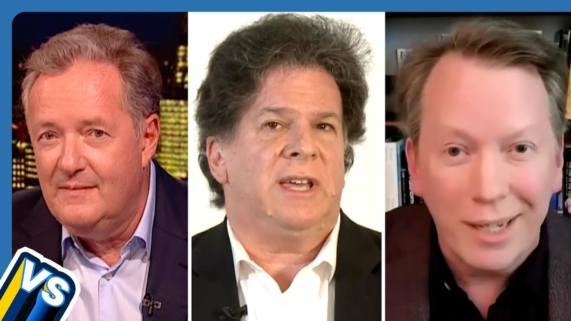
Today, the biggest brains on the planet are at loggerheads over what all this means – and for this special Uncensored debate, Piers Morgan is joined by two scientists with very different answers to the big questions – Dr. Eric Weinstein and Professor Sean Carroll.
00:00 Introduction
02:51 Prof Carroll and Dr Weinstein on their ‘bitter divide’ over String Theory
09:45 AD: Tax Network USA
10:46 Dr Weinstein: This matters so we can ‘traverse the cosmos’
18:00 Prof Carroll on the multiverse and parallel universes
19:26 AD: Beam
20:27 Dr Weinstein rages against being ‘misportrayed’ by Prof Carroll
23:04 Dr Weinstein’s ‘Theory of Everything’
29:40 AD: Pique
30:52 Prof Carroll gives his view on Dr Weinstein’s ‘Geometric Unity’
45:30 A reality check on the big topics in science
Transcript
00:00:00
Piers Morgan: What is your main bone of contention with Eric Weinstein?
00:00:04
Sean Carroll: Uh, you should probably ask Eric that.
00:00:06
Eric Weinstein: Sean has been nothing but civil. He’s also extremely nasty. So let me say a bunch of things to Dr. Carroll. Dr. Carroll, I’d like to hear your explanation for three generations of flavor chiral fermions with the observed quantum numbers under the group SU3 cross SU2 cross SU1.
00:00:23
Sean Carroll: ‘Cause I have read Eric’s paper. Here it is. I actually have it here. It’s worse than you [laughs] would think.
00:00:28
Eric Weinstein: How dare you?
00:00:28
Sean Carroll: How dare he read your paper?
00:00:30
Eric Weinstein: I highly advise you to spend more time in your physics department and less time on YouTube.
00:00:34
Sean Carroll: So we’re not allowed to think about Eric’s theory and write a follow-up paper about it-
00:00:39
Eric Weinstein: Oh no-
00:00:39
Sean Carroll: … including-
00:00:39
Eric Weinstein: … you’re very much allowed-
00:00:40
Sean Carroll: … complete contradictions
00:00:40
Eric Weinstein: … Sean.
00:00:41
Sean Carroll: I have my disagreements with string theorists, my agreements with them, but I respect it and I think that they’re trying their best.
00:00:48
Eric Weinstein: The first rule of physics fight club is don’t talk about the problems with physics fight club.
00:00:53
Sean Carroll: I have found myself in the awkward and unenviable position of defending the establishment heterodoxy.
00:01:00
Eric Weinstein: Your intellectually insulting, uh, aspect reminds me of you as the Marie Antoinette of theoretical physics, uh, influencer.
00:01:07
Piers Morgan: Given I’ve only understood about 1/10th of what either of you have said for the last hour, I would like to end on a point where none of us know the answer to something. For centuries, scientists have grappled with the most fundamental question of them all: what is reality? Well, up until the 20th century, it was considered to be a matter of common sense. We lived in a material and objective reality, perhaps created by God, but one that could be accurately measured and predicted. And then came Einstein, who revolutionized everything by saying that things were a lot more relative than all that. Space could bend time, mysterious black holes existed, the universe was expanding. But even Albert Einstein failed to truly grapple with what came next, the wild world of quantum physics, where nothing plays by the rules, even Einstein’s, and things seem to exist in two places at once. Today, the biggest brains on the planet are at loggerheads over what this all means and where science goes next. Are there multiple universes? Do we live in a Matrix-style simulation? Could there be an intelligent designer? For this special Uncensored debate, I’m joined by two scientists with very different answers to the very big question. Sean Carroll is professor of physics and philosophy at Johns Hopkins University. He hosts his own podcast, Mindscape, and draws audiences of millions elsewhere. Dr. Eric Weinstein is a Harvard-educated mathematician. His appearances on The Joe Rogan show alone have been viewed 26 million times, and he’s a regular guest on Uncensored. And despite, uh, both being scientific podcasting rock stars, Dr. Weinstein and Professor Carroll have never actually appeared together until now. Uh, so welcome to you, gentlemen, and thank you for agreeing to, uh, lock horns. Very, I have to say, very intelligent horns. Uh, Dr. Carroll, let me ask you first of all this. Are we actually here?
00:02:56
Sean Carroll: I think so. I’m here. I don’t know about anybody else. It could be a solipsistic kind of thing, but yeah, you know, I think that there’s a lot of things that you can imagine meaning when you say things exist, things are real, et cetera. And I think that if you don’t include you and me and tables and chairs, et cetera, I, I don’t think that you’re on the right track in defining what it means to exist. So yes, we’re here.
00:03:20
Piers Morgan: What is your main bone of contention with Eric Weinstein?
00:03:26
Sean Carroll: Uh, you should probably ask Eric that. I mean, I’m a working physicist. I am a professor at a physics department. I write physics papers. Uh, I have found myself in the awkward and unenviable position of defending the establishment heterodoxy. Like, it’s never what I imagined I would be doing. But there’s good reasons why the heterodoxy is the heterodoxy. So I think that academic physics, even though I’m happy to disagree with certain choices they make about what to work on and what emphasis to put on there, is working in good faith. I think that we’re trying our best to understand the universe at a deep level. String theory, which we’ll talk about in the program, is one example of this. I have my, uh, my disagreements with string theorists, my agreements with them, but I respect it and I think that they’re trying their best, and if someone else comes up with a better idea, they’ll move what they’re doing and focus on that idea. It just hasn’t happened yet.
00:04:22
Piers Morgan: For those with, with smaller, uh, brain power than you, what is string theory?
00:04:28
Sean Carroll: That’s a great question, and in fact, very famous string theorist, Joe Polchinski, wrote a very influential paper called What Is String Theory decades after string theory started [laughs] being a, a popular theory to think about. And the, the fact is we still don’t know yet. It’s an approach. You start with a very simple idea, that instead of the universe being made of particle-like things at the fundamental level, like the electron being a point-like particle, the photon, et cetera, which we all knew wasn’t exactly right anyway, but we can talk about that later, replace that with a little loop of vibrating string. Now, why would you do that? There’s a prehistory that goes into features of the strong interactions that motivated people to do it. They looked at this idea. What if the world were made of little loops of string rather than point particles? Problematically, the theory kept failing at what they were trying to do with it, which is, uh, explain the strong nuclear force, because it kept predicting the existence of gravity. So eventually people said, “Well, wait a minute, gravity exists. Maybe this is a theory of gravity as well.” And after, uh, many, many years of hard work on the part of people who were otherwise ignored by the community, they showed that it’s actually a very successful theory of gravity and possibly everything else. You have to buy a lot of extra stuff, like extra dimensions of space time that we don’t see and so forth, what is called the holographic principle, which again, we could get into if you want to, but the theory keeps moving forward while at the same time utterly failing to connect directly with experiments. So this has caused, you know, a lot of hair-pulling among the physics community. The theory looks very promising, but we haven’t actually been able to put it to work to connect to the real world.
00:06:10
Piers Morgan: Okay. Eric Weinstein, your response to that.
00:06:15
Eric Weinstein: Well, first of all, uh, I just assume that, uh, I’m being simulated by Sean Carroll.
00:06:20
Piers Morgan: [laughs]
00:06:20
Eric Weinstein: Uh, so, uh, who knows what’s real? You know, more or less, whether we’re in a simulation or whether we’re in not a simulation-
00:06:26
Piers Morgan: Well, it’s a really good question
00:06:27
Eric Weinstein: … uh, we are real.
00:06:27
Piers Morgan: I mean, before you get into your, into your response, I mean, we don’t actually know, do we? I mean, I, I, I have sometimes the most extraordinarily vivid deja vu dreams, um, or I dream stuff and then it seems to happen or whatever, and it always makes me sit there shaking and trembling and sweating and thinking, uh, are we all just living in some weird simulation? How would we know?
00:06:51
Eric Weinstein: Well, maybe we should never have legalized cannabis then. I don’t know.
00:06:53
Piers Morgan: [laughs]
00:06:54
Eric Weinstein: The, uh, the situation is that, um, I think that Sean and I probably agree almost completely on everything until 1972. Then you have the first, uh, really serious s- situation where a mysterious term is not only introduced into our common vocabulary, uh, called quantum gravity, um, but it takes over as a fictitious history that the, uh, central problem of theoretical physics is the quantization of gravity, um, which is not true historically, and you can check it on Google Ngrams, so this is just a fiction. The progress in the object that tracks our progress in, um, in, in physics called the Lagrangian or the action, uh, stops moving in 1973. And there’s a bunch of wiggle words that I don’t think we have time for between fundamental physics and regular physics, but then the, my guess is, is that the first problem that Sean and I will find ourselves at loggerheads over is that I think that making quantum gravity the holy grail of theoretical physics, which is repeated and perseverated ad nauseam, is a, is a terrible crime.
00:08:08
Piers Morgan: And what is quantum gravity?
00:08:10
Eric Weinstein: The second great crime-
00:08:10
Piers Morgan: But again, for those who are not as au fait with this as you guys, what is quantum gravity?
00:08:14
Eric Weinstein: If I may, the… So there’s a standard story that you’ll hear. M- more or less, Sean is a part of a group of about five people who do most of the communication of theoretical physics to the American public. In the UK, they’re are different ones. And there’s certain tropes that are repeated, and you don’t hear anything else. So the trope that sounds something like this. We have two theories, uh, that are bedrock reality. We have one called the standard model, which covers three out of four forces, the non-gravitational ones and all of the matter that we see in the universe, as well as something called the Higgs field and maybe some other fields as well. In the other theory, we have Einstein’s theory of gravity, which was put into relatively final form bet- before 1920, maybe by 1917. And then the claim is, is that the incompatibility between the two of them is that one of them is a quantum theory, that is the standard model of, uh, the nuclear force’s electromagnetism as a quantum theory, whereas Einstein’s grav- gravitational theory, general relativity, has resisted quantization. And then as the trope goes, that that incompatibility must be resolved by forcing the children of Einstein to submit to the will of the children of Bohr. And that explanation to me is patently absurd. The, there’s an incompatibility in the classical version of the standard model before you get to the quantum version of the standard model, which is that one of them is a so-called gauge theory and the other theory cannot be gauged-
00:09:40
Piers Morgan: Mm
00:09:40
Eric Weinstein: … um, successfully at least so far.
00:09:42
Piers Morgan: And why does it matter so much?
00:09:43
Eric Weinstein: Then-
00:09:45
Piers Morgan: Tax day has passed, but for millions of Americans, that’s where the trouble begins. The IRS is now ramping up enforcement for those who missed the April deadline or still owe back taxes. Well, today’s sponsor, Tax Network USA, can still help. If your books are a mess, if you’re self-employed or if you’re a business owner, Tax Network USA specializes in cleaning up financial chaos and getting you back on track quickly. They say the IRS is applying enforcement pressure at levels they’ve never seen before. But even after the deadline, it’s not too late to take control. The consultation is completely free. Acting now could stop, stop penalties, threatening letters and surprise levies before they escalate. Call 1-800-958-1000 or visit tnusa.com/piers. That’s tnusa.com/piers. Let Tax Network USA make the next move, not the, uh, IRS.
00:10:46
Eric Weinstein: Why does it matter?
00:10:47
Piers Morgan: Yeah.
00:10:47
Eric Weinstein: Well, it, it, it, it depends what you’re trying to do. I mean, I can tell you why it, my, the lead tweet in my Twitter feed is assume a traversable cosmos. If Einstein is left in force, my claim is, is that there are only two rocks that Elon’s, uh, chemical rockets can get us to, um, and that we’ve allowed ourselves to fall into the misunderstanding of Einstein’s theory as the map of gravity rather than the territory of where we actually live. I don’t think we live in space time at all. And Piers, I just need to get to one further thing-
00:11:23
Piers Morgan: Mm
00:11:23
Eric Weinstein: … which is, um, that the really significant problem, I would say I am the only person in Generation X to have actually been present in the room when everything shifted, uh, towards string theory, which happened in 1983 at the University of Pennsylvania when a fellow named Edward Witten gave the first lecture, uh, that I think he ever did publicly on string theory, and his will and his mind were so powerful and his influence so, so completely commanding that the entire sociology of the field, uh, turned on a dime, uh, in ’83 and ’84. And a- a- as such, I think I’m essentially the only person in Generation X who saw the old, uh, culture of physics become the new culture of physics, and what I claim is, is that Sean and I probably aren’t that divided even on the mathematics of string theory. What we’re, where we are bitterly divided … is, is that I believe that Sean thinks that the system works pretty well. I would say he’s part of the two cheers for, uh, the institutions. Uh, n- meaning that he has a to be sure paragraph saying that the institutions undoubtedly have their problems and he wished things could be done better. Whereas I see an absolute collapse in the ethics, efficacy, productivity of this at our deepest levels, and if you’re thinking about dark energy, dark matter, dark chemistry, all of the things that physics has done. Essentially, our modern world has been built by physicists, even molecular biology and the internet, uh, come out of physicists and CERN respectively, uh, the, with the World Wide Web. So if you think about the impact of physics, more or less the story of physics is the story of the world economy in the modern era, and we will be trapped here almost certainly unless you, uh, go in for science fiction tropes where we will not be able to get out of the solar system, and the Moon and the Mars will be our only diversification, giving the lie to Elon’s claim that he’s going to save humanity by making us multi-planetary. The only real diversification exists is if we shed the one atmosphere we share here, uh, and travel the cosmos.
00:13:33
Piers Morgan: Okay. So I, my takeaway from that, and it was brilliantly articulated, um, uh, Sean, is that basically you are going to be responsible for the end of civilization as we know it.
00:13:45
Sean Carroll: Apparently, yeah. I didn’t know, but now, you know, the weight is, is bearing down on my shoulders. Look, the, the story Eric just told is a kind of wacky and wildly misleading history of physics in the last 50 or 60 years. Uh, the idea of quantum gravity is a very natural one because the world runs by the rules of quantum mechanics as far as we know. This is the international year of quantum, ’cause it’s the 100th anniversary of really figuring out how quantum mechanics works. And the thing about quantum mechanics is it’s not a theory by itself. It’s a framework in which you can do theories. In contrast with classical mechanics from Isaac Newton that came before it. And gravity, our best current theory of gravity from Einstein, the theory of general relativity, is a thoroughgoingly classical theory. Certainly, the default expectation is that someday we will better understand gravity at the quantum level. You don’t have to think that, ’cause you don’t have to think anything. You’re welcome to come up with better theories, but again, that’s the default expectation. If you have a different point of view, there’s a certain burden of proof to convince people that it’s interesting to contemplate this other point of view. The idea of actually doing the detailed calculations to quantize gravity goes back to at least the 1950s, but it instantly hit roadblocks, and physicists were smart enough to know that it wasn’t working the way they wanted it to. The very simple thing you do, if I can get just a little bit detailed for a second here, because people never hear this, and I think it’s really, really important to understand why string theory is so popular. If you want to invent a new quantum mechanical theory of the world, the first thing you do is you ask yourself, if I have two particles and they come together and scatter, there’s a probability that different things will happen. I’m gonna make photons, I’m gonna make electrons and positrons or whatever, and you calculate that probability. And the famous triumph of mid-20th century physics was to show that you can do that and get a finite answer. If you’re sloppy about it, your answer turns out to be infinity and your, and your theory is on the wrong track. Everything that we know about in the physical world has a nice finite answer in this quantum mechanical realm except for gravity. Gravity doesn’t fit. And indeed, it was recognized pretty quickly that there was a good reason why gravity doesn’t fit, and it was almost impossible to imagine fitting gravity in. Namely, that gravity interacts with everything. Gravity interacts with photons, with electrons, with quarks, with whatever. And so when you do this scattering experiment, you do the calculation, everything in the universe contributes to the infinitely big answer that you don’t want to get. Apparently, what you would need is some kind of miraculous cancellation between all the different contributions from all the different fields, and people looked at that and said, “We have no idea how to make that happen. Let’s not worry about quantum gravity.” And then string theory comes along, and again, it wasn’t even trying to be a theory of gravity, but when they do this calculation, the miraculous cancellation happens in string theory. You get a finite answer to what happens when you scatter different particles off of each other. That is right now the only theory in which that miraculous, uh, uh, happening actually works, and this was finally put together as a sort of sensible, viable theory in the mid-1980s. Uh, and it was a calculation by John Schwarz and Michael Green that showed that it w- the theory did not have what are called anomalies, and you can look up the magazines at the time. Physics Today ran an article saying, “Anomaly cancellation launches super string, string bandwagon.” The point is, the reason why I had to go into those details is many, many physicists instantly became interested in string theory and quantum gravity who were not before. But the reason they did is not because Ed Witten is a smart guy and he towers over the field. It’s because there was a calculation that showed the theory is promising. Physicists are not sheep. If Ed Witten had said, “We should all work on this,” but everyone else looked at it and thought it wasn’t very promising, he would have been ignored. But since then, there’s no competitor to string theory that has had that miraculous feature that string theory has.
00:17:58
Piers Morgan: And just before I go to Eric to respond to that, y- your belief is, as a result of all this, it is more likely than not that there are, th- there’s a multiverse, there are many other worlds. It, it, I’m not misrepresenting you, I hope
00:18:12
Sean Carroll: Uh, well, you’re in the, you’re, you’re saying true things for the wrong reasons. It’s what philosophers call a Gettier problem.
00:18:18
Piers Morgan: [laughs]
00:18:18
Sean Carroll: Um, I’m a believer in, uh, the many worlds interpretation of quantum mechanics.
00:18:23
Piers Morgan: Mm.
00:18:23
Sean Carroll: That’s a question about the foundations of quantum mechanics, which again goes back to the 1950s. But that is more or less separate from the question of which model within the world of quantum mechanics is the right one. Is it field theory? Is it string theory? Is it loop quantum gravity? Is, is it something else? So I, I do believe that the best understanding of quantum mechanics we have right now implies the existence of parallel universes. Again, that could be true, and if we have a better theory that comes along, I’m happy to change my mind. There’s also a separate idea of the multiverse that comes with combining string theory with inflationary cosmology, a, a scenario of what happened very close to the Big Bang. So those are two different ideas about the multiverse. Many worlds of quantum mechanics says literally every time they make a quantum measurement, now there’s two worlds in which different measurement outcomes were obtained. The string theory multiverse says very, very, very far away in cosmological distance, there’s a patch of space where conditions look remarkably different than they do here.
00:19:26
Piers Morgan: [whoosh] If you’re struggling with sleepless nights and exhausting days, you might want to try Beam’s Dream powder. Beam is proudly founded in America and run by people who value hard work, integrity, and delivering results. It’s a healthy nighttime blend packed with science-backed ingredients to improve your sleep so you can wake up refreshed and ready to take on the day. Dream is a powerful blend of all-natural ingredients, reishi, apigenin, L-theanine, melatonin, and magnesium. It’s designed to help you fall asleep and to stay asleep. We’ve teamed up to give you a massive discount of up to 40% for a limited time. So go to shopbeam.com/piers, P-I-E-R-S, and use promo code PIERS at the checkout. That’s shop B-E-A-M.com/piers. Use promo code PIERS for up to 40% off. Sleep better, wake up stronger, and show up ready for your family, your work, and your country, too. [whoosh] Okay, Eric, your response.
00:20:29
Eric Weinstein: Yeah, I just got completely misportrayed, and this is, uh, actually, I’m glad that this is happening because this is sort of what happens when you tangle with the group of people who are supportive of this program. I did not say, uh, what I think Sean is choosing to either infer incorrectly or imply, uh, that somehow the world is not quantum mechanical or quantum field theoretic, and that somehow gravity is given a hall pass to go home and enjoy, uh, relaxation where every- everyone else has to work hard. Um, what I said was that, um, the idea of forcing gravity to submit to the same quantization procedures that have been successfully applied to other forces and to matter, uh, has not worked. It has stagnated the field, and that quantum harmonization is far more important. You could also decide to geometrize the quantum rather than quantize gravity, and thus quantize the geometry. So because Sean’s framework precludes somebody saying something outside the framework, the inference is, is that someone ignorantly just said that gravity can be kept out of, uh, the quantum f- framework, which I absolutely don’t say. You’ll also notice that Sean did not choose to take issue with the fact that one of these is a gauge theory and another one isn’t a gauge theory, and so that there is a problem with gauging gravity and what that means, and the fact that we’re getting no actual progress in the harmonization of gravity with the quantum that can, uh, give us a green light and tell us where we’re going. Like, I would happily cede to Sean all sorts of things, like the string theorists are by far the smarter group of, uh, all people trying to go beyond the standard model in general relativity. I would further cede that if the task is to quantize gravity directly, the string theorists and the string theory program have been more successful. But what you just saw is an example of what is actually going catastrophically wrong in the field, that a dominant narrative that has been perseverated into an as-if reality has created two teams, a smart team that gets it and a dumb team that just doesn’t. And that kind of toxic sociology is the true problem. And my guess is that that will recur multiple times during this thing, is that I will not be heard, and that Sean will continue to have a version of Eric that lives in his head, uh, which shares my name, but not my understanding nor my beliefs.
00:23:00
Piers Morgan: And that is, of course, if we get past the hurdle of whether we’re all here at all. Um, now, Eric, Eric, you’ve come up with an alternative theory of everything. It’s based around geometric unity, and my understanding is it’s, it’s a proposed framework aiming to unify the fundamental forces of nature, including gravity and quantum mechanics, within a single geometric structure, introducing a 14-dimensional manifold that extends space-time and embeds known particles and forces into a larger mathematical context. And the observation we had here in the research is that while ambitious, the theory remains largely unpublished in peer-reviewed literature, has not yet been formally tested or widely accepted by the physics community. Now, because you’re so, uh, smart about this stuff, your geometric unity paper is 69 pages long, extremely complex, way over my head, so we did what everyone in my position does these days. We went onto YouTube and saw, uh, if we could find anybody who’d analyzed it and had a conclusion, and we found this
00:24:04
Curt Jaimungal: Thank you to Eric Weinstein. It’s an avant-garde and creative theory. Curt here, several months later. This has been so long in the making. Geez, you have no idea. Anyhow, I wanted to say that I mean what I just said. I may have said this before in the iceberg, and if I haven’t, I should have, because it bears repeating. I haven’t seen a theory like this come from any single individual ever, not one that’s this fleshed out or has this amount of unexampled connections within itself, as well as to what’s known as the theoretical physics backbone that we talked about earlier.
00:24:39
Piers Morgan: Now, Eric, um, there’s lots of people doing stuff like that about it. Um, why do you think that the mainstream physics world is not taking this seriously enough?
00:24:51
Eric Weinstein: Well, first of all, I disagree. You see, part of what’s going on is, is that Sean is part of a group of physics influencers who are constantly spreading misinformation, which leads to a climate of fear. Um, you know, I, I, for example, found the following quote of Sean, “What I really, really want to get across to the audience is that nobody in physics departments is discussing this with other people in physics departments.” Now, I don’t happen to be coming to you from a physics department at the moment, but I happen to be on a five-day visit to a leading physics department. Um, and in this situation, uh, I just had a nine-hour conversation and talk with three hours, or four hours rather, of that being an explication of geometric unity. What Sean is doing constantly is attempting to say, look, let’s do some pattern matching. We have a man, uh, generously in midlife. He’s not trained in the subject. He doesn’t appear to accept the quantum gravity program. Uh, he appears to be possessed of the idea that a single individual, Ed Witten, caused all sorts of people who aren’t sheep, uh, to cohere into a single framework that has been perseverated and, uh, doesn’t seem to produce fruit. Um, he has a telling of the tale that is, first of all, just not courageous. It’s, it’s at odds with reality. Uh, from my experiences in this physics department, um, what I can tell you is that we have a situation in which everybody sees the problems. And so when Sean does a four-hour, um, podcast, which I think maybe three hours I’d recommend to anybody because Sean is one of the best explainers and also extremely good at mathematics and keeping true to actual physics in terms of his understanding, um, you know, he, he then goes into this thing that there is no crisis in theoretical physics. And as one of my physics colleagues said last night, the first rule of physics fight club is don’t talk about the problems with physics fight club. Uh, there is a self-evident crisis. Everybo– I can show it to you numerically. Uh, somehow the idea is that a small number of people who are either at the top of the physics influencer pile, which is where I would put Sean, or at the top of the, uh, prestige pile in research, have held a view that is completely at odds with reality, which, whose key feature is the exclusion of different perspectives. So when, for example, y- I, I can tell, uh, I can, I probably can guess the AI peers from which you’ve got the analysis of geometric unity. Uh, what you see is a very strange situation where a group of people go around attempting to throw shade on anyone who questions whether there’s a massive problem in physics that everybody, uh, who’s actually in the game, uh, can see with their own eyes. Now, if you ask me what’s going on with geometric unity, I can say something very simply that because you have a very large viewership, will go out to many people. You won’t understand it, but I’ll, it’ll be over very quickly, and it should be an astounding comment. If you take a Lorentzian metric as a section of a, a bundle of pointwise Lorentz metrics and pull back the Weyl, positive Weyl spinors, uh, with suitable, um, s- passing to maximal compact subgroup, you get one generation of Petit Salon Grand Unified Fermions. Now, that was very quick, but what it really just said is that general relativity knows the standard model. Anybody of Sean’s ability should be able to parse that twenty-second sojourn and say, “Is that something we know? Is that something that might be interesting?” Then we w- what we’ll have is we’ll have the typical physicist large language model conversation in which physicists will ask, “Do you have a new prediction at anything at electroweak scale?” Which is a question that doesn’t get asked to the string theorists. So you have a differential treatment in which the physicists remember what physics used to be like in the mid-twentieth century when they’re hearing a competitor, and they choose to forget it when they’re hearing something that comes from this other community. Hence, I think what you’re gonna find is if you look at this three-hour, uh, documentary that was just made on geometric unity, which in itself has flaws, by a person who does not have a PhD, it evidences the highest level of understanding of geometric unity found in a second person over forty-one years of trying to have conversations with physicists who tend to be polarized by one collection of theories led by a single individual.
00:29:38
Piers Morgan: Now, everybody knows how much I enjoy my tea, and I’m very happy to say that today’s show is sponsored by Pique’s Pure Fermented Teas. These are not your average brews. They’re sourced from two hundred and fifty-year-old wild trees in the Himalayan foothills, which are untouched by modern farming. No pesticides, no fertilizers, just nature at its best. Pure delivers a full spectrum of prebiotics, probiotics, and postbiotics. Just like the fermented foods found in longevity hotspots. It comes in crystal form, so there’s no messing around. Just dissolve, sip, and feel the difference. It’s trusted by health experts, including Casey Means and Dr. Mike- Mark Hyman. There’s teas for all occasions, and they all support your gut health, metabolism, and cellular renewal. The next time you put the kettle on, ask yourself, “Is my tea working as hard as me?” Pique’s pure fermented teas, for the gut of a Brit and the longevity of a Himalayan monk. Get 20% off for life, plus a free frother and glass beaker with the Pure Bundle. Visit piquelife.com/piers. That’s Pique, P-I-Q-U-E, life.com/piers. [whooshing] [upbeat music] Okay. Sean Carroll.
00:30:56
Sean Carroll: Well, I find it very telling, I don’t know, it makes me sad that you’re looking for a second opinion about geometric unity, and you go to YouTube [laughs] and see what pops up. I, I don’t think that’s the standard to which we would like to aspire. There are professional physicists right there in your country who work on understanding quantum gravity, field theory, geometry at a deep level, and you could ask them what they think. Look, there’s a lot of talk so far about sociology, and I’d much rather talk about physics. But I would like-
00:31:27
Piers Morgan: Sure
00:31:27
Sean Carroll: … to let people out there know, who might be working outside the academic physics community, that it is 100% possible to have a good idea and have it have an impact on what physicists do. But it’s not easy. You have to do a certain amount of work to show that your theory is worth the time, that it is respectable, that it is interesting, that it is promising. The first thing you gotta do is make sure that your theory makes contact with modern physics as it is understood. If you have a new paper out, physicists are gonna look at it. They’re gonna look for, you know, where’s the Lagrangian? Where’s the interactions? Is the proton stable? Is there dark matter? Like, how does it fit into what I already know?
00:32:09
Piers Morgan: Those are all different levels of the stack, Sean.
00:32:11
Sean Carroll: And Eric’s theory, Eric- Eric’s paper has none of that. You would also ask, have-
00:32:15
Piers Morgan: Excuse me?
00:32:15
Sean Carroll: … has the theory been shown to be viable in a very basic way? Is it stable? Is it free of anomalies?
00:32:22
Piers Morgan: Sean.
00:32:22
Sean Carroll: Is it finite, in the sense of the quantum mechanical calculation that I already mentioned? Again, none of that is there. Are there any new predictions? Eric says, and completely correctly, string theory doesn’t make any new predictions either. But also, I, I really don’t want people to get the idea-
00:32:38
Piers Morgan: No, no, no. Wait, Sean
00:32:39
Sean Carroll: … that string theory has some dominant picture.
00:32:41
Piers Morgan: Sean, you’re, you’re just misrepresenting the world.
00:32:41
Sean Carroll: In my department at Johns Hopkins, we have… Let, let me just finish, and then you can talk. That, I think it’s a good system. In my department at Johns Hopkins, we have six professors in the theoretical physics group. One of them does string theory, and even he only does it sort of half-time. I wish we had more, honestly. This is very typical. Even at the most stringy departments, it’s maybe half the people who do string theory. There are plenty of other approaches being advocated, and many of them do make different predictions, and we’re looking for them in cosmology and astrophysics and elsewhere. And finally, does your theory solve any interesting problems that we already thought we had? That’s the reason why string theory became interesting. Because we had this th- this problem with quantum gravity, that it gave infinite answers, and string theory solved that problem. And again, I see none of that in Eric’s paper. So it’s very possible that somewhere in Eric’s theory there are interesting ideas, but he has given us no reason to think that it is a promising theory. I encourage other people who would like to have an impact on the research agenda of modern physics to take these easy steps rather than going on podcasts and talking about their victimization.
00:33:53
Piers Morgan: Okay. Eric, it’s always, uh, it’s always a, a pivotal moment in these debates when you put your glasses on, so I’m bracing myself.
00:34:01
Eric Weinstein: Yeah. This is… Well, first of all, Sean has been nothing but civil throughout our relationship. He’s also extremely nasty, but I really appreciate the civility, and I attempt to, uh, respond in kind. Sean and I really should be divided, but we appear to be. I don’t understand it. Um, he did respond. It just shows that none of this is series, serious, um, uh, speaking about what I’m talking about. He said, uh, “This is not something that is going to be a thing.” He also says that he hasn’t read it. So let me say a bunch of things to Dr. Carroll. Dr. Carroll, I’d like to hear your explanation for three generations of flavor chiral fermions with the observed quantum numbers under the group SU3 cross SU2 cross SU1. In another podcast, you said, “Before I listen to your theory, you should listen to my, Sean Carroll’s, theory. My theory is na- known as the standard model.” I can give you an explanation for why SU3 cross SU2 cross SU1, why there are three generations, why 16 particles in a generation, why the observed quantum numbers are the way they are, why the Higgs sector comes out of, of seemingly nowhere, uh, with a quartic potential, with, uh, a quadratic term, why the Yukawa coupling is, uh, just there, uh, just so in order to produce mass, uh, when the weak force forbids a mass directly in the Dirac operator. Uh, Sean knows what every single thing that I just said is in that statement. Um, why Sean chooses to misportray the fact that I can say why there should be dark matter, what the dark energy is, what the exact quantum number assignments are for the two families that are luminous that have yet to be seen, um, I have no idea, because Sean also proudly says is that he hasn’t looked at it and hasn’t read it. That’s why he says that there are no Lagrangians in it. Uh, I have no idea where Sean gets this stuff. Sean is insistent that the idea that somehow I am not choosing to go through the usual channels, uh, and instead talking as he is right now via YouTube, is somehow significant when I’ve just given talks in three different countries on dark energy. And by the way, every time I talk about talking about this, somebody is telling me, “Don’t talk about the fact that you’re actually in a physics department.” And what I’m trying to tell you is I give talks in physics departments, I hang out with physics colleagues, I’m welcomed at places like the Institute for Advanced Study, MIT, et cetera, et cetera. And yet, I have to deal with this nonsense. I talk to both physics colleagues. You know, right now you’ve got a giant problem called, something called D-E-S-I or DESI, the dark energy, or is it spectroscopic instrument, which is at the moment going after Einstein’s unwanted cosmological constant. That is not a constant. The dark energy is not a constant term. That is the only term that you can put into the Einstein field equations, because of the Einsteinian curvature satisfies an automatic differentiate equation called divergence-free. So if you have another term in the, uh, equation, it has to have the same property. There’s only one known automatic equation, which is that the metric of Einstein that creates space time is annihilated by its own Levi-Civita connection. And Sean, you’re misrepresenting things, because I’m gonna give a formula for the dark energy. I do all sorts of things that you have no idea of, because your attitude, which you repeat in other podcasts, and I highly advise you to spend more time in your physics department and less time on YouTube, um, is is that this is not a serious thing-
00:37:38
Piers Morgan: Wow. [laughs]
00:37:38
Eric Weinstein: … nobody’s taking it seriously, and your misportrayal of the situation, uh, is nearly constant, for reasons that completely elude me.
00:37:48
Piers Morgan: Sean?
00:37:50
Sean Carroll: The good news is I have read Eric’s paper. Here it is. I actually have it here, right here. And, uh, it’s worse than you [laughs] would think, you know. It, just very quickly, it starts off by saying, “The author is not a physicist and is no longer an active academician, but is an entertainer and host of a podcast. This work of entertainment is a draft work in progress, and it may not be built upon.” So we’re not allowed to think about Eric’s theory and write a follow-up paper about it-
00:38:18
Eric Weinstein: Oh no, you’re very much allowed, Sean
00:38:20
Sean Carroll: … in, in complete contradiction to everything-
00:38:22
Eric Weinstein: But, but-
00:38:22
Sean Carroll: … that is normally done in scientific discourse. You hope that people build upon your theories. You don’t try to prevent them. Then later on it says-
00:38:31
Eric Weinstein: Sean, people have built upon my theories since-
00:38:31
Sean Carroll: …”This document is an attempt to begin recovering”… I’m, I’m gonna read this. “This document is an attempt to begin recovering a rather more complete theory, which at this point is only partially remembered and stitched together from old computer files, notebooks, recordings and the like, dating back to as far as 1983.” And this is why this is, paper is not going to appear in the peer-reviewed literature. It’s not serious. It’s the dog ate my homework kind of thing. If you have a dark matter thing-
00:39:00
Eric Weinstein: How dare you, Sean
00:39:00
Sean Carroll: … if you have a dark matter prediction, if you have a dark energy prediction, I wanna see a plot in the paper. I wanna see redshift versus distance.
00:39:08
Eric Weinstein: No, no, no, Sean, you-
00:39:09
Sean Carroll: I wanna see a calculation of a relic abundance so I can figure out how much dark matter is supposed to be. If you do that-
00:39:16
Eric Weinstein: Sean
00:39:16
Sean Carroll: … people will pay attention to the theory. It’s very possible.
00:39:20
Eric Weinstein: Sean, first of all, um, how dare you? Second of all-
00:39:25
Sean Carroll: [laughs]
00:39:25
Eric Weinstein: If you’re going to go by the standards-
00:39:27
Sean Carroll: How dare I read your paper?
00:39:27
Eric Weinstein: … of the, of the f-… No, Sean, how dare you cast shade and aspersions of the kind that I wouldn’t seek to cast on you, but I will now. Uh-
00:39:36
Sean Carroll: Okay
00:39:36
Eric Weinstein: … I’m not seeking your favor, nor do I n- nor do I need to seek your approval. As you know, you failed to gain tenure, uh, at the University of Chicago. You’re not highly regarded in the field. And again, I’m only returning the shade in which you just yourself cast. I wouldn’t have done this otherwise. You then spent time as a non-tenured faculty at, uh, Caltech, and you only gained tenure in a non-standard professorship. You’re not a leading person in the field. Um, my belief structure about this is, is that you imagine that I’m coming to you saying, “Oh, Sean Carroll, let, find a g- let me, tell me which graft I, graph I should do so that I can please you.” As you know, because you’ve read the paper, you s- what you said about Lagrangians is false. What you said about predictions is false. My concern is what you did, is, is that you seized upon something where people have built on my ideas since 1994. The equations that Natty Seiberg and Ed Witten introduced that took over the world were called the insufficiently nonlinear equations when I was at Harvard in 1987 and introduced them. The question, uh, is why appear as an entertainer rather than as a physicist. First of all, ne- neither you nor I are trained as physicists, Sean. You’re actually trained as an astronomer. Um, what you have in this situation is, is that you and I are both interloping in a field that is not the one to which we trained. That doesn’t bother me about what you’re doing. I’ve enjoyed some of your papers. I’ve thought very poorly of others. Uh, you have a wide range of interest. I think you’re very creative. Uh, your intellectually insulting, uh, aspect reminds me of you as the Marie Antoinette of theoretical physics, uh, influencers. Uh, I’m not here to please you. You know that there are tables in the document that you’re reading that have plenty of predictions. You know that it solves plenty of problems.
00:41:29
Sean Carroll: Right.
00:41:29
Eric Weinstein: What you are doing is creating an environment of fear where every university worries, what does it mean to talk to this person? And what I would say to you is you are commenting on the effect that you are in fact inducing. You and a small cadre of people are like intellectual border collies of the physical sciences, uh, casting shade and aspersions on those who are succeeding where the quantum gravity, string theoretic, and M-theoretic programs are failing.
00:42:03
Piers Morgan: Sean?
00:42:06
Sean Carroll: Look, I mean, I didn’t say anything about Eric as a person, his history or anything like that. I said things about the paper. Everything he says about me is, like, 90% true, as, as many things he says. The paper is not giving us any reason to think that this approach is promising. There is no quantum mechanics in the paper. There’s no attempt at showing that this solves any of the known problems of quantum gravity. Again, it’s just not just about Eric, it’s about anyone. If you want to make an impact on the physics research community, you have to give them a reason to think that what you do is promising.
00:42:45
Eric Weinstein: Sean, you have a serious problem with dark energy that you’re developing, and it’s gonna go right through having been a problem with Lambda-CDM to eventually being a problem with the Einstein field equations themselves, perched as they are atop the space of metrics as an completely inadequate, uh, space of field content. What you’ve just said and what, the aspersion that you have just cashed, uh, cast, you are simply not qualified to say. What you have said is that I have given no reasons. Let me imagine that that paper, which was a draft rushed to get to an April 1st date, um, remains i- in a world where Sam Altman and Elon Musk, uh, continue to compete for better and better AIs. What would you say if at some point, uh, those AIs then got to that paper and said, “Holy cow, that is exactly, uh, what we’ve been missing. This thing solves all sorts of problems.” And the problem that we have is that a group of influencers with a penchant for being, and this is one, becoming one of my least favorite words, although I didn’t have any negative association until recently, debunkers. The, the problem, Sean, is, is that you and I are naturally allied on almost everything. We’re not very far apart. I don’t disagree with the standard model. I think the standard model is the most beautiful piece of, uh, differential geometry before it becomes theoretical physics. But one, one of the things that you just said is is that it’s a classical music, a classical field theory that is not quantized. As you well know, there was a revolution in the 1970s which said that we blew Hamiltonian analysis, and that in fact every phase space carrying a symplectic form can be treated, um, locally as if that symplectic form is the curvature of a line bundle, and the sec- L2 sections of that line bundle form a Hilbert space, and the P and Q coordinate functions can be promoted to operators. It’s said that wine is you, what you get when you stop grape juice from becoming vinegar, and in fact, Hamiltonian analysis is what happens when you take a physical problem and you stop it from quantizing itself. That was one of the great errors of our time, that Hamiltonian analysis was actually pointing the way to saying that most classical problems contain the seeds of their own quantization. Um, you know all this stuff, and I know this stuff. We know the same people. Uh, we probably can work in the same notation. My guess is, is that if you and I got over, uh, whatever [laughs] this bizarre tension is between us and buried the hatchet, um, my guess is that after two days you’d say, “Boy, I really just didn’t understand what he was saying.”
00:45:21
Piers Morgan: You know what? I would love that to be the case, and maybe you guys can, can make that happen. Talking of dark energy, a little bit of dark energy has crept into this debate, so I’m gonna try and end on a slightly lighter note, and these will require much shorter responses, but I just wanna see whether you guys… I mean, as you said, Eric, you agree about a lot of stuff. Do you agree about-
00:45:42
Eric Weinstein: Most- mostly.
00:45:42
Piers Morgan: Yeah, mostly. Th- th- I wanna ask whether you agree about some of these fundamental things which have struck me as interesting about where we are. Professor Stephen Hawking, I did the last television interview that he ever gave before he, he died. He said that the, uh, biggest threat to mankind was if artificial intelligence learned to self-design. Do you agree, Sean?
00:46:07
Sean Carroll: No, I don’t think that’s the biggest threat to mankind. I think that AI is a threat, but in a completely different way than is usually portrayed. Uh, the AIs that we’re working on now are not really the kind that will reach general intelligence in the way that we think about it. There’s no obstacle to reaching that in principle, but the currently popular, uh, architectures aren’t on that trajectory. The real problem, as we saw just this week, uh, with the Chicago Sun-Times, is people are lazy, and people use AI for the wrong reasons. This was a very, very trivial example where they published an article about the fun summer book reads this year, which was completely hallucinated by an AI, and they just published it in the newspaper. That doesn’t really hurt anybody, but when these architectures are being put to work in things that could actually hurt people, that’s when AI is gonna have a really bad impact.
00:46:58
Piers Morgan: Eric?
00:47:00
Eric Weinstein: I would say I completely agree with Sean. I believe that the biggest problem and threat to humanity is that we share a single atmosphere. We h- can have different land masses, but we have to share one atmosphere, and that, um, pathogens, radiation, and climate are all bound up in this one resource. And I would say that the biggest problem that I’m seeing is a general, um, madness in the American political system on both left and right, where we went from being the thing that was like the control rod stopping the world from going critical, uh, to a crazy isolationist perspective where the Democratic Party is not able to restrain the worst excessi- excesses of the Republican Party, and conversely, and I fear that what we’re going to see is a move towards nuclear proliferation, which remains the single greatest threat, which is what we physici- physics people, uh, unleashed in November of 1952 at a thermonuclear level. And I think we’ve, since we’ve never used such a thing in, in anger, and we’ve had a test ban treaty since the early ’60s, we are completely unprepared for what the cost is of retreating fr- as the world’s policemen.
00:48:06
Piers Morgan: Fascinating. Um, Sean, will we ever be able to time travel, either forwards or back?
00:48:14
Sean Carroll: Well, forwards, I time travel all the time. Yesterday, I time traveled 24 hours into the future, and here I am. I mean, that’s not that hard. Einstein showed us that there’s a trick. You can even travel into the future faster by either moving near, near the speed of light or by hanging out in a strong gravitational field like a black hole. Backwards in time, no. I don’t think that we’re gonna be able to do it. I’ve written papers about it. Uh, it’s pl- it’s something that is, I would say, conceivable but not plausible. We know how it might work in principle, but all of the indications are it’s not gonna work in practice.
00:48:46
Piers Morgan: Eric?
00:48:48
Eric Weinstein: Well, as, as Sean has thoroughly digested, uh, my paper, uh, he knows that I believe that there are either five or seven dimensions of time in a 14-dimensional world, which is split five of time, uh, nine of space, or seven of time, seven of space. So when you talk about time travel, it’s times travel, and only when time is one-dimensional is there an arrow of time. If there were two dimensions of time, you’d have a whirlpool. Three dimensions would result in a right-hand rule of time. These things are technically called orientations. One of the things that is really interesting about multiple dimensions of time, which leads to something which is very l- poorly studied called ultrahyperbolic equations, is is that you have the opportunity of going back in time without going back through time. So just as you can, uh, play a record, and when the, the stylus comes to the, uh, inner circles of the record, you can jump again to any track that you like. On a cassette tac- tape, you have to go back through time. So my belief is no, we will not go back through time, but we will have to figure out, uh, s- how to stop thinking in terms of initial conditions because it is only in the case of a single dimension of time leading to hyperbolic equations that you have that luxury. So I think that times travel is going to be perhaps the most interesting thing to come out. When you ask why should we worry about these things, buckle up.
00:50:08
Piers Morgan: Fascinating. Uh, and my final question is my probably the biggest question I, I can ask any guest, and I’ve asked quite a few of them, w- I have to say with very limited responses. So I’m asking two highly intelligent people this question now, which is I happen to believe in God, and the reason I do, other than the fact I was reared as a Catholic by my, my mother, um, is because I genuinely think there must be a superior being out there, uh, who is able to answer this fundamental question in a way no human being has been able to answer it t- for me, which is for those who believe in the Big Bang theory, what was there before the Big Bang? In other words, what was nothing, and what was there before nothing? And because I do not believe a human brain can answer that question, there must be, de facto, a more superior thing out there that can. Sean.
00:51:10
Sean Carroll: Well, I’m glad to be the one who frees you from your religious convictions because the human brain can absolutely tackle that question, and it does so all the time. I encourage, uh, viewers/listeners to listen to the upcoming episode of my podcast called Mindscape, where I talk to Niess F. Shorty and Phil Helper about exactly this question, what happened at or before the Big Bang?
00:51:33
Piers Morgan: Yeah.
00:51:33
Sean Carroll: We don’t know the answer. We don’t even know whether the Big Bang was the beginning-
00:51:37
Piers Morgan: Well, there you-
00:51:39
Sean Carroll: … of the universe
00:51:40
Piers Morgan: Well, there you go.
00:51:41
Sean Carroll: So w- w- the fact that we don’t know doesn’t mean we can’t know. Those are two very different statements. We have-
00:51:45
Piers Morgan: Well, if you don’t know, you, you can’t know at the moment, surely. You have to admit you don’t know.
00:51:50
Sean Carroll: I don’t know, and we’re doing science on it in the hopes that we will know.
00:51:55
Piers Morgan: Yeah, but it’s-
00:51:55
Sean Carroll: That’s how science works
00:51:55
Piers Morgan: … but with respect, Sean, Sean, with respect, it is utterly impossible. You will never as a human being be able to tell me what was there before nothing. How can you? You can’t comprehend it, can you?
00:52:07
Sean Carroll: I come up with a theory. I show that the theory fits the data. That’s how we do it. That’s what science is.
00:52:11
Piers Morgan: What was there before nothing, then? Go on, best guess.
00:52:14
Sean Carroll: We don’t know. Uh, my personal favorite theory is there was a preexisting universe out of which our cosmos arose as a baby universe-
00:52:21
Piers Morgan: And what was there before that?
00:52:22
Sean Carroll: … due to a quantum fluctuation.
00:52:23
Piers Morgan: What was there before that?
00:52:23
Sean Carroll: No, it’s infinite in, it’s infinite in time in both directions.
00:52:27
Piers Morgan: So what was there before… So you mean it’s never-ending?
00:52:31
Sean Carroll: Yeah. I wrote a book if you wanna read it, Piers.
00:52:33
Piers Morgan: I do.
00:52:34
Sean Carroll: [laughs] From Eternity to Here. It’s a great book.
00:52:36
Piers Morgan: I do, but what’s there before eternity?
00:52:39
Sean Carroll: There was no such thing as before eternity. Like, what is less than minus infinity? That’s not a sensible question to ask.
00:52:44
Piers Morgan: Yeah, but I think it’s a cop-out by you, if you don’t mind me saying this very respectfully, to say that something is infinite. Because if you’re saying it’s infinite, you don’t have to answer the question. You’ve just made that up. You don’t know it’s infinite.
00:52:55
Sean Carroll: Th- this very often happens in the progress of human knowledge, that a question that we thought was an interesting one becomes not answered but shown to be uninteresting because we get a deeper understanding.
00:53:06
Piers Morgan: [laughs] See, that, I’m sorry. I’m gonna come to you, Eric, on this. That seems to me a very pompous answer. That is basically trying to apply a superior intelligence to a response to a lesser mortal by saying that my im- my, my, uh, attempt to a- get this question answered is so stupid that there should be no need by the brain power in front of me to answer it.
00:53:30
Sean Carroll: No, it’s exactly the opposite of that. I don’t know why people are trying to psychoanalyze me and, and think about what I’m thinking of them. What I’m saying is the question of what happened before the Big Bang is prima facie a perfectly sensible question to ask, but we need to be open to the possibility that there is no beginning to the universe, that the universe is simply-
00:53:50
Piers Morgan: But that, but that, yeah, but that is a ridiculous thing to say because you know-
00:53:55
Sean Carroll: [laughs]
00:53:55
Piers Morgan: … you know that your human brain cannot comprehend something that has no beginning. How can it? We can’t.
00:54:04
Sean Carroll: I can comprehend the real numbers. They go from minus infinity to infinity. I don’t see why it’s harder to comprehend infinity years versus 14 billion years. That doesn’t make sense to me.
00:54:15
Piers Morgan: All right, Eric, am I, am I mad?
00:54:20
Eric Weinstein: No. I mean, look, uh, one of the things that I like, Pierce, is that you invite me on this program often not to do battle, as we heard in the previous seg- segment. So let me try something as an offering to the good Dr. Carroll, and you can tell me whether this matches anything, uh, because I also share, uh, atheism at some level along with him. What I believe is that you’re conflating three different category problems. One, you’re talking about something observational which might terminate at what we would call the surface of last scattering, the thing that we cannot see beyond with our instruments. Um, that takes place, uh, along the lines of something, let’s say, call it the cosmological model, which is a reduction of Einstein’s field equations assuming greater certain, uh, symmetry. That is a one comma three problem where you have one dimension of time, three of space, and you can prove that there’s a something called an essential singularity in the center of a black hole, a Schwarzschild singularity, and an initial singularity in what would be called a Friedmann-Robertson-Walker metric. So that is a map of the territory that we are trying to observe. But there’s a third thing, which is an assembly sequence, which also has an ordinal concept of development which could be confused with a chronological one of time. What is it that built the manifold so that time could progress? Now, the thing that’s truly radical about geometric unity, and I think Sean would probably agree with this if he’s, if he’s read it at all, and I’m not sure that he has, is that it is the only theory I know that begins from almost nothing and tries to get, and by theory of everything, we don’t mean all knowledge, we mean a complete, uh, set of the rules of the universe. What it says is, is that four degrees of freedom are all that is necessary for the quark, lepton, CKM, PMS, et cetera, et cetera, PNMS structure of the universe. That basically sweet, salty, sour, and bitter or, uh, treble, mid, base, and reverb is all that’s necessary to create a universe. What the point of a theory of everything, which is almost never discussed, and by the way, I would point out that I quite agree with Sean that philosophy, when done well, is, uh, an essential complement to understanding physics, lest we be tempted into the wrong kinds of thinking. What I would say a theory of everything is, is a theory that starts from minimal assumptions, recovers all of the rules, and demotivates the further scientific study of the initial set of data used to construct the model. Not that the model, not that the initial set of data is uninteresting, but it, that it’d be interesting to theologians and philosophers rather than be motivating to mathematicians and physicists. And what I would say is, if it’s true, imagine we were on the branch where geometric unity has proven itself and the good Dr. Carroll agrees, what I would say is, at that point, why there are four degrees of freedom is not a scientific question. I don’t think anybody that I know would be motivated to try to figure out how to get four degrees of freedom from nothing. Uh, that would be an interesting question, and that is the question upon which your God hinges. But I would say that, uh, in the case, case of a scientific atheist, what we’re trying to do is to come up with a complete set of the rules of chess, as it were, for the physical universe from minimal inputs, and those minimal inputs should have so little structure that they are demotivating to everybody who studies partial differential equations or group representations.
00:57:55
Piers Morgan: But just to be clear, Eric, like Sean, I think I’ve got a point of, of where you both come to the same place here. You don’t actually know, do you, what was there before nothing?
00:58:07
Eric Weinstein: No, absolutely not.
00:58:08
Piers Morgan: I would love-
00:58:09
Eric Weinstein: And, and, and you know what, by the way-
00:58:09
Piers Morgan: You know what? I would like to, given I’ve only understood about one tenth of what either of you has said for the last hour, I would like to end on a point where none of us know the answer to something, ’cause it makes me feel slightly less stupid. Uh, fascinating debate, gentlemen. I’m glad we ended up with a bit of unanimity at the end there. Uh, I appreciate you coming together. I realize you are at loggerheads about a few things. I suspect, as Eric said, Sean, if you spent a couple of days together over a few pints of foaming British ale, or whatever your tipple may be, uh, you’d probably find you end up best buddies. And I, I would love to do that interview if you ever do that. So thank you both very much for joining me.
00:58:52
Sean Carroll: Thanks.
00:58:52
Eric Weinstein: Thanks for having us. And Sean, thanks for doing this. Maybe a cocktail instead of some lager.
00:58:56
Piers Morgan: [laughs] Bit bitter. Just bitter, to be clear. Uh, but thank you both very much. [upbeat music] Piers Morgan Uncensored is proudly independent. The only boss around here is me. If you enjoy our show, we ask for only one simple thing. Hit subscribe on YouTube, and follow Piers Morgan Uncensored on Spotify and Apple Podcasts. And in return, we will continue our mission to inform, irritate, and entertain. And we’ll do it all for free. Independent, uncensored media has never been more critical, and we couldn’t do it without you. [upbeat music]