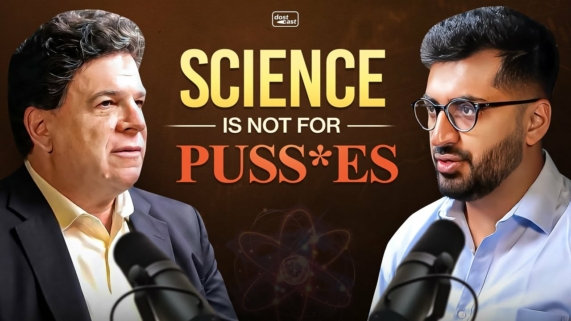
In this episode of Dostcast, Vinamre and Eric discuss:
The hijacking of modern institutions and the “shaming fetish”
Free speech, the pursuit of truth, and the beauty of friction in art
Jewish identity, humor, and the cultural influence of Palestine
How to read people, restore beauty to life, and question “the performance of science”
Speculations on aliens, the future, and the secrets of the universe
Outline:
0:00 Prakhar’s Wedding Experience
1:40 How Vinamre Discovered Eric
4:30 Hijacking of Institutions
8:30 The Shaming Fetish
10:00 Free Speech & the Pursuit of Truth
21:00 The Beauty of Friction in Understanding Art
25:33 Russell Conjugation
27:22 Lack of Original Thought
36:00 Palestine and Arabic Influence on the Internet
41:59 Vinamre’s Experience in Kibbutz Beeri
44:10 The Horrors of Barbarism
48:10 Jews and Synagogues
54:30 Jewish Humor
57:20 California Dreamin’ and Aspirations
1:03:20 Secrets of the Universe
1:07:57 How to Bring Beauty Back into Life
1:10:10 Opposable Thumbs
1:12:30 How to Read People
1:19:10 The Performance of Science
1:28:09 The Poisonous Mango
1:33:55 Believing Institutional Claims
1:35:00 Aliens
1:39:00 What’s the Future?
1:47:47 Conclusion
Transcript
00:00:06
Vinamre Kasanaa: [laughs] Hey man, uh, I have lots to discuss with you. First of all, you were an unexpected surprise at my friend Prakar’s wedding. I did not expect to see you-
00:00:18
Eric Weinstein: So were you.
00:00:19
Vinamre Kasanaa: Yeah. It’s… It was just a strange table of people. I mean, those two, Kushal and Abhijit are, uh, notorious in India, but having you there sitting with us, and then I dropped a picture with you and my friend Arpit Bala, and that broke the Indian internet for a while because-
00:00:36
Eric Weinstein: Was that right?
00:00:37
Vinamre Kasanaa: Yeah, because he’s, he’s huge in the memes, and he’s like a… He’s the most memed person on the Indian internet right now.
00:00:43
Eric Weinstein: Wow.
00:00:43
Vinamre Kasanaa: And they couldn’t believe it.
00:00:45
Eric Weinstein: That’s very funny.
00:00:46
Vinamre Kasanaa: Yeah.
00:00:46
Eric Weinstein: I mean, it, it… Look, it, it was a wonderful wedding. Had a really good time. And, uh, uh, it was also sort of interesting to see, uh, like Kushal and, uh, Abhijit in, uh, in that different setting. I had them to the Bombay Gym as our guests, and I realized, “What was I doing? Was I gonna scandalize South Bombay?” Um, but yeah, I mean, I just… I, I loved the, just the diversity of people, uh, that we were hanging out with. It was fun.
00:01:16
Vinamre Kasanaa: Yeah. That, that was the internet table. But let me tell you how I first learned about you.
00:01:22
Eric Weinstein: Okay.
00:01:23
Vinamre Kasanaa: I was in college in 2016. Uh, my mind was ready for red pilling. I was an Indian kid, uh, who had come to America, and I thought I was the shit, you know? Uh, topper in school, fantastic at the English language, debating, speaking. I thought I could win America. In 2015, I land in Boston, and I can’t even croak a few words of English.
00:01:45
Eric Weinstein: What?
00:01:45
Vinamre Kasanaa: Uh, I just couldn’t think in the language.
00:01:47
Eric Weinstein: Hmm.
00:01:47
Vinamre Kasanaa: And I felt all kinds of shy and underconfident, and I started to work on myself. During that time, I learned that podcasts were a thing, right? And then something happened. I… This word woke or anti-woke seemed to penetrate college campuses. And, uh, then I heard another term called the intellectual dark web. That was nine years ago.
00:02:12
Eric Weinstein: Okay.
00:02:12
Vinamre Kasanaa: And, uh, it was you, Sam Harris, Jordan Peterson, Joe Rogan, your brother, Bret Weinstein. And for me to now sit with you is very surreal. If you could describe what was that moment in time that led you to become so popular on the internet?
00:02:34
Eric Weinstein: It’s a very weird moment where it became, uh, seditious and dangerous to say ordinary things. If you used your own eyes and said what you saw, uh, you were, you know, called up as a heretic. And I think we don’t realize how far the institutions have degraded themselves, that we can now survive their hit pieces, the barbs, the name-calling and say, “Okay, well, that’s just them.” Um, these were very powerful institutions, and I, I believe that we were in a moment of madness, I mean, worldwide madness coming out of the US. And so we talk about mass delusions, and I think, you know, woke doesn’t exist. It’s not a real thing. What you’re talking about is you’re talking about revolutionary thinking, and these woke people really were just revolutionaries. Um, they were trying to destroy the institutions that they had infiltrated. So they had gotten themselves hired inside of, uh, let’s say newspapers, uh, magazines like Harper’s or The Atlantic, universities. And their passion was to bring down that infrastructure by using its vulnerabilities against it. So I think that’s really what happened. This was akin to a Marxist revolution.
00:04:02
Vinamre Kasanaa: I sometimes am surprised by how seriously American takes… Americans take speech and articles and diatribes. But, uh, it seems to me that nine years later, uh, except for maybe the cultural tide in America, the cultural political tide in America shifting slightly toward the right, nothing much has changed. I see that American society is very articulate, very verbose, very much about talking. It’s like they, they value critical thinking or talking a lot about what they believe in. But, uh, the hijack of institutions, is that, is that still prevalent? Do you still find yourself-
00:04:38
Eric Weinstein: Sure. Yeah, absolutely. We’ve lost our institutions. We’ve lost our minds. We’ve lost our sensibility. [laughs] This was huge, man. This was, like, really… You know, we couldn’t rebuild our society now if we had to. We’re, we’re, we’re living off of what was built by people who could come to some sort of understandings and agreements, and we’ve lost the ability to agree on anything. You just take this Charlie Kirk assassination. Um, well, what happened? You know? W- was this an international conspiracy? Was Turning Point USA supposed to, um, you know, trying to kill him? Was it his wife? It’s so stupid. We’re, we’re in some sort of world in which nobody can come to ground truth. We don’t have any concept of something actually happened. We… And now, of course, with AI, uh, I’ve, I’ve now watched video episodes that I’ve never done of me.
00:05:36
Vinamre Kasanaa: That’s crazy.
00:05:36
Eric Weinstein: Right. And so, you know, in part, we’ve lost ground truth, and that’s huge. It’s really important. It’s, it’s a catastrophe, and we’re going to see the unwind of our world.
00:05:50
Vinamre Kasanaa: But, uh, when you say you’ve lost a sense of what it meant to be civil in America or perhaps be coherent in America or to agree across the aisle, is there a time in the past where this was true, where you-
00:06:06
Eric Weinstein: Yeah, it’s an interesting question. So since we’re sitting here in, in India, uh, let me bring up the famous example of The Jungle Book as an animated movie.
00:06:18
Vinamre Kasanaa: Sure.
00:06:18
Eric Weinstein: If you think about Shere Khan, he’s unfailingly polite. He’s extremely gentile. He represents the British and their fetishization of manners. But of course, the British were savage, right? The same people who put heads on pikes outside the Tower of London were very focused on how one should behave in a drawing room or not to drink our finger bowls or whatever these, you know, faux pas are. And so this concept of gen- gentility, uh, is often co- coupled directly to savagery. You see the same thing, for example, in, uh, in the remnants of the Ottoman Empire, if you visit Istanbul, um, one of the most feminine cities anywhere. I mean, the… just the grace of the, the glassware and the, the styles of the architecture, and you could afford to be feminine the way, uh, say, Jimi Hendrix or Vin Diesel would wear a boa because you’re so overwhelmingly masculine that you don’t need to prove yourself. And so in a certain sense, that gentility comes only from strength. And so what I was advocating for, in part with civility, was not that we be weak, that we be strong, and we conduct ourselves like civilized people who do not unsheath a sword frivolously. You know, there’s an old saying, which is seldom quoted in modern times, um, but maybe Christopher Hitchens, uh, was the only one I’ve heard it from, which is, “A gentleman is defined as a man who is never rude by accident.” It’s not that he’s never rude, but he knows where the lines are. And my feeling is that what we just did is we, we, we frivolously abused shunning, for example, and called it cancel culture. So we need shunning and shame, but what we did was we used it frivolously, so now it has very little normal effect. And by the way, we’re in the middle, and I, I was just talking about this on another podcast, of a worldwide shame fetish. Shame is so hot right now.
00:08:41
Vinamre Kasanaa: Yeah.
00:08:42
Eric Weinstein: And who does shame better than India? I don’t know anyone.
00:08:45
Vinamre Kasanaa: It’s, [chuckles] it’s very interesting, uh, because right now everyone on the internet, not just India, is, like you said, weaponizing shame.
00:08:55
Eric Weinstein: Mm.
00:08:56
Vinamre Kasanaa: If you-
00:08:56
Eric Weinstein: Not just weaponizing. Enjoying.
00:08:58
Vinamre Kasanaa: Yeah, if you look at the comments section, um, what’s happening with Piers Morgan right as we speak, uh, he tried to, I guess, degrade Nick Fuentes in some way, and suddenly people are going after his wife. Uh, the same-
00:09:15
Eric Weinstein: After Piers Morgan’s wife?
00:09:15
Vinamre Kasanaa: After Piers Morgan’s wife. Well, it’s this phenomenon where to cancel a man, you dig up his wife’s past. Uh, they did it with Logan Paul. They’ve done it with Piers. They tried to do it with Akash Singh from Flagrant. And the internet just piles on-
00:09:30
Eric Weinstein: Mm
00:09:31
Vinamre Kasanaa: … in a way which you bring that shaming back home, and the husband and the wife have to have a discussion on how to combat it. But I will say this about America: it’s a land of free speech. I think it’s the one thing that almost all Americans I’ve met, my friends from college, people I’ve met on this recent trip that I went on, despite all the problems, you value and revere free speech. Now, in contrast, in India, our free speech laws in the Constitution are a little fuddled-
00:10:04
Eric Weinstein: Mm
00:10:04
Vinamre Kasanaa: … a little complicated.
00:10:05
Eric Weinstein: So are ours, though.
00:10:06
Vinamre Kasanaa: Really?
00:10:07
Eric Weinstein: Yeah. Yeah, if you look at, say, Brandenburg versus Ohio, um, or if you were to look at, uh, the Atomic Energy Acts of 1946 and 1954, we put all sorts of restrictions on speech. We’re just very weird about it because we say something… We, we give with one hand, namely the First Amendment of the Constitution-
00:10:30
Vinamre Kasanaa: Mm-hmm
00:10:31
Eric Weinstein: … and we take with another hand, because you can’t, for example, um, cause people to doubt the armed services when they are recruiting in the face of a war, right? This whole concept of clear and present danger and all of these things are adjustments to the doctrine of free speech. Furthermore, just not to get in front of your point, ’cause I quite like it, we… We’re not honest about what the magic of free speech is. The magic of free speech is not being an ass. It’s, it’s carrying the… It’s shouldering the responsibility of free speech and not bringing up somebody’s mother’s sexuality, uh, just because you can.
00:11:13
Vinamre Kasanaa: Yeah.
00:11:13
Eric Weinstein: And so this idea that, you know, the Milo Yiannopoulos of the world are somehow free speech… No, they totally don’t understand what free speech is. If you wanna keep free speech, you use it when you need it, and you check to see that you have the full range of it. But for God’s sakes, you don’t squander it talking about the sexuality of a man’s wife or his mother or his daughter.
00:11:38
Vinamre Kasanaa: Yeah, I feel like there is a special place in hell for people who are able to become public intellectuals on the basis of slander, because it’s something that I’m very uncomfortable with. In India, our public discourse is confrontational only in the parliament, and, and-
00:11:54
Eric Weinstein: [laughs]
00:11:56
Vinamre Kasanaa: … it’s… In India, it’s, it’s… You know, I was reading up some of the stuff about your childhood, how you grew up in this very competitive debate-like household, where you and your, uh, brother would talk and debate about ideas all the time. I could be wrong and I could be attacked for this, but I feel like we’re very eager to g- come to agreements, because we would rather make friends than be intellectual enemies.
00:12:20
Eric Weinstein: How interesting.
00:12:21
Vinamre Kasanaa: And it’s this… Because I, I personally do not like disagreements, because I have to now pretend to listen to my friend who I know is wrong, but I would rather be, “Okay, fine. You’re right.” I would rather like to move on.
00:12:33
Eric Weinstein: Is it possible that you’re wrong? No. [laughs]
00:12:36
Vinamre Kasanaa: Uh, no, it’s completely possible. I… Some… It’s, it’s very interesting, because the pursuit of truth takes you to very uncomfortable places, and sometimes, uh, when you want to s- uh, maybe I’m sounding simplistic, when you wanna save face or you wanna keep friendships, you choose the path of compassion, knowing in your heart that the truth will eventually prevail or the truth is less important than the relationship.
00:12:59
Eric Weinstein: See, I think this is fascinating. I don’t think that pursuing the truth and using free speech to its fullest is anything like this image of brutal truth.
00:13:13
Vinamre Kasanaa: Interesting.
00:13:14
Eric Weinstein: Yeah. In fact, like, I very much value highly diplomatic cultures. So for example, Arab society is famously diplomatic, as is Turkish, as is Indian, because to, to give offense unnecessarily invites violence, invites permanent-
00:13:34
Vinamre Kasanaa: Resentment, the worst
00:13:35
Eric Weinstein: … schisms, feuds that last decades, right? And so in some sense, the pursuit of truth is all about control of your instrument. I, I just, I think that we have a very bad meme at the moment, which is that truth is brutal. There’s so many different ways to present the truth. There’s no reason to present it in a way that is maximally frontal.
00:14:04
Vinamre Kasanaa: I love that. I, I, I had assumed you would be a free speech maximalist in the most crass way possible.
00:14:13
Eric Weinstein: I am a free speech maximalist. I am not a free speech absolutist. And to me, free speech is all about care. You know, it’s a little bit like leaving the washroom on a flight in the, at least the same state in which you find it. If everybody be- badly behaves, by the end of the flight you don’t wanna go in there.
00:14:39
Vinamre Kasanaa: That’s true. Um, I was gonna say, I do think that because we have… Well, my friends like Kushal are gonna argue differently, but I think because we have so many restrictions on free speech, we end up becoming extremely creative in the way we speak, because circumvention becomes-
00:14:56
Eric Weinstein: Oh, interesting
00:14:57
Vinamre Kasanaa: … circum- circumvention and saving face and saying things in innuendos becomes an art form in itself.
00:15:03
Eric Weinstein: I love that.
00:15:05
Vinamre Kasanaa: Yeah, I think it’s, it’s a great art form, because it actually… It’s like a constraint. When you have constraints, creativity is born.
00:15:11
Eric Weinstein: Yeah. Say more.
00:15:13
Vinamre Kasanaa: Right? Um, it’s like saying if I wanna talk about Modi and I wanna-
00:15:16
Eric Weinstein: Yeah
00:15:18
Vinamre Kasanaa: … I… No, I can’t even say it. Like, I can say Trump is a stupid buffoon, and nothing bad will happen to me. I’m not saying that the BJP government is gonna come and attack me if I say Modi is bad. But if I, you know, push it too much, sure, there’s gonna be consequences. Do I believe this? No, I’m just putting it… I’m giving out an example. We say things in hypotheticals, uh, in India to get away with a lot. Uh, our comedians, uh, the ones that are very political face the ire, uh, of politicians, because it’s too dangerous to talk about politics, so they say it in innuendos. It’s like, uh, the best example I have of this is I was in college and, uh, there was this class I took, uh, with the professor. It was called the History of the Modern Middle East, and she was talking about a certain… I think it was, uh, uh, Bashar al-Assad’s father or Hafez. I don’t know what his name was.
00:16:10
Eric Weinstein: Hafez al-Assad?
00:16:11
Vinamre Kasanaa: Yes, that guy.
00:16:13
Eric Weinstein: [laughs]
00:16:13
Vinamre Kasanaa: In, in, in that society-
00:16:15
Eric Weinstein: Right
00:16:16
Vinamre Kasanaa: … they, they had talked about how something had happened and he’d become larger than life.
00:16:20
Eric Weinstein: Yeah.
00:16:21
Vinamre Kasanaa: He’d become like the father of the nation.
00:16:23
Eric Weinstein: Sure.
00:16:23
Vinamre Kasanaa: Right? So a comedian did a stand-up set and he had a, an empty chair, and he said, “Well, hello friends, you, me, and the president,” and he would keep referring to the president as the empty chair. It’s these… It leads to these interesting situations, but I really wanna be able to come or try to work toward a society that actually has some what America has, which is this free speech. How do you think that… I mean, i- is it a, is it… Is free speech in America a consequence of the Constitution? Is it a consequence of the people that propagate it further?
00:17:01
Eric Weinstein: Mm.
00:17:01
Vinamre Kasanaa: And do you think the same thing can be done in a country like ours?
00:17:05
Eric Weinstein: It’s a great question, really a good question. Um, I don’t know. I believe that in the US it’s a collision between a culture that had gone through, let’s say, the Scottish Enlightenment and other enlightenments. Like, there’s also the Jewish Enlightenment. Um, it’s a document, the Constitution’s a document for a post-enlightenment culture. And the question about Indian enlightenment and Indian secularism versus India… You know, India finding its way as a nation, because it’s not a natural country. It’s a collection of states with very strong personalities and subcultures and subcultures upon subcultures. So to call something India is already… You know, it’s, I, I fre- frequently draw the analogy to Italy. Italy is not a natural country.
00:17:54
Vinamre Kasanaa: Sure.
00:17:55
Eric Weinstein: Right? So what can one do? One has to model, um, how to speak, right? A- a- and this is… You know, for example, I gave a, a description the other week … to an economist where I described Harvard as the collision of the sharpest minds with the sharpest elbows. And then he had asked about a conflict between two members of the economics department. And I named both names, and I said, “Well, one of them represented the sharpest minds,” and I left the other unsaid. Now, in other words, the dots remained to be connected, and I didn’t need to connect them because I wasn’t looking to skewer that person.
00:18:41
Vinamre Kasanaa: Mm-hmm.
00:18:42
Eric Weinstein: But there’s a certain amount of care that you have to use when speaking about divisions in a highly multicultural society. So the, the intra-Indian diversity is off the charts. Americans don’t see it, but my God, I mean, this is… Like, India itself is the most diverse [laughs] place you could possibly be. There’s so much happening inside of it, and that’s going to make it very difficult to know when you’re causing offense. So for example, my closest friend, uh, from college invited me to India in 1985, and I put my foot at some point on a phone book, an old phone directory. And because it was a Muslim household that revered the Quran, and all books are related to the Quran, putting my foot on any book-
00:19:34
Vinamre Kasanaa: Yeah
00:19:34
Eric Weinstein: … even a phone book, you know, was an absolute no-no. Now, of course, you know, the white guy doesn’t know, uh, not to do that. But my point being that, um, when you’re dealing between communities, it’s extremely important to have a concept of charity, to have a concept of diplomacy, one of forgiveness.
00:19:59
Vinamre Kasanaa: Mm-hmm.
00:20:00
Eric Weinstein: And a lot of those things I think are very well practiced in India. And I would, I would say build the free speech con- concept in India that is intrinsically Indian. Don’t copy something that required something that happened in Scotland if it never happened here, right? And so in part, um… Gosh, I’m just trying to think of if I have any examples.
00:20:31
Vinamre Kasanaa: W- we have examples of… I, I can’t name a specific example. W- I know of many Indian kings that had courts where scholars would come and argue from all across the world and try to arrive at some kind of a truth. We did have that culture.
00:20:44
Eric Weinstein: Okay. So for example, the way in which sharab is used in Urdu and in poetry and ghazal singings where-
00:20:52
Vinamre Kasanaa: Sharab as in alcohol, right?
00:20:53
Eric Weinstein: Well, is it? Is it?
00:20:55
Vinamre Kasanaa: I’m not sure.
00:20:56
Eric Weinstein: Yeah, that’s right. So the whole point is, is that are we referring to that, or are we referring to being, you know, drunk on the ecstasy of Sufi excess? You know, I don’t-
00:21:06
Vinamre Kasanaa: Mm-hmm.
00:21:07
Eric Weinstein: Um, and so, you know, when you’re talking about the beloved, are you talking about God? Um, all of these techniques were used to convey something like eroticism or, uh, inebriation without running afoul of very strong, um, social structures. Or for example, uh, in Turkey, you’re not allowed to depict, um, pictures of, let’s say, peacocks. Uh, but you can write a poem in script that has the form of a peacock, right? And so, right? So very subtle ways of evading and playing with the boundaries. And, you know… Or, you know, here’s a Bollywood example. If you think about, uh, “Choli ke piche,” you know, what is, what is it? What is under my-
00:21:58
Vinamre Kasanaa: Sure.
00:21:59
Eric Weinstein: Okay.
00:21:59
Vinamre Kasanaa: Blouse. Yeah.
00:22:00
Eric Weinstein: Well, you know, maybe it’s my heart.
00:22:03
Vinamre Kasanaa: Uh.
00:22:03
Eric Weinstein: Uh, okay. Yeah, maybe. And that kind of, uh-
00:22:10
Vinamre Kasanaa: And then you’ve got Cardi B’s Wet Ass Pussy, that song.
00:22:14
Eric Weinstein: Right.
00:22:14
Vinamre Kasanaa: Which-
00:22:15
Eric Weinstein: And, and that, and that’s what’s wrong with it. It’s not that we’re prudes. It’s not that we’re prudes. It’s that there’s no art in it, right? And so you used to have to work to understand the meaning, and wasn’t that better, that you could talk about something almost frontally, but come at it from the side at the last moment so that it doesn’t need to become unnecessarily crude?
00:22:43
Vinamre Kasanaa: You are a son of California, and so was Charles Bukowski.
00:22:45
Eric Weinstein: [laughs]
00:22:45
Vinamre Kasanaa: I would love for Charles Bukowski to have a meeting with Rumi. It’s just two different forms of literature, right?
00:22:52
Eric Weinstein: Sure. It, it’s, it’s a good example. Um, you know, th- there, there is, there is beauty to be found in the gutter.
00:23:00
Vinamre Kasanaa: Mm-hmm.
00:23:00
Eric Weinstein: And, you know, when Rabelais-
00:23:02
Vinamre Kasanaa: I, I love him, by the way.
00:23:03
Eric Weinstein: Yeah.
00:23:03
Vinamre Kasanaa: I think he’s fantastic.
00:23:04
Eric Weinstein: When Rabelais talks about beloved syphilitics, you know-
00:23:07
Vinamre Kasanaa: [laughs]
00:23:08
Eric Weinstein: … in Gargantua and Pantagruel. No, I mean, he, he addresses this. Or I don’t know if you know this, um, this poem of e.e. cummings, “the boys i mean are not refined,” sometimes called the holograph poem because it was written out longhand. And I thought-
00:23:22
Vinamre Kasanaa: I don’t know
00:23:22
Eric Weinstein: … oh, “the boys i mean are not refined they go with girls who buck and bite. They do not give a fart for art and hump them thirteen times a night.” That’s how it begins.
00:23:31
Vinamre Kasanaa: [laughs]
00:23:31
Eric Weinstein: And then it says, uh, it ends with something that reminded me when the Trump administration came in. Uh, “They say what’s ever… They say whatever’s on their mind. They do whatever’s in their pants. The boys, I mean, are not refined. They shake the mountains when they dance.”
00:23:45
Vinamre Kasanaa: Mm-hmm.
00:23:45
Eric Weinstein: You know, this concept of, um, you know, could… It, it, it could be the menace in Thin Lizzy’s “The Boys Are Back in Town.” You know?
00:23:54
Vinamre Kasanaa: Yeah, I’ve heard that song. Yeah.
00:23:55
Eric Weinstein: Right. And so, you know, in part, um, why, why did Hitchcock, the great director, not show us the murder of Janet Leigh early in his film, where he kills off his main female character almost at the ins- you know, almost as soon as the film begins? Using the mind properly is you have to avoid WAP.
00:24:20
Vinamre Kasanaa: Yeah.
00:24:20
Eric Weinstein: Not because you have to avoid the subject matter.
00:24:23
Vinamre Kasanaa: Yeah. What would you say about someone like a Cardi B?
00:24:28
Eric Weinstein: Oh, for example.
00:24:29
Vinamre Kasanaa: Mm-hmm.
00:24:30
Eric Weinstein: If you just think about that as, as an example, what does the Kama Sutra say? It talks about eating the mango fruit. Very akin to T.S. Eliot’s Do I Dare to Eat a Peach, you know, where the idea is that that, that sort of indulgence, uh, you know, obviously referencing something close to cunnilingus is, uh… or, or fellatio, is discussed in reference to fruit.
00:24:59
Vinamre Kasanaa: Hmm.
00:25:00
Eric Weinstein: And the idea of drawing the parallel someplace where it can be des- described. And, you know, why did I choose those two words? Um, because they’re less frontal.
00:25:09
Vinamre Kasanaa: Oh.
00:25:10
Eric Weinstein: So I, I think that, you know, it’s really important to think about this concept that I’ve tried to point people at, um, of Russell conjugation. So I don’t know if you’ve ever read my article on this in, in Edge-
00:25:23
Vinamre Kasanaa: I have not
00:25:27
Eric Weinstein: Bertrand Russell noticed something very odd, and I, I had been searching for it. I didn’t know anybody had, had found it. W- what do we think about the concept of a synonym in English? Synonym, sorry, a synonym is something like, um, two words that mean the same thing. But do fink and whistleblower mean the same thing? At a content level they do, but the emotional shading is totally opposite. So Bertrand Russell said, “I am steadfast, you are stubborn, he, she, or it is a pig-headed fool.” And the key point is the underlying fact remains the same-
00:26:12
Vinamre Kasanaa: Mm-hmm
00:26:12
Eric Weinstein: … but the, the emotional instruction, direction differs.
00:26:16
Vinamre Kasanaa: I love that. Um, as someone who grew… In Hindi, we call synonyms prayavachi shabd. And my, my dadi, my grandmother, was a Hindi teacher.
00:26:25
Eric Weinstein: Pray?
00:26:26
Vinamre Kasanaa: Prayavachi.
00:26:27
Eric Weinstein: Vachi? And shabd is word?
00:26:28
Vinamre Kasanaa: Shabd is word, right.
00:26:29
Eric Weinstein: Okay. What’s the first-
00:26:30
Vinamre Kasanaa: It’s just prayavachi.
00:26:32
Eric Weinstein: Yeah, what does that mean?
00:26:33
Vinamre Kasanaa: It’s synonyms-
00:26:33
Eric Weinstein: Uh-huh
00:26:33
Vinamre Kasanaa: … but in Hindi. And, uh, in my, while I was growing up, uh, re- you know, learning Hindi as a subject-
00:26:41
Eric Weinstein: Right
00:26:42
Vinamre Kasanaa: … it used to be an essential part of grammar to learn synonyms. And, uh, that really helps populate your imagination with all kinds of Hindi words that, you know… I, I, I think one of the problems that modern people have is that they, they want to say a lot of things, but they’re stuck with good, great, best.
00:27:02
Eric Weinstein: Sure.
00:27:02
Vinamre Kasanaa: Right? And which is why I wanted to ask you, you’re from the hard sciences. That requires a degree of aloneness, isolation, pondering. And I have this idea of myself in the head, this writer five years down the road writing great poetry, great books, and this idea is somehow punctuated by my phone. I don’t want to be simplistic and say, “Okay, my phone is the problem,” but-
00:27:31
Eric Weinstein: Your phone is the problem
00:27:32
Vinamre Kasanaa: … in some way I find that there is no one teaching me anymore, or there is no good example in my life who… someone who ponders, someone who thinks. I feel like everything I read online is just regurgitated outlines and headings. There is no original thought, and I’m not sure 20 years from now I could have it. And if I do decide to go on that route, it seems painful and lonely and anachronistic.
00:28:05
Eric Weinstein: Yikes. What are you going to do?
00:28:07
Vinamre Kasanaa: I’m going to ask you.
00:28:08
Eric Weinstein: That’s a good question. I… Look, in, in some sense, podcasting is the, is the thing that’s going in the other direction, because people will listen to a very long podcast multiple times, indicating that attention spans haven’t actually collapsed. But we don’t feel comfortable, um, using our minds to explore and wander without a, an immediate point. We’ve been trained to use our visual cortex too much and our closed eyes too little, right? And so when it comes to if you were to write a great poem, to whom would you read it?
00:28:52
Vinamre Kasanaa: To friends.
00:28:53
Eric Weinstein: Yeah, but very few of them will care. I can tell you some great poems that have been written recently, and there’s no audience for it and there’s no ability to trade it, right? And so, you know, here’s a question. Do you have any poems memorized?
00:29:08
Vinamre Kasanaa: Um, no.
00:29:09
Eric Weinstein: None?
00:29:10
Vinamre Kasanaa: None. None that I can think of, no. I’ve written many poems, and talk about trade, they’ve been shared on Instagram many times-
00:29:17
Eric Weinstein: Okay
00:29:18
Vinamre Kasanaa: … which is a good medium to do it on. But, uh, s- say more.
00:29:23
Eric Weinstein: Well, you know, if I were to say, “The sun was shining on the sea, shining with all its might. It did its very best to make the billows smooth and bright. And this was odd, because it was the middle of the night,” that’s not familiar to you.
00:29:34
Vinamre Kasanaa: No.
00:29:35
Eric Weinstein: So I can’t quote to you, “The time has come, the walrus said, to talk of many things. Of shoes and ships and sealing wax, of cabbages and kings. And why the sea is boiling hot and whether pigs have wings.” That should be in our common vocabulary so that we can trade a slight reference without having… I should be able to say, “The time has come, the walrus said,” right? And I don’t need to complete it. But now that we’ve lost that call and response, and, you know, I think about this loss of canon. Um, you know, I probably have 20 minutes worth of poems stored in my-
00:30:14
Vinamre Kasanaa: You’ve committed them to memory since you were a kid?
00:30:17
Eric Weinstein: Yeah, probably.
00:30:18
Vinamre Kasanaa: Yeah.
00:30:19
Eric Weinstein: I mean, I’ve just visited two of them. And, you know, maybe I’m not word for word, but, you know, I, I, I gave this example recently of Eliot writing April is the cruelest month, um, you know, at the beginning of the, The Waste Land, and it’s a, it’s an echo of the Middle English that everyone is supposed to be taught from the British system. Whan that Aprille with his shoures soote The droghte of March hath perced to the roote, And bathed every veyne in swich licóur Of which vertu engendred is the flour. People don’t hear that these are two different versions of April, and that Eliot is bridging the States and the UK with a, a nod to Chaucer at the beginning of literature in the modern era. These were all interconnected. They were all a ser- series of self-references. And you have this in, in a weird way in India with a different canon, right? So you have, you know, the Mahabharata, you have the, uh, Upanishads, whatever these Indian references are.
00:31:22
Vinamre Kasanaa: Uh-huh.
00:31:23
Eric Weinstein: And those don’t have high currency outside-
00:31:26
Vinamre Kasanaa: Sure
00:31:26
Eric Weinstein: … in the US.
00:31:27
Vinamre Kasanaa: I remember reading The Waste Land in school, and we had to dissect what it was. But I feel like in our generation there’s an amnesia to those things. Uh, we… Like, why would I want to waste my time reading what a poet referenced in another poem of his? The excess of information that I have has corroded my ability to dis- discern what is canon, what is prestigious, or what is pure, and what should be discarded.
00:31:54
Eric Weinstein: It means much less than you would imagine, in my opinion, that we have the perfect canon. The most important thing is that we have a shared canon, right?
00:32:06
Vinamre Kasanaa: But isn’t that more values, like we share-
00:32:10
Eric Weinstein: So assume that it’s imparted artificially through school. The school makes a choice. We’re all going to read the Lord of the Flies.
00:32:18
Vinamre Kasanaa: Sure.
00:32:18
Eric Weinstein: Or we’re all going to read Freedom at Midnight or whatever the hell we’re supposed to read. At least we will have some kind of knowledge that what’s in my head and what’s in your head shares something, right? So for example, you know, to, to fellow Jews, I say don’t wait for the bread to rise because it’s a reference to who got out of Egypt, um, were those who did not wait for the bread, uh, yeast to puff the bread up. And so we eat the bread of affliction once a year. Every Jew knows the same reference. Um, it’s a way of signaling each other and in a certain sense, you know, the, um, the ways that Indians signal each other. Uh, if I, if I quote a Bollywood song, nobody around me in the US knows what I’m talking about. Um, and everyone in India should.
00:33:16
Vinamre Kasanaa: Yeah.
00:33:16
Eric Weinstein: And so, you know, what… It doesn’t matter what the vocabulary is, as long as it’s rich enough to convey dangerous ideas, you know, powerful ideas. And, uh, you know, that, that… So we’ve already been through the Love Song of J. Alfred Prufrock. We’ve referenced the Kama Sutra, e.e. cummings, uh, Chaucer, Eliot.
00:33:43
Vinamre Kasanaa: Mm-hmm.
00:33:44
Eric Weinstein: It’s we have to have commonality, and it can’t all be about Nick Fuentes.
00:33:51
Vinamre Kasanaa: I think you’re right. Uh, one of the ways in which in my travels across the world and relate with other travelers is references to music. Uh, and they are delighted by knowing that I know some of their customs. But-
00:34:07
Eric Weinstein: Give me an example.
00:34:09
Vinamre Kasanaa: So for example, with my Jewish friends, I know what Shabbat Shalom is. I can proudly say I was in Israel for five days. I’ve eaten some of the bread, uh, a few things here and there, enough to get by where there’s some kind of a kindredness of spirits.
00:34:24
Eric Weinstein: Yeah.
00:34:24
Vinamre Kasanaa: But not enough to… I can… I know what the Torah is. I know who Moses was, stuff like that. Um, but I think you’re right. I have this friend who watches plays and reads a book a day and is older than I am. And he, like you, can, uh, recite poems and quotes on the spot as if it’s, it’s almost like he… Like I would need a Notion document.
00:34:55
Eric Weinstein: Mm.
00:34:55
Vinamre Kasanaa: I would need a Notes app to… But he just has it in memory. It’s maybe just a consequence of, of a different time.
00:35:03
Eric Weinstein: I’m very old. All right? I’m, I just turned 60.
00:35:06
Vinamre Kasanaa: I know. Happy birthday.
00:35:07
Eric Weinstein: Yeah, well, thanks very much [laughs] you bastard. [laughs] I just… It feels very ancient. And I think people just don’t remember why we remember things, right? There’s a reason that you don’t just look it up on the internet because you don’t have it stored client side next to your CPU in the brain. You can’t make the connections if you’re constantly checking to see where that thing is, right? And so you have to keep a fair amount of it between your own ears because that’s how you realize these things, you know, are all connected.
00:35:42
Vinamre Kasanaa: Let me ask you this. I didn’t have enough time to go to the American gun range when I was in America. I was there after six years.
00:35:51
Eric Weinstein: Okay.
00:35:51
Vinamre Kasanaa: And, uh, I was really looking forward to it because I… One thing I… I mean, I know America is very divided on guns, but as an external visitor, I really enjoy the absolute-
00:36:02
Eric Weinstein: They’re fun
00:36:02
Vinamre Kasanaa: … freedom. They’re so much fun, right? Like just seeing those… And I was talking with some army men in the country. It’s like off camera they all say, “We need some gun influencers in the country because that will really help bolster the spirit of the army.” But we have different laws here. I couldn’t go to the gun range, but- Uh, in my last few days in America, I started thinking about it is so interesting that two countries, one supposedly a country depending on which side you’re on, thousands of miles away divide a country which I’m in, which is supposedly the most powerful country in the world. Israel and Palestine, thousands of miles away, have divided Americans. How, how is that conflict so central to American political discourse?
00:36:47
Eric Weinstein: No, it isn’t. It isn’t. Th- th- this is just the, the power of the internet and the genius of the Palestinian Arabs and their supporters. What a, what an amazing job the Arab world, uh, and the Muslim world did with the propaganda opportunities of the phone and the internet. Um, look, whatever you think about this region, there, there are two groups of people who have claims to the same land.
00:37:19
Vinamre Kasanaa: Mm-hmm.
00:37:20
Eric Weinstein: And, you know, the… I’m not here to adjudicate that. I don’t care. What, what this wasn’t was genocide. Completely ridiculous use of the term. Um, this was an, a major innovation in warfare by Sinwar, and you have to track genius in war. So for example, LTTE and the Tamil Tigers were ingenious in their use of suicide bombings.
00:37:52
Vinamre Kasanaa: Mm-hmm.
00:37:53
Eric Weinstein: That spread to the Middle East with the barracks bombing in Lebanon. This is just a description of fact, right? There was the golden age of air- airline hack, uh, hijacking in the ’70s, which gave way to the golden age of suicide bombing. Um, this, what this was was an ingenious use of, um, IDF-assisted martyrdom operation, a society-wide IDF-assisted martyrdom operation. This guy realized that he could sacrifice enormous numbers of people and get incredible video, and that that video could be presented to the world, uh, to, in large measure, turn it against, uh, the, the Israelis. Ingenious. Brilliant. I, I, I’m not speaking about it morally. I’m just saying what it was. And then you have this, you know, amplification network largely due to Qatar. Um, and Qatar’s playing this incredibly complicated game by being a US ally and being the thorn in Israel’s side and brokering peace and pretending it’s Switzerland of the Middle… I, I don’t even know. I, I’m not smart enough to figure this out. Yeah, it divides people in part also because we can’t stand to watch it. This is… You think about what the US did with the bombing of Tokyo and the bombing of Dresden. You know, th- these were not genocidal acts in World War II of the United States. We’ve lost the taste for war, which in, in many ways is a great thing, and so we can’t stand to watch these images, and the Israelis are saying, “Look, we’re fighting for our lives.” Um, if Israel wanted to obliterate Gaza, it could’ve obliterated Gaza. It has the military might. You know? And the fact is, they just didn’t under- they, they were outplayed. They were outplayed. This was not… You know, human shields is the old terminology.
00:39:59
Vinamre Kasanaa: Mm-hmm.
00:39:59
Eric Weinstein: The new terminology should be something like, um, they’re not targeting. You, you put a tunnel, tunnel-based targeting underneath an old age home, hospital, a mosque in order to get your adversary to bomb it, to blow it up. And in a human shield, you’re trying not to get your adversary to fire. Here, you’re trying to get your adversary to come after you. And hopefully they’ll knock out an old age h- age home or a hospital or a mosque or a church, and then, you know, you take video, video of it and it’ll go around the world. Now that’s, I think that’s a, a description of what happened. I’m not here to tell you that the Israelis, uh, are a blameless group and that they’re the most ethical, uh, fighting force in the world. That’s, that’s their propaganda, so I’m not gonna get involved in that. But you have to, you have to admire the genius of Sinwar, and you have to admire the genius of the Israelis in, you know, disabling Iranian air force defenses by being in country or the crazy attack on Hezbollah, uh, through pagers and then walkie-talkies and then forcing people to gather. What you’re, what you’re dealing with is you’re dealing with war between super minds, and I would say this is hybrid war, which is not a familiar term, and in hybrid war, um, you have a kinetic war, which Israel clearly won, and you have a war for hearts and minds, which in my opinion, Israel clearly wo- lost and, and Hamas won. That’s how I see it.
00:41:42
Vinamre Kasanaa: Just to give context on that, when I was in Israel, uh, I went to, uh, Kibbutz Beeri where-
00:41:50
Eric Weinstein: Oh, wow
00:41:51
Vinamre Kasanaa: … where the attack happened, met the survivors, met the first responder, saw horrific images, and when I landed in Delhi, uh, went to a bar and my hands were shaking. And I don’t have any PTSD from… I haven’t been in a war, but it was too intense, and I realized that five days had wrapped and it took me a long time to come to peace with what I saw. I just saw images and videos that first responders showed to me. But, um, you know, I was making a vlog just to highlight that I’m here in the middle of all of this, in the middle of the conflict. This was last year. And, uh, I was just, uh, showing the damaged Hamas trucks, and, uh, put a video on my Instagram. Within minutes, I had hundreds of comments-
00:42:41
Eric Weinstein: Yep
00:42:41
Vinamre Kasanaa: … calling me the meanest things.
00:42:43
Eric Weinstein: Yep.
00:42:44
Vinamre Kasanaa: And a few people I knew, who had the numbers of, who I had hung out with several times, partied with them-
00:42:56
Eric Weinstein: Mm
00:42:57
Vinamre Kasanaa: … sent me long messages with the most horrific abusive words that I have seen, and I have, you know, said all kinds of things.
00:43:07
Eric Weinstein: I’m sorry.
00:43:07
Vinamre Kasanaa: No, it’s fine. What-
00:43:09
Eric Weinstein: That’s not fine
00:43:09
Vinamre Kasanaa: … what it showed to me was these are Indian people.
00:43:13
Eric Weinstein: Mm.
00:43:13
Vinamre Kasanaa: They have never stepped foot inside Israel or Palestine. They don’t even know where it is on the map. If, if I ask them what are the neighboring countries, they wouldn’t know. But what I was surprised by is, is that what does, what do words like resistance, operation, oppression, uh, the flag on a bio, you know, um, Arabic, that when you translate on Instagram converts to something that’s abstract-sounding, which is in the domain of the readings-
00:43:42
Eric Weinstein: Sure
00:43:42
Vinamre Kasanaa: … they’ve, you know, read. It just makes it palpable enough for them to build an enemy in their head and start hating because they’re bored.
00:43:52
Eric Weinstein: Sure, but let me ask a question. How many of these Indians would recognize words like Nariman House, Oberoi, Taj, Café Leopold, VT Station? You went through a horrific attack in Bombay that I, uh, I followed just on the heels of that attack. And to be entirely honest, um, you know, my synagogue is here in Bombay.
00:44:20
Vinamre Kasanaa: Yeah.
00:44:20
Eric Weinstein: We don’t have… Yeah, we don’t have a synagogue in California. We have a s- our synagogue is here. And when we had our Hanukkah celebration, we had a giant menorah right outside Gateway, and we had a multi… Um, I’m gonna try not to get emotional. We had a multicultural police force protecting our families celebrating right in the shadow of this massacre that Bombay was subjected to, you know? You’ve been through what we w- went through as Jews, you know? It’s not like you don’t know. You went through Palgam.
00:45:00
Vinamre Kasanaa: Uh-huh.
00:45:02
Eric Weinstein: And it breaks my heart that you can’t understand when we’ve understood exactly what India was subjected to, what this was. This is barbarism. And, you know, and it, it’s not the Islamic world. The Islamic world is divided about use of these tactics, and this is to take the side of the wrong part of the Muslim world, the side of barbarism against the side of modernity and the side of, of decency. So my, my feeling is, is that India is going to continue to be subjected to horrific attacks like at, like Palgam. You know? We’ve, we’ve seen the video of this guy zip-lining, not understanding what’s happening below. Come on, man. Open your, open your heart. There’s plenty of reason to be upset about things that Israel has done. Here, you’ve got to be kidding. The, the horror that was not shared on what happened on October 7th, because Israel chose not to share all of it. You’ve seen-
00:46:11
Vinamre Kasanaa: Mm-hmm
00:46:12
Eric Weinstein: … some of the video, right? This is what’s called casus belli. Uh, it’s, uh, it’s provocation through atrocity. And my feeling about this is, uh, Bombay knows as well as any city on Earth what this is like, and I stand with Bombay. So I don’t understand why Bombay is having a difficulty understanding this. I don’t understand why India is having a difficulty understanding this.
00:46:48
Vinamre Kasanaa: I thank you for sharing that. You know, I think some of it I attribute to a lack of knowledge. There is a desire to stand for something. But when you’re unable to understand what to stand for, you stand for George Floyd, or you stand for Black Lives Matter in America-
00:47:09
Eric Weinstein: Right
00:47:09
Vinamre Kasanaa: … when, when clearly your own country is riddled with caste problems, riddled with all kinds of inequalities.
00:47:14
Eric Weinstein: I did not stand for Black Lives Matter.
00:47:16
Vinamre Kasanaa: No, I, I don’t mean you.
00:47:17
Eric Weinstein: Yeah, yeah, yeah, but Black Lives Matter is a terrible organization with a wonderful slogan.
00:47:23
Vinamre Kasanaa: Mm.
00:47:23
Eric Weinstein: Yeah. If somebody comes at you with an organization called Save the Adorable Baby Puppies, y- it doesn’t mean that you should support that organization. You have to ask-
00:47:33
Vinamre Kasanaa: No
00:47:33
Eric Weinstein: … what does that organization actually do? And, and just-
00:47:37
Vinamre Kasanaa: Yeah
00:47:37
Eric Weinstein: … you know, keep in mind, India’s been amazing standing up for her Jews, all sorts of ways. So I, I’m insanely proud of how we Jews have been treated in India.
00:47:55
Vinamre Kasanaa: Yeah. It’s, um, I did not know, first of all, that your synagogue is here. I, I would assume… Is, is that a thing that you, you’re just, like some people decide to have a church?
00:48:05
Eric Weinstein: No, this is the synagogue that my wife’s family attended. I married into this community. Yeah, it’s not, it’s not, it’s not an, [laughs] it’s not an Ashkenazi synagogue.
00:48:16
Vinamre Kasanaa: So help me understand. So if you marry your wife, you choose her synagogue as the only synagogue that you will go to?
00:48:22
Eric Weinstein: We had a different congregation in San Francisco, but now since the children have moved away, we haven’t… When we, we’ve relocated to Los Angeles, we don’t, we haven’t… We might choose a new synagogue. But I’m saying the only synagogue to which we are affiliated is Kneset Eliyahu
00:48:39
Vinamre Kasanaa: What happens inside? I mean, as, as a non-Jew, I always wonder.
00:48:44
Eric Weinstein: Come-
00:48:44
Vinamre Kasanaa: I’ve been inside a church
00:48:46
Eric Weinstein: … come in. Yeah, no, it’s a… You know, there’s this, a central bimah. This is Sephardic style, uh-
00:48:52
Vinamre Kasanaa: Okay
00:48:52
Eric Weinstein: … I don’t know if it’s really Sephardic. It’s, it’s really Mizrahi, so it’s Middle Eastern Jews. They came from Aleppo and Baghdad-
00:49:00
Vinamre Kasanaa: Mm-hmm
00:49:00
Eric Weinstein: … in, like, the 1700s. They came to Calcutta on a merchant route, and then from Calcutta many of them relocated to Bombay. And the women sit upstairs, the men sit downstairs, and they mumble a lot of stuff in prayer.
00:49:14
Vinamre Kasanaa: Mm-hmm.
00:49:15
Eric Weinstein: Um-
00:49:15
Vinamre Kasanaa: W- Hebrew. In Hebrew?
00:49:16
Eric Weinstein: In Hebrew.
00:49:17
Vinamre Kasanaa: Yeah.
00:49:18
Eric Weinstein: And, and also other ancient Semitic languages. And the women s- sit up in the, in the rafters and talk about who’s marriageable, uh, who, who would be a good match for their daughter. You know, it’s, it’s, it’s a social, um, pious thing, but it’s, it’s also… We’re, we’re getting to the end of this. There were three communities of Jews in, in, in historically, and our community, in my opinion, is the least interesting. They’re just transplanted Middle Eastern, uh, Jews who came for, for commerce.
00:49:55
Vinamre Kasanaa: What’s the architecture inside a synagogue? Like, i- in a church you’ve got benches on both sides and Jesus Christ is in the front.
00:50:02
Eric Weinstein: There’s an ark where the Torah is kept in the front.
00:50:05
Vinamre Kasanaa: Yeah.
00:50:05
Eric Weinstein: And there’s an elevated platform. This is not the case in, uh, synagogues necessarily in, in the US, which is much more like… You’ll see many more church-like synagogues that have-
00:50:17
Vinamre Kasanaa: Mm-hmm
00:50:18
Eric Weinstein: … borrowed from the Christian tradition. And the bimah is where somebody will read the Torah, you know, aloud. The… And you’re, you’re going through the book-
00:50:29
Vinamre Kasanaa: Mm-hmm
00:50:29
Eric Weinstein: … so it’s different sections as the year progresses.
00:50:32
Vinamre Kasanaa: Mm-hmm. And d- does the rabbi also tell you about how to live your life and do commentary? Like, in a church they will do that. Sometimes if you… In Hi- in India we have these guys called kathavachaks, which basically take a, they take a book.
00:50:51
Eric Weinstein: Yeah.
00:50:51
Vinamre Kasanaa: They take a religious book. It’s a big, uh, event where everyone sits down. They read from the book. Uh, they, you know, sometimes sing, uh, bhajans, praises of God. But then they also do this extra commentary on Hindu society and how to live and whatnot. Does that happen in synagogues?
00:51:08
Eric Weinstein: It does happen in synagogues, al- although, you know, part of the problem, as you saw, when you go to an Indian wedding, you know, you have a pundit who’s mumbling stuff that no one, uh, knows [laughs] because-
00:51:20
Vinamre Kasanaa: Yeah. Yeah
00:51:21
Eric Weinstein: … they don’t understand, right?
00:51:21
Vinamre Kasanaa: Yeah, yeah.
00:51:22
Eric Weinstein: And so this is part of the problem with ancient Hebrew, is that you’re not necessarily… Sometimes there’ll be, like, a study group around it so that if the… You know, the concept of orthodoxy doesn’t really exist outside of America because we have Reform and Conservative as two different traditions, but elsewhere orthodoxy is just Jewishness.
00:51:44
Vinamre Kasanaa: Oh.
00:51:44
Eric Weinstein: And so there isn’t a lot of Reform. So in part, this idea of the, the rabbi getting up and saying, “I was walking to Pilates today, and I realized-“
00:51:54
Vinamre Kasanaa: [laughs]
00:51:55
Eric Weinstein: … you know, that thing is, is sort of weak Judaism.
00:51:59
Vinamre Kasanaa: Mm-hmm.
00:51:59
Eric Weinstein: And India had strong Judaism, had follow the book, read the, read the Torah, and then, you know, very often people had no idea what was going on, so it was sort of more meaningless to them.
00:52:13
Vinamre Kasanaa: I wonder… Uh, let me take a tangent. In college, I had this professor, Professor Yair Lior, and, uh, he taught this class called Religious and, Religion and Science. I still regret not doing a podcast with him because I fell sick the day I invited him, and then he never spoke to me again. But, um, um, it seems to me that many Jewish people can have the faith, do the practice, and still be as scientific as you are. There’s just something more deep than revering or praying to a Jewish, a Jewish god.
00:52:51
Eric Weinstein: It’s very, it’s a very funny question. Um, assuming that religions are somewhat made up for the moment-
00:52:57
Vinamre Kasanaa: Mm-hmm
00:52:57
Eric Weinstein: … because they can’t all be true.
00:52:59
Vinamre Kasanaa: Sure.
00:53:00
Eric Weinstein: Why would a religion help you doing science? Why would storytelling? And, you know, this is an interesting question on multiple levels. One thing I would say is that most people who do science as Jews are on their way out of the religion. So we don’t really realize that people are always diffusing Judaism into the world. So if you start from an orthodoxy of somebody who has 12 children and is following the book very literally, are all 12 of those children gonna be Orthodox? No.
00:53:31
Vinamre Kasanaa: No.
00:53:32
Eric Weinstein: Right. So they’re gonna lose a bunch of them, and maybe some of those are going to be cultural Jews who are Reform. And then some of those, their kids, their grandkids, are gonna be atheists. So in part what you’re seeing is you’re seeing Judaism diffusing Jewish thinking and reason into a world in which Jews aren’t necessarily going to marry other Jews. They’re going to stop being Jewish shortly. Furthermore, you know, we don’t even recognize how Judaism infiltrates all of our thinking. If you, you ever watched the show Seinfeld?
00:54:11
Vinamre Kasanaa: Sure. I’ve seen parts of it, yeah.
00:54:13
Eric Weinstein: Okay. Seinfeld is not only Jewish humor, it is specifically Talmudic legal humor. It’s all about questions of law. So like re-gifting. If you’re given a gift, can you give that gift as a gift as if you yourself purchased it?
00:54:29
Vinamre Kasanaa: People do that all the time.
00:54:30
Eric Weinstein: Well, okay. But the point is you have to have… In Judaism you’d have an argument-
00:54:35
Vinamre Kasanaa: Where it’s legal humor, it’s the humor you’re al- allowed to-
00:54:38
Eric Weinstein: So for example, the double-dipping episode, um, where he– George Costanza goes to a funeral, and he dips a chip into the bowl, and then he takes a second dip without, um, eating the chip the first time. Like, he, he’s potentially putting his saliva back into the bowl through this practice. That’s straight out of the Talmud.
00:55:03
Vinamre Kasanaa: Oh.
00:55:03
Eric Weinstein: Two rabbis are having hummus. One of them is using a leaf, and one of them isn’t, and the one who’s using the leaf goads his friend and says, “How long are you gonna feed me the filth of your backside?” And the guy using, uh, no leaf at all says, “And how long are you going to continue to feed me your saliva?” Right? And so, you know, in a weird way, these are all questions of adjudication. Um, what constitutes an offense? What are the thresholds? What is, what is the evidence? This is how Jews think. They, they walk all around a problem in order to understand it. So it’s, you know, it’s a very interesting thing that nobody knows that Seinfeld, which is not played with all of these characters being obviously Jewish. Like, you know, Sex and the City is basically four gay men, but it’s played through straight women, right? And so-
00:56:01
Vinamre Kasanaa: Sure.
00:56:02
Eric Weinstein: Yeah. So the same way, Seinfeld was all of these Jewish characters who aren’t written necessarily to be Jews.
00:56:09
Vinamre Kasanaa: Mm-hmm.
00:56:09
Eric Weinstein: And it’s all about legal humor. So it’s just– it’s very funny that the world didn’t notice what was being transmitted. So in some sense, this is, you know, the whole world is attuned to Jewish humor and Jewish thought.
00:56:23
Vinamre Kasanaa: That is so interesting. Um, have you watched BoJack Horseman?
00:56:27
Eric Weinstein: No.
00:56:28
Vinamre Kasanaa: You haven’t?
00:56:29
Eric Weinstein: No, no.
00:56:29
Vinamre Kasanaa: I think you would enjoy it. It’s a, it’s about this washed up– It’s a, it’s a world full of animals and humans, but they’re all in the same universe.
00:56:40
Eric Weinstein: Yeah.
00:56:41
Vinamre Kasanaa: And it’s a, it’s an adult, adult animated series. Uh, it’s about this washed up horse. He’s a ’90s sitcom star, and now he’s an alcoholic. He’s got a little bit of a potbelly, and he lives in a big mansion in LA.
00:56:56
Eric Weinstein: Okay.
00:56:56
Vinamre Kasanaa: And it just talks about his washed-up-ness and his struggles through Hollywood. It is a hilarious show. Um, you grew up in California.
00:57:05
Eric Weinstein: Yeah.
00:57:05
Vinamre Kasanaa: Right? Do you still live in California?
00:57:07
Eric Weinstein: Yeah. Well, I, I, I went on a walkabout for thirty-seven years.
00:57:12
Vinamre Kasanaa: I find that something about the West-
00:57:16
Eric Weinstein: Mm.
00:57:17
Vinamre Kasanaa: The end of the West-
00:57:18
Eric Weinstein: Right
00:57:18
Vinamre Kasanaa: …as, as said in Red Hot Chili Peppers, “End of western civilization.” You know, California, that’s where the, the West stops literally. It’s the place where great innovation and great madness happens. I often think something that happens in LA happens in Bandra a year later, right? The matcha comes there and disappears, and the matcha comes here, right? It’s, it’s, it’s how Western-looking Indians, they look there and New York for inspiration. But California is also the subject of deep aspirations, where every single person that I know who’s from my school knows the song California Dreaming. “California.” And to me, it’s funny that you said Indians should stand out and, you know, make their own identities and as the power structures are shifting.
00:58:08
Eric Weinstein: Yeah.
00:58:10
Vinamre Kasanaa: I still feel like what will we say? What will we talk about to the West, which is sort of like a place where all media disseminates itself to the world and we respond to it?
00:58:23
Eric Weinstein: I don’t understand this at all. So first of all, California Dreaming. What is the, uh, what is the source of it? It’s an East Coast song.
00:58:35
Vinamre Kasanaa: Really?
00:58:36
Eric Weinstein: Yeah.
00:58:37
Vinamre Kasanaa: Mamas & Papas are an East Coast band?
00:58:39
Eric Weinstein: I don’t know, I don’t know that that’s true. I think they were a West Coast band. “Stopped in- to a church they had along the way. I got down on my… Preacher likes the cold. He knows I’m gonna say ‘California dreamin’.”
00:58:52
Vinamre Kasanaa: Oh.
00:58:52
Eric Weinstein: Right? So, you know, the idea is it’s, it’s aspirational for the East Coast. By the way, it’s also really Hit the Road, Jack. I don’t know if you’ve noticed this.
00:59:01
Vinamre Kasanaa: What’s that?
00:59:03
Eric Weinstein: Uh, the Ray Charles song. Dun, dun, dun, dun-dun-dun-dun. Hit the road, Jack, and don’t-
00:59:08
Vinamre Kasanaa: No, I haven’t heard it
00:59:10
Eric Weinstein: …walk into, walked into a church. And you hold church a little bit too long for Hit the Road, Jack.
00:59:16
Vinamre Kasanaa: Oh.
00:59:17
Eric Weinstein: Uh, uh, it’s just the progression cycling through, uh, four notes. Doesn’t matter.
00:59:23
Vinamre Kasanaa: My, my strumming on the guitar is limited to about seven chords, so I’m, I’m not the smartest in music theory.
00:59:29
Eric Weinstein: Okay, so it’s sa and then, uh, uh, ni komo-
00:59:35
Vinamre Kasanaa: Equally bad at that
00:59:36
Eric Weinstein: …nikomo. Okay.
00:59:36
Vinamre Kasanaa: I understand C, D, E, F, G, A, B, C. That’s, that’s more-
00:59:38
Eric Weinstein: Then don’t– never mind.
00:59:40
Vinamre Kasanaa: [laughs]
00:59:40
Eric Weinstein: Um, yeah, Bollywood is aspirational for an entire planet. You have an entire ecosystem that’s focused on where Bollywood reached. So my feeling about this is India is aspirational. Travel through Indonesia and have people come up to you and, or through the old city of Jerusalem. You know, they’ll, they wanna talk to you about Raj Kapoor.
01:00:11
Vinamre Kasanaa: Sure. There’s actually a very funny incident. I’m, I’m sure you don’t even know this, and I tried to look it up on Twitter. This one night many years ago, I was drunk, and, uh, I think I had an idea that I’m, I was gonna y- uh, write down the names of the global intellectuals that I knew and, uh, say who they look like. And for you, I wrote Kader Khan. I think you got offended and you wrote, “I don’t look like Raj Kapoor.” Uh-
01:00:41
Eric Weinstein: I did, I, I did
01:00:42
Vinamre Kasanaa: … I couldn’t find that tweet. I d- really tried to look for it. I maybe have… Because that blew up. This was many years ago.
01:00:47
Eric Weinstein: I did not… I don’t remember the… No, the… Look, my feeling about this is so much about India’s aspirational. People want the wisdom of India. They want the wealth of its palaces. They want the sumptuous silks, the over-the-top jewelry, you know, spilling with sapphires and diamonds, the serenity o- of the Himalayas or, you know… I, I just don’t think India should be thinking about California’s aspirational.
01:01:36
Vinamre Kasanaa: Yeah. Um-
01:01:39
Eric Weinstein: You have Bangalore.
01:01:40
Vinamre Kasanaa: Sure.
01:01:41
Eric Weinstein: And you have, uh, Rajasthan.
01:01:44
Vinamre Kasanaa: I love Rajasthan. Favorite state.
01:01:45
Eric Weinstein: I love Rajasthan and [laughs] we just came back from Kerala.
01:01:48
Vinamre Kasanaa: Yeah.
01:01:49
Eric Weinstein: Mind-blowing.
01:01:50
Vinamre Kasanaa: Yeah.
01:01:50
Eric Weinstein: Um, I… Look, I’ve probably lived 1 to 2% of my adult life in India. Not that much.
01:02:02
Vinamre Kasanaa: Every single time you tweet about how magnificent it is, I, I had Grok pull up all of them.
01:02:06
Eric Weinstein: Oh. Well, just maybe 30 to 40% of my living and my stories come from 1 to 2% of my life here, you know? And it’s just, it’s been a, such a gift for me. And you know, I, I’m not gonna claim that I don’t… I love the trash and I, my spir-
01:02:27
Vinamre Kasanaa: Sure
01:02:27
Eric Weinstein: … my spiritual soul is quenched. It’s not. It’s just that this is such a cauldron of the world’s best stuff.
01:02:37
Vinamre Kasanaa: I believe that, too. For someone who had just gone to certain monuments in Jaipur, my mind was blown when I was on a 10-day road trip with my friend across Rajasthan. The people we saw, the elites, uh, people on the roads, it changed my mind. And I was like, “You know, maybe, maybe I should traverse through the states.” Um-
01:02:55
Eric Weinstein: It’s impossible.
01:02:56
Vinamre Kasanaa: It is impossible.
01:02:56
Eric Weinstein: It’s an impossible place.
01:03:00
Vinamre Kasanaa: L- Let me ask you this. Do you know about Joe Dispenza?
01:03:08
Eric Weinstein: Mm, trigger, trigger my memory.
01:03:11
Vinamre Kasanaa: Uh, he’s this meditation teacher who talks about the quantum field.
01:03:15
Eric Weinstein: Oh, my gosh. Sounds bad. [laughs]
01:03:19
Vinamre Kasanaa: The reason I bring it up is… Full disclaimer, in India we have, uh, in 11th and 12th grade you can take streams.
01:03:28
Eric Weinstein: Yes.
01:03:28
Vinamre Kasanaa: There’s commerce, commerce with math, um, arts, humanities, and, uh, basically-
01:03:36
Eric Weinstein: Science is the highest, commerce is the second, arts is the third. I think I, I think I’ve heard…
01:03:44
Vinamre Kasanaa: Yeah. So I am someone who had commerce with math, and my ability at math was so shit-
01:03:50
Eric Weinstein: You don’t know what your ability at math is
01:03:52
Vinamre Kasanaa: … We will get to that
01:03:53
Eric Weinstein: … uh-huh
01:03:54
Vinamre Kasanaa: … uh, that my teacher said it’s better to drop it.
01:03:56
Eric Weinstein: Sure.
01:03:56
Vinamre Kasanaa: So I dropped it. As a commerce without math nerd, uh, I grew up with this self-fulfilling feedback loop that physics and math and the sciences are serious business for serious people, and I am in this small but beautiful domain of literature, arts, music, poetry, media, all of that. Now, this gentleman, Joe Dispenza, uh, I went to his meditation retreat before I came here, back to India, and he in his, uh, meditations-
01:04:23
Eric Weinstein: Yeah
01:04:23
Vinamre Kasanaa: … keeps talking about there is a quantum field in physics where everything is possible. Now, you are a mathematician. You’re someone who knows what this word means. Um, does any of this mean anything to you? Is there a way to arrive-
01:04:40
Eric Weinstein: Sounds to me like he’s trying to sleep with you or get you to give him some money, but I don’t know for sure. And, look, w- you, you are a quantum wave. That’s what you are. I don’t know that it helps you. Like, you’re not a solid object in the sense that you probably think you are. So if you think about, you have a, a book here with a hanging, uh, cord.
01:05:08
Vinamre Kasanaa: Mm-hmm.
01:05:09
Eric Weinstein: And if I do that-
01:05:10
Vinamre Kasanaa: Mm-hmm
01:05:11
Eric Weinstein: … the wave travels. It’s not that the molecules in the ribbon travel.
01:05:17
Vinamre Kasanaa: Mm-hmm.
01:05:17
Eric Weinstein: Okay. When you and I walked through that door of your studio, that was a medium like this is a medium.
01:05:28
Vinamre Kasanaa: Mm-hmm.
01:05:28
Eric Weinstein: And you excited that medium into the Vin pattern, and I excited the same medium a second later into the Eric pattern. So yeah, it’s completely mind-blowing, but it doesn’t, it doesn’t [laughs] get you closer to Krishna. It, it, it doesn’t, it doesn’t inform you the way you’re imagining. It’s a question of do you want to understand what existence is at a level that is highly impersonal? It’s not… The universe does not appear to be about us. It’s a, it’s a cold and indifferent medium in which we are excitations and in which we play out our lives. And, and it, it’s not a message anybody wants to hear, which is why Deepak Chopra is much more successful than I am at, uh, getting large numbers of people into ecstatic states over their quantum selves. And, and, you know, by the way, I, I sort of subscribe to a certain amount of, like, astrology and palm reading and all of these things because it, it works for reasons people don’t like to admit. It works because it allows us to dream. You know, if, if you wanna do something- Like if you want to take a trip-
01:06:46
Vinamre Kasanaa: Mm-hmm
01:06:46
Eric Weinstein: … you don’t really have the money to do it, and you go to a palm reader, and the palm reader says, “I see you going on a voyage, and you will never regret it,” you’re gonna say, “Sure.” That’s… [laughs] I didn’t want to go, but the, the palm reader told me I was gonna go on an amazing voyage. You’re gonna take that trip. So we abuse the occult, the magical, the mystical. And if you don’t allow yourself to be seduced by this madness, you’re missing out on a lot. But it’s what it is. It’s a seduction.
01:07:19
Vinamre Kasanaa: That’s a wonderful way of putting it. Um, and-
01:07:22
Eric Weinstein: Yeah, and speaking of which, the same thing is true with wordsmithery. You know? That, that, um… Allowing us to believe things are much more magical and wonderful than they actually are is an incredibly important part of life.
01:07:41
Vinamre Kasanaa: How do you bring back the beauty of the world to your cold, scientific mind? That’s the first part. The second part is, how did you as a cerebral person learn to read the room?
01:07:55
Eric Weinstein: Hmm. Let me try the first part and see if I even get to the second part. Um, look, I don’t see science as cold. You have to know what not to dissect. So for example, you know, when a, when a young man meets a young woman and says, “I, I don’t know. I’m sort of… She, she’s not from my community, but I’m ex- I can’t stop thinking about her,” I’ll often ask him something like, “Did she smell good?” And say, “What kind of a question is that?” Well, I know that, for example, um, scent is one way in which we test to see whether a potential mate might help combine immune systems to contribute to the viability of the offspring.
01:08:47
Vinamre Kasanaa: Sure.
01:08:47
Eric Weinstein: As if somebody whose major histocompatibility complex co- contributes something that’s not a member of your own might smell very good to you, because that’s a great potential mate. Now, if you reduce it to that, I feel sorry for you, you know? Uh, she, she smelled like a night-blooming jasmine, you know. I, I, I couldn’t, I couldn’t stop thinking about her. That’s, that’s more beautiful than saying, uh, “I think this would be an acceptable mate based on the fitness of our offspring.”
01:09:19
Vinamre Kasanaa: Or, or telling, uh… Or, or saying that a woman’s breasts are just balls of fat on the chest, but many great poems have been written about the bosom.
01:09:28
Eric Weinstein: Yeah, yeah. So that is… I don’t know whether you know this. That is the quintessential human attribute, that of approximately 5,000 mammalian species, only one has permanently engorged mammary glands, and that’s us.
01:09:45
Vinamre Kasanaa: Not even orangutans?
01:09:46
Eric Weinstein: No, they’re not perm-
01:09:47
Vinamre Kasanaa: They, they have si- sidits.
01:09:48
Eric Weinstein: They’re not perm- they’re not permanently. They’re situationally.
01:09:52
Vinamre Kasanaa: Really?
01:09:53
Eric Weinstein: Yeah, yeah. And it… We, we believe that it is because of our opposable thumbs. You know the story?
01:10:01
Vinamre Kasanaa: No.
01:10:03
Eric Weinstein: So if I can grasp a remote, that gift of the opposable thumb creates a problem, which is that if I attempt to run on all fours-
01:10:15
Vinamre Kasanaa: I can’t
01:10:15
Eric Weinstein: … I can munch my thumb, and it’s very dangerous, so I have to walk upright. So now I have an unstable situation with a high center of gravity and a great danger of falling, and what is the benefit of this is that it… Gravity pulls on the breasts. And so a woman communicates her remaining fertility, um, in part by showing how much her breasts resist gravity due to the youth and elasticity of her skin. So this idea of, “I’m a leg man, I’m a breast man,” it’s not really true. Everyone is a breast man, and the reason is, is that it’s a credible indicator. Now, that is to rob every young man of the wonder of seeing a woman, uh, in an incredible sari, right?
01:11:13
Vinamre Kasanaa: Yeah. I will fucking show up for this. Um, I h- I actually have an answer. People who are… Men who are ass men generally come from first world countries because they’re well-fed. But, um, in the third world countries, you’re parched for milk, uh, so that’s why you’re just very happy to see breasts. [laughs]
01:11:36
Eric Weinstein: I’m not going to engage that too much, but I will point out-
01:11:39
Vinamre Kasanaa: [laughs]
01:11:39
Eric Weinstein: … that there are fat deposits in Africa associated…
01:11:44
Vinamre Kasanaa: [laughs]
01:11:45
Eric Weinstein: Never mind. What was your second question?
01:11:50
Vinamre Kasanaa: Um, [laughs] I, I have now forgotten my second question. Well, let me try to jog my memory. Uh, the second question was, uh, exactly this, which is, how did you as a cerebral man-
01:12:05
Eric Weinstein: Learn to read the-
01:12:05
Vinamre Kasanaa: … learn to read the room? And I say this because, um, I will just use that example. At, at my friend… at my friend’s wedding, uh, we had one other person come and speak with us, right? It was me, my friend Hardik, you, and your wife, and this other person who was interesting. But I noticed about them that they wanted to engage with you cerebrally, and they were sort of unable to understand that the conversation was perhaps a little lighter-
01:12:35
Eric Weinstein: Mm
01:12:35
Vinamre Kasanaa: … right? That the… If you meet your heroes or if you find someone interesting, you really just want to be like, “Hey, so I love your theory about, you know, string theory,” whatever it is, right? And then just- S-suck the energy out of the environment, and you assume that everyone else is this receptor of only cerebral conversation. We’re gonna be locking into the-
01:12:57
Eric Weinstein: Yeah, sure
01:12:57
Vinamre Kasanaa: … magnificence of intellectual thought like that.
01:13:00
Eric Weinstein: First of all, not everyone… Uh, how do I put this? Well, let me turn it on myself. I certainly don’t read the room successfully all the time. We all have better days-
01:13:12
Vinamre Kasanaa: Mm-hmm
01:13:12
Eric Weinstein: … and worse days.
01:13:13
Vinamre Kasanaa: Sure.
01:13:15
Eric Weinstein: In part, how many different rooms do you find yourself in? So, you know, when we, when we had a very difficult discussion before about terror and, you know, religious terror, a lot of the time that I was thinking about that I was… I have my Muslim friends in my head, you know? Uh, one of the things that I often say to people in the US is that when they tell me that there is no connection between Islam and violence, I say, “Well, you’ve told me something you have no, no knowledge of.” They say, “What’s that?” I said, “That you have no close Muslim friends, because if you did, you would be at their table, and they would be talking about this and the problem of religious violence.” And being in that room requires being sensitive to a reality most people never see, which is the pain that every community has in its own problems. You know? That we Jews have all sorts of problems. We have a white collar crime problem sometimes, where very aggressive business practices go over a line. An example of a problem that, that I think we have, and I, you know, I believe that we have a problem with, um, humiliation, uh, in part of the Palestinian-Arab population in, in Israel. If you’re in enough rooms, you try to keep those rooms in your head, and you say, “Okay, well, how, how would my s- my Sikh friends hear this? How would my, how would my Christian friends hear this?” If I’m addressing India and I lose track of the D- Dravidian divide and I, you know, start referring to Indic languages, I’ve just lost, you know, part of the country that, that really matters to me. If you’re in enough different rooms, I think one of the things that happens is that you, you learn to be less strident, less moralistic. It’s not that you lose your moral compass, but you just… I, I think compassion becomes really important, and you fuzz out issues, and you show compassion, you show gratitude, and you show humility. One of the things that I find least fun about being public is the number of times I’ve had to say I changed my mind about something.
01:15:59
Vinamre Kasanaa: Mm.
01:16:00
Eric Weinstein: I was wrong about X, about Y, about Z. I’ve been wrong about various things, and I’ve had to say, you know, to large numbers of people, “Hey, if you followed me and you like my points on that, I no longer believe that.”
01:16:10
Vinamre Kasanaa: Mm.
01:16:11
Eric Weinstein: Um, so one of the things I find just really important is I, I know the incident you were talking about at the wedding.
01:16:18
Vinamre Kasanaa: Mm-hmm.
01:16:19
Eric Weinstein: Yeah, he wasn’t reading the situation particularly well, but how many times have you or I been that guy?
01:16:25
Vinamre Kasanaa: Of course.
01:16:26
Eric Weinstein: I’m worried that I’m that guy in this episode.
01:16:29
Vinamre Kasanaa: [laughs] Oh.
01:16:29
Eric Weinstein: No, no, no, I’m not kidding, right?
01:16:30
Vinamre Kasanaa: Yeah.
01:16:31
Eric Weinstein: Like… And, you know, I, I remember being on Rogan’s show and, and him saying something that put me in an awful position, and he’s usually incredibly diplomatic.
01:16:42
Vinamre Kasanaa: Mm.
01:16:42
Eric Weinstein: You know, there was like one brain fart moment where… And, and I’m sure I’ve done that to him. You just have to, you have to show compassion for yourself, for other people, and recognize that it’s a process. And, you know, one of the great dangers of becoming well known through a medium like this-
01:17:00
Vinamre Kasanaa: Mm-hmm
01:17:01
Eric Weinstein: … is you start to take it for granted that people are gonna recognize you, that they’re gonna think well of you. And, you know, just always realizing that this could vanish in an instant. You know, we were talking before about Ranveer’s situation where suddenly that one brain fart-
01:17:16
Vinamre Kasanaa: Mm
01:17:16
Eric Weinstein: … undoes his entire life and, you know, recognize that we’re always one step away from that being us.
01:17:30
Vinamre Kasanaa: That’s true. We’ve almost come back to diplomacy and harmony-
01:17:34
Eric Weinstein: There you go
01:17:34
Vinamre Kasanaa: … where we started, right? Because as, as we’ve progressed in our discussion, I’ve begun to understand that, uh, well, I used to believe that if I meet someone like you, they would just be angrily telling me about free speech. But this is perhaps what happens when you go to several rooms. You learn tact, diplomacy. It’s almost like, uh, less proclamation and more, you know, like a wis- I don’t know how to explain it. Um, but I, I prefer that. I prefer that in, when I meet people because sometimes I’m a little alarmed when I speak to s-some of my American friends. Not saying that my Indian friends don’t say horrible things sometimes, but, uh, there is something in, you know, saying it in a way which… It’s almost like human beings have been given this gift to modulate language in a way which makes it, you know, reach you in a way where the effect happens five, six seconds later. Like Oscar Wilde, right? Like, he leaves so much to the imagination when he says something.
01:18:37
Eric Weinstein: Mm.
01:18:38
Vinamre Kasanaa: Um, I want to ask you, for someone who is interested in the sciences in this world-
01:18:45
Eric Weinstein: Mm
01:18:45
Vinamre Kasanaa: … and find themselves not particularly interested in AI, but just the hard sciences- How would– should they go about building an audience like you have for yourself?
01:18:57
Eric Weinstein: I don’t know. You know, the… I’m– My grandfather said something which I interpreted, and I’m not positive what he actually said, but I interpreted it as the phrase: “You owe the world your eyes.” Your eyes may see something different than everyone else’s eyes may, and maybe your eyes are playing tricks on you. But, you know, when I, when I speak about science, I speak about science as I see it, and very often I’m told by the community that is sort of the official representative of that perspective, “You’re doing tremendous damage to the field.” And I’ve, I’ve grown old, and I’ve decided that they’re out of their minds. Science is not the institutional representation of science. Science is a part of humanism. It’s, it’s, it’s, it’s not at odds with literature or poetry. It’s a question of learning… If I can make an analogy. Western music, particularly orchestral music, is written as sheet music on staffs with lots of dots.
01:20:07
Vinamre Kasanaa: Uh-huh.
01:20:09
Eric Weinstein: Imagine that no one could afford an orchestra and somebody hands you Beethoven’s Seventh Symphony. A small number of people can read that and say, “Oh, the beauty of this tune, the way he arpeggiates the major chord. This is, uh, unparalleled. It’s just heartbreaking.” I don’t know how to do that. I need somebody to perform it, and that’s really a lot of what’s going on in the sciences. Um, we trade papers between a tiny number of people who do not need a symphony to perform the paper. We don’t know what is said. Like, um, behind you, I notice that there is some sort of a floral picture.
01:21:01
Vinamre Kasanaa: Sure. Yeah, some random shit.
01:21:03
Eric Weinstein: You say, but one of the most astounding things in the world is that you’re based on an alphabet of four letters, and it’s the same four-letter alphabet. That’s your cousin there, right?
01:21:16
Vinamre Kasanaa: This plant.
01:21:17
Eric Weinstein: That plant.
01:21:17
Vinamre Kasanaa: My, my genome is related to this plant.
01:21:20
Eric Weinstein: Yeah. Your A, C, Ts and Gs and its A, C, Ts and Gs and the 20 amino acids that are coded for by 64 codons, which are the three-letter words that can be written in a four-letter alphabet, so four to the third possibilities. Um, that unifies all life. That’s an astounding fact. That… I can’t tell you if you say C-T-A-A-G-A-G-G-C-T-A-C-C. I don’t know what that is. But there’s a 12-letter sequence that codes for four amino acids that when spliced into a spike protein, brought planet Earth to a halt for two years, right? So in other words, something, maybe nature, maybe Tony Fauci, maybe the Wuhan Institute of Virology, spliced in 12 nucleotides to code for four amino acids to humanize the spike protein so that it would afflict planet Earth’s human population in a way that shut down a planet. That was like the performance of a tiny little tune, right? So if I say, [singing] but I do it as amino acids, [laughs] suddenly the effect on the planet is profound. Very often, what you need is you need a performance of science in order to feel its full power, and you’re not getting that performance because what we do is we trade papers.
01:23:09
Vinamre Kasanaa: I remember the basketball with the flashlight at school-
01:23:15
Eric Weinstein: Mm
01:23:15
Vinamre Kasanaa: … where the teacher wanted to show me what the effect of the sun looks like on a planet, right? It’s something I can remember as… But I, you know, I feel like people use reading scientific papers as status signals, and the average person is like, “Well, what do I do?” I really enjoyed the fact that you got Ben Greenfield on your podcast many, many years ago.
01:23:36
Eric Weinstein: Mm.
01:23:37
Vinamre Kasanaa: Now, many would say he’s a very unscientific man, but I’ve greatly benefited from his experiments on himself.
01:23:46
Eric Weinstein: Isn’t that interesting? Because his theories don’t really seem to hold much water at one level.
01:23:53
Vinamre Kasanaa: Mm-hmm.
01:23:53
Eric Weinstein: And yet you can clearly see that his guinea pigging has had astounding effects.
01:23:59
Vinamre Kasanaa: Mm-hmm.
01:24:01
Eric Weinstein: Right? And so this is… This science becomes very precious. Uh, we don’t recognize that what we are is scoundrels who dig up graveyards to do anatomy studies. That, uh, Benjamin Jesty, in a desire to protect his family, uh, sucked out the pus of his cows and injected his children and wife because he noticed that his milkmaids never got smallpox. They got cowpox. So that was the beginning of vaccination. We’re disreputable people, we scientists, and, uh, I just think that there’s such beauty in that, right? Like all these people… “Well, that’s not a peer-reviewed study that appeared in Cell, Nature, or Science.” Oh, really? And, and tell me something. What was Benjamin Jesty doing with that cow pus? You have no idea what science is. These people are filled with the letter and empty of its spirit.
01:25:00
Vinamre Kasanaa: Wow, you hate them with a passion
01:25:02
Eric Weinstein: Oh, it’s not that. It’s that they block the experience of understanding the world. I mean, the division… Because we’re in India, it’s worth saying that half of the particles in the universe, the ones that make up the matter in this room, like this table, are named after Italy, Enrico Fermi, and they’re called fermions.
01:25:25
Vinamre Kasanaa: Mm-hmm.
01:25:26
Eric Weinstein: And the other half that make up the force and that impart mass to those particles and keep them from speeding off the speed of light come from Bose. They’re Indian particles, right? So the world is divided into Italy and, uh, and India.
01:25:42
Vinamre Kasanaa: Hmm. One could say the same about one of our opposition parties as well. Um… [chuckles]
01:25:48
Eric Weinstein: What I would say, though, is that, um, it’s an invitation. It’s an invitation to get to know what the world actually is. You can find out so much, uh, about our reality that was never known to anyone. Here’s, here’s a simple suggestion to your listeners. Go to the Protein Data Bank, PDB, and look at all of the, the, the tiny nano-machines that make our bodies possible are called proteins.
01:26:18
Vinamre Kasanaa: Mm-hmm.
01:26:18
Eric Weinstein: And some of them are like zero… uh, you know, photocopiers. Some of them are like scissors. Take a look at the three-dimensional structure. You can rotate these proteins, these machines all around. Nobody was ever supposed to see this. It was like an art museum that was created. There’s… They’re gorgeous structures.
01:26:40
Vinamre Kasanaa: It’s an online directory of sorts?
01:26:41
Eric Weinstein: Yeah, it’s an online directory where you can look up a protein. So for example, I don’t know if you know GFP, green fluorescent protein-
01:26:48
Vinamre Kasanaa: Mm-hmm
01:26:48
Eric Weinstein: … which I think was isolated from jellyfish, from bioluminescence. I believe it’s this beautiful barrel made up of what’s called a beta sheet folded on itself. So if you want a place to start, try GFP protein. Um, it is gorgeous, and you don’t need to know anything. Uh, th- in, in some sense, this is the performance of the sheet music. So you can go… or, or you know the… go to a phylogenetic tree explorer. So for example, we were in Kerala, and it was right before the election, and this communist boat-
01:27:31
Vinamre Kasanaa: Mm-hmm. Yeah, sorry, I’m just going to turn the AC off.
01:27:32
Eric Weinstein: No problem.
01:27:33
Vinamre Kasanaa: Yeah. Yeah.
01:27:35
Eric Weinstein: So we were in Kerala, and it was right before the election, and this communist boat comes around the bend blaring its message.
01:27:42
Vinamre Kasanaa: Sorry, our Twitter, yeah.
01:27:43
Eric Weinstein: Yeah, and we were backed, uh, up in the shikara we were in, and I look up and, uh, there are all these gorgeous mangoes just hanging there, and the guide says, “No, no, no, no. Those are the poison fruit. This is the suicide tree.” Do you know about this?
01:28:02
Vinamre Kasanaa: No.
01:28:03
Eric Weinstein: That some mango relative is completely poisonous. Now, usually the… according to the theory of evolution, you come up with a very expensive sweet fruit where all of this nectar and, and, and flavor and, and sugar is packaged up to induce an animal to take the seed far away while it’s chewing on its mango prize. So why would you create a poisonous fruit to… around a seed? It’s because it’s above a waterway. The water is the intended replacement for the animal. So in order to discourage the animals from carrying the fruit away, you make it poisonous. Genius. Wonderful application of Darwinian and Wallace… uh, Darwin and Wallace’s theory. But, like, I didn’t really know how this worked, and there they were, these poisonous pseudo mangoes, uh, in Kerala hanging over a waterway, and it’s just… What a wonderful, intricate world that’s open to everyone, and then these people just ruin it. And, and then th- they, they have the stupidity to call me anti-science. I, I wonder, did they go to school? Did they miss the… Do they have no soul? It’s very confusing.
01:29:23
Vinamre Kasanaa: I have a friend who asked me to chew a piece of… to keep a piece of cardboard between my teeth-
01:29:32
Eric Weinstein: Mm.
01:29:32
Vinamre Kasanaa: … right here in the back teeth, and, uh, to point my left eye, uh, diagonally up here, and to hold a specific position with the body, I can’t explain it really, and to exhale, and to hold that while I move my head like this. And he said, “What does your vision feel like now?” Minus five here, minus three here. And I could read temporarily the text on the posters outside.
01:29:58
Eric Weinstein: Hmm.
01:30:01
Vinamre Kasanaa: This person doesn’t have a science degree. He’s a pain coach. But, uh, in the process of trying to help heal his clients, he’s just discovered things about the body that perhaps no vision correction literature would dare to peer review. But it’s true, because it happened to me. As someone with stunted vision, I could literally read something that is blurry to me and has been blurry to me since the time I had spectacles. But-
01:30:28
Eric Weinstein: Very, very fast.
01:30:31
Vinamre Kasanaa: Yeah. It’s, uh… I… That’s why I, I really enjoy the fact that you are a scientist, but you feel like the frontier of science doesn’t belong to industries and institutions, because in their attempt to preserve the status quo, they actually stop innovation.
01:30:49
Eric Weinstein: Well, we haven’t really solved this problem. So, you know, as soon as I hear, you know, “My friend, uh, has a house, and I guarantee you that if you go there on December 17th every year, there’s a ghost that comes down at midnight and walks the hallway,” I think I don’t want to go to your friend’s house December 17th
01:31:13
Vinamre Kasanaa: Yeah
01:31:13
Eric Weinstein: You know, but what happens is that some percentage of these old wives’ tales and whatnot, the wives are onto something.
01:31:21
Vinamre Kasanaa: Mm-hmm.
01:31:21
Eric Weinstein: You know, it’s… A good example of this is ethnobotany of the Amazon, where all of these drugs that we’ve turned into pills, you know, are known to indigenous people of the region.
01:31:32
Vinamre Kasanaa: Mm-hmm.
01:31:33
Eric Weinstein: You know, and funnily enough, there’s this big question about ayahuasca. I don’t know whether ayahuasca has come to you yet.
01:31:41
Vinamre Kasanaa: Uh, I mean, people do private retreats here and there, of course, illegally. I’ve heard about it, but-
01:31:47
Eric Weinstein: Okay. So it’s the combination of two separate plants, one of which I think is a leaf or something, the other is a vine.
01:31:57
Vinamre Kasanaa: Yeah.
01:31:57
Eric Weinstein: And one of them is DMT, and the other one is an MAOI.
01:32:00
Vinamre Kasanaa: Mm-hmm.
01:32:01
Eric Weinstein: And, um, how did these people in the jungle ever put this together? How do we know which mushrooms are poisonous, which ones are psychedelic, which ones are just tasty? You know, there’s, there’s lots of knowledge that isn’t held by people who are officially scientists.
01:32:21
Vinamre Kasanaa: Yeah. We dismiss them. Well, I think most scientists and people in the rational world dismiss them.
01:32:29
Eric Weinstein: Well, or we, or we eroticize it. So for example, I think the story of Ramanujan is not the story that’s actually true. We decide that the great white, uh, mathematician, Hardy, plucked an obscure Tamil clerk out of, uh, you know, a life of anonymity, but I think he was actually quite well known in mathematical circles in India, you know? And so in a certain sense, we, we are always on the lookout-
01:32:59
Vinamre Kasanaa: Mm-hmm
01:32:59
Eric Weinstein: … for a good story. And Hardy… You know, I, I do know that Hardy writes and he says, um, “I have two conflicting thoughts about Ramanujan. One is that if he had only gotten more training, what he might have done because of the beauty and, and power of his mind.” He says the con- the other thought is, “And if we’d done that, he would be much less Ramanujan.” That in some sense it was the bizarre feature of the fact that he came out of relative obscurity, and without the benefit of the world’s best formal training, that made his gift so unique. And so in, in part, you know, you have to just… You have to be on the lookout for not believing the institutional claims too strongly, nor throwing them out too quickly. It’s very hard to beat the core of science and to come up with something wholly new. So you saw this 3I Atlas thing, for example.
01:34:02
Vinamre Kasanaa: W- w- the what?
01:34:03
Eric Weinstein: This comet that seems to be somewhat strange, the third interstellar visitor to visit our solar system.
01:34:10
Vinamre Kasanaa: Okay.
01:34:12
Eric Weinstein: And there’s a question, you know, is it just a comet? Because we only have three of these objects that have ever shown up from way out of town. We don’t know whether to treat it as a natural occurrence or as, you know, potentially alien visitation.
01:34:26
Vinamre Kasanaa: Mm-hmm.
01:34:27
Eric Weinstein: And you know, my feeling is you should always interrogate your own desires. A lot of us want it to be aliens because that… Wouldn’t that be exciting?
01:34:35
Vinamre Kasanaa: Sure. I mean, I… For, you know, podcast hosts are known to talk about aliens, but I just don’t think about aliens a lot, to be honest.
01:34:47
Eric Weinstein: Why is that? ‘Cause Indians don’t as much as Americans.
01:34:52
Vinamre Kasanaa: Yeah. It’s, it… I guess in movies, every alien ship lands in America. [laughs] It rarely ever lands in some other part of the world. Uh, I don’t know. S- I mean, I guess America has all the Area 51s of the world and whatnot. I’m not sure what the shadow governments of the world, where they kee- maybe if they keep some aliens here at, you know, being dressed as-
01:35:15
Eric Weinstein: Well, you know that the story is supposedly linked to nuclear weapons, of which India has several.
01:35:21
Vinamre Kasanaa: Sure. I… What’s the story?
01:35:23
Eric Weinstein: We don’t know. I mean, this is just an interesting puzzle. Um, I used to think there was no story at all, it’s a very clear situation where I was just wrong about something. I thought this was the dumbest thing in the world.
01:35:38
Vinamre Kasanaa: Mm-hmm.
01:35:39
Eric Weinstein: And it’s very clear that it’s a story about something, we just don’t know what it’s about. We don’t know whether it’s a fake US program to throw off our rivals, where we pretend that there are UFO visitations. We don’t know if it’s some sort of extraterrestrial contact. We don’t know whether it’s a cult inside of government in which all sorts of high-ranking admirals and politicians believe in a new religion. But nothing makes sense. It just doesn’t add up. And so to not care about it is very strange, and this is one of the things that I’m very focused on in science. If something makes no sense, you should care, right?
01:36:24
Vinamre Kasanaa: Sure. Yeah.
01:36:25
Eric Weinstein: This makes no sense.
01:36:28
Vinamre Kasanaa: It’s just I’ve heard so many theories about some Americans believing that the government is run by reptiles and shit like that, so I don’t indulge, but I see where you’re coming from. I would actually love to read the private journals of those who’ve signed the NDA above the NDA, because that would be interesting. Well, just to peek inside their mind.
01:36:45
Eric Weinstein: My claim is just don’t try to figure it out. Recognize that somehow we are being lied to. We have no idea about what. We have no idea why. There is not a shred of hard evidence for alien visitation in the public domain that I’m aware of, and there’s abundant circumstantial evidence that there’s a massive secret program about aliens. And I can’t make it make sense, but this is an example of what people don’t like about science. They want science to either say, “Are there aliens or aren’t there aliens?”
01:37:21
Vinamre Kasanaa: Mm.
01:37:23
Eric Weinstein: We don’t really know. We just know that it’s very strange that there’s no hard evidence in the public domain that makes this conclusive, and there’s abundant circumstantial evidence that something is going on that’s at least using UFOs and aliens as a cover story. And, and not resolving that, that’s the weird thing. I don’t know why it is that I’m pressured… I’m just observing two separate facts that don’t seem to fit together, and that’s what a scientist is supposed to do. You’re supposed to be able to use your eyes and say, “Things aren’t adding up.”
01:38:02
Vinamre Kasanaa: It’s like that movie, Don’t Look Up.
01:38:04
Eric Weinstein: D- what a crazy film.
01:38:06
Vinamre Kasanaa: Right?
01:38:07
Eric Weinstein: Right.
01:38:08
Vinamre Kasanaa: I loved it. It was-
01:38:10
Eric Weinstein: I hated it.
01:38:10
Vinamre Kasanaa: Why?
01:38:11
Eric Weinstein: ‘Cause it’s so close to reality. No, I’m not…
01:38:14
Vinamre Kasanaa: [laughs]
01:38:14
Eric Weinstein: That’s what it… It’s spot on.
01:38:18
Vinamre Kasanaa: Yeah.
01:38:20
Eric Weinstein: We cannot save ourselves. We just can’t. We can’t concentrate. We can’t recognize the gravity of the situation.
01:38:29
Vinamre Kasanaa: Is that what you tell your children when they are looking for optimism from their dad?
01:38:34
Eric Weinstein: No, but I-
01:38:35
Vinamre Kasanaa: What do, what do you tell them about the world? What, what’s the worldview that you espouse to them?
01:38:41
Eric Weinstein: The world has been as calm as it h- has ever been for about 80 years, and the mother of all tsunamis is headed our way, and everyone you know who isn’t very, very, very old has lived in a bubble of relative placidity. Very little happened for a very long time in most of the world. You know, Mao’s Great Leap Forward was a big deal, a giant disaster. Partition was horrible. Um, but more or less since World War II, the world has been dead quiet, and things are just about to start happening.
01:39:28
Vinamre Kasanaa: Do you think we’re headed into a cycle of war globally?
01:39:32
Eric Weinstein: I don’t think that covers it.
01:39:34
Vinamre Kasanaa: There’s more?
01:39:35
Eric Weinstein: Oh my God. I mean, what do, what do you imagine this AI is? Do you think it’s just another technological development? Do you think it’s-
01:39:42
Vinamre Kasanaa: It’s ha- it has me glued to my toilet seat talking to it forever, like it’s f- friend that I can just harass for free. It’s changing the way I think.
01:39:54
Eric Weinstein: Yeah.
01:39:55
Vinamre Kasanaa: Yeah.
01:39:56
Eric Weinstein: She’s amazing. I assume yours is female.
01:39:59
Vinamre Kasanaa: No, I just talk to the Grok AI. I don’t spend… I don’t use ChatGPT. It’s just easier.
01:40:03
Eric Weinstein: Oh, I use ChatGPT.
01:40:05
Vinamre Kasanaa: Okay.
01:40:05
Eric Weinstein: I use the female voice.
01:40:06
Vinamre Kasanaa: Okay. Oh, you speak to her?
01:40:08
Eric Weinstein: Oh, absolutely.
01:40:09
Vinamre Kasanaa: Yeah.
01:40:10
Eric Weinstein: Um, it’s not a romantic thing, and it’s not that I ever confuse her for being human. It’s just you can’t combine different ideas with any human that you know if you know different things, like you can with the AI. So the AI is providing… You know, if I wanted to talk about similarity between two cities, and most people haven’t been to both-
01:40:38
Vinamre Kasanaa: Mm-hmm
01:40:38
Eric Weinstein: … the AI can always do that. You know?
01:40:41
Vinamre Kasanaa: Yeah.
01:40:41
Eric Weinstein: It’s just drawing on so many different things. This is… Where- wherever we look, nothing much has happened, and we claim that we were in the process of, uh, dizzying technological advancement for a long time.
01:40:57
Vinamre Kasanaa: Mm-hmm.
01:40:57
Eric Weinstein: And it was, it was false. The internet was a big deal. So computers are more or less… Computers and communication are the two things that have been happening, but most things have been quiet. And I, you know, I, I give the example to people, go into any room, subtract the screens, so your phone, the flat screen TV, the laptop.
01:41:18
Vinamre Kasanaa: Mm.
01:41:19
Eric Weinstein: How do you know you’re not in 1973?
01:41:22
Vinamre Kasanaa: I read a tweet once that said, “If you go outside in the world, it’s still 2007.”
01:41:26
Eric Weinstein: Yeah.
01:41:26
Vinamre Kasanaa: Yeah. It’s true. You’re right, because all-
01:41:30
Eric Weinstein: Nothing, nothing happened, right? And so now… Well, think about quadcopters.
01:41:38
Vinamre Kasanaa: You mean the ones with two rotors?
01:41:40
Eric Weinstein: Four rotors.
01:41:40
Vinamre Kasanaa: Four rotors. Yeah.
01:41:42
Eric Weinstein: You need the four rotors because the degrees of freedom allow it to maneuver.
01:41:46
Vinamre Kasanaa: Okay.
01:41:48
Eric Weinstein: Quadcopters were a big advance. That’s something new that happened, or, you know-
01:41:54
Vinamre Kasanaa: Mm
01:41:54
Eric Weinstein: … tomography. Um, you know, you couldn’t do CAT scans and PET scans before-
01:41:59
Vinamre Kasanaa: Mm-hmm
01:41:59
Eric Weinstein: … some period of time. The number of things like that are… is gonna just blow up, and we’re not r- ready for it. If you look at… You know, I, I give people this example. If you look at, uh, photographs between 1902 and 1952, it’s 10,000 years difference between the two of them. There was no powered flight until 1902. By 1952, we had thermonuclear weapons. So you have to recognize that sometimes nothing happens, and sometimes everything happens all at once. And the first half of the 20th century was 10,000 years. And then largely things came to a standstill. Right now it’s just picking up. So I tell my children, “That’s what’s gonna happen. Your lives are going to be dominated by the mother of all tsunamis. Get your board in the water. Learn to surf. Good luck. I can’t help you because I haven’t lived it.”
01:43:00
Vinamre Kasanaa: Wow. It’s oddly optimistic and oddly fatalistic at the same time, this, this advice because-
01:43:10
Eric Weinstein: Something amazing is about to happen, and nobody knows what
01:43:18
Vinamre Kasanaa: What’s something that remains? And I say this because me personally, as the world seems to go away from what I can understand, I go back to the tangible as sense to find comfort. The table I can touch, the friend whose hand I can shake, the girl I can kiss, right? The book I can read. One could say that everyone has done that where they start preserving the past and, you know, start becoming nostalgic and sentimental. But I feel like it’s, it’s more and more an act of revolution to do, to do that now, as opposed to doing it 11 years ago or 13 or, like, 30 years ago. It’s this tangibility. Like, I have a fucking film camera now that I’m using. It’s not here, it’s outside, where I’m clicking the pictures and wa- and going to the dark room and getting them-
01:44:14
Eric Weinstein: Yeah
01:44:14
Vinamre Kasanaa: … processed and waiting because I want something of the old world to remain.
01:44:21
Eric Weinstein: Yeah, Thorstein Veblen talked about this as the retention of antiquarian traits by the elite.
01:44:31
Vinamre Kasanaa: [laughs] Wow. What is it called? What, what… Who talked about this?
01:44:37
Eric Weinstein: Some guy. Never mind. But-
01:44:38
Vinamre Kasanaa: That’s so, that’s so funny. [laughs] Wow, it– in a, in a, in a sentence, you’ve basically described the lives of so many.
01:44:47
Eric Weinstein: Well, but we’re looking for that connection, right? And, uh, you know, my daughter just bought a, a sewing machine from 1909 or something like that.
01:44:58
Vinamre Kasanaa: Mm-hmm.
01:44:59
Eric Weinstein: A Franklin. And, um, she wants to be connected to something that she can actually wrap her head around and understand, which is this marvelous gadget that replaced, you know, the painstaking needlework of a seamstress. Um, I don’t even know whether she knows that her great-grandmother was a seamstress, and we did not come from elevated stock. And, um, you know, you said something you can touch, like this table.
01:45:25
Vinamre Kasanaa: Mm-hmm.
01:45:26
Eric Weinstein: So, you know, my, m-my claim is if you watch kids who are raised on iPads, they do this thing on ordinary surfaces.
01:45:34
Vinamre Kasanaa: Oh, they zoom in and zoom out?
01:45:36
Eric Weinstein: Yeah.
01:45:36
Vinamre Kasanaa: That’s crazy.
01:45:37
Eric Weinstein: That’s right, because that’s, to them, every surface is potentially zoomable.
01:45:47
Vinamre Kasanaa: Yeah. Ugh.
01:45:49
Eric Weinstein: And you can go back to, I think, 2003, 2006, at a TED Talk. It’s the first time somebody does this in an audience, and you hear the gasp. It’s called multi-touch gestures.
01:46:06
Vinamre Kasanaa: Wow. Uh, this, uh, Cal Newport, the guy behind the book Deep Work, he said that our fingers aren’t meant to scroll up, down, but they’re used… They’re designed for handicrafts and craftsmanship. I think if your daughter has bought that old sewing machine-
01:46:25
Eric Weinstein: Yeah
01:46:25
Vinamre Kasanaa: … it’s perhaps a return to something that’s, uh, how do I say it? Tactile.
01:46:30
Eric Weinstein: Yeah. There’s a, a fancy way of saying this, which is techne versus episteme.
01:46:35
Vinamre Kasanaa: Mm.
01:46:36
Eric Weinstein: And the idea is that the person who knows how to do something in their mind is practicing, uh, e-episteme. That’s the analytic version of knowledge.
01:46:47
Vinamre Kasanaa: Mm-hmm.
01:46:47
Eric Weinstein: But the woodworker who knows how to, uh, sand, how to, how to cut, how to join-
01:46:57
Vinamre Kasanaa: Mm-hmm
01:46:58
Eric Weinstein: … that person is engaged in techne. And so there is this moment where you realize that you can’t do everything in the mind.
01:47:08
Vinamre Kasanaa: Yeah. I’m looking forward to the rise of physical hobbies. I’m looking forward to the rise of leisure, even as a revolt to the excess- the excessive nature of the online world. Um, I wanted to ask you one more thing, which is, before we depart, mathematical ability. You’re a mathematician, so by definition, you are someone who does math extremely well, right? Uh, and I would say, who am I? Well, I’m someone who sometimes ma- does math well. Actually, been using this app called Mattix, which is like a social math game, and that really helps sometimes. But I’ve been in a constant environment of people telling me, “Your math sucks.” And so I get a little afraid, and I do less and less of it. And you said earlier that you can learn math at whatever time. I’m paraphrasing you, but y-you seem to, you seem to say that mathematical ability is for everyone. Everyone can do it.
01:48:07
Eric Weinstein: I wouldn’t say it that way, but let me riff where I think you’re at it and see whether we can meet. First thing I say is, if you haven’t taken a concentration in math at a university level, you have no idea whether you’re good at math or not. And this came as a shock to me because I wasn’t good at high school math.
01:48:32
Vinamre Kasanaa: Really?
01:48:33
Eric Weinstein: No.
01:48:34
Vinamre Kasanaa: So you were not a born prodigy at numbers?
01:48:39
Eric Weinstein: I was terrible. I’m dyslexic and all sorts of learning di-divergences. Yeah. So anyway, I, I had a B-minus in high school math. Um, but there was no way you were gonna fence me out of understanding the language in which the world is authored, so I just decided to ignore it. And I found out I was really good at math major math. In other words, the language of proofs and rigor. We basically lie to people about math up until about, in the US, their junior year of mathematics. Nobody– Almost nobody gets to that, you know. I think there were 10 math majors at Penn when I was there. So roughly speaking, people don’t know whether they’re any good at math at all. And it’s, it’s tragic. And there’s so many different ways to see math. I mean, there’s a, you know, a video series that I, I think is quite good called Dimensions on YouTube.
01:49:45
Vinamre Kasanaa: Mm-hmm.
01:49:46
Eric Weinstein: And what’s amazing about it is, is that it uses, uses the visual cortex to explain mathematics. Well, there’s a, a shout-out to, uh, Grant Sanderson, the channel 3Blue1Brown. Um, particularly check out his, uh, Fourier series video in which he draws a picture of Fourier using Fourier series. It’s just amazing what he can do. He’s the world’s greatest math teacher.
01:50:14
Vinamre Kasanaa: Mm.
01:50:14
Eric Weinstein: And Sal Khan is somebody else I’ve, I’ve met. Just a wonderful… One of the most brilliant people on Earth. You know, we don’t talk about him that way, but the number of just-
01:50:23
Vinamre Kasanaa: From Khan Academy?
01:50:24
Eric Weinstein: Yeah.
01:50:24
Vinamre Kasanaa: Yeah, that guy. Yeah, yeah.
01:50:26
Eric Weinstein: How does he know all this stuff? How does he know all this stuff? So Sal, if you’re out there, uh, amazing stuff. Um, yeah, I think Grant Sanderson and Sal Khan are two of the people to follow. Follow the Dimensions series, uh, of videos. If that appeals to you, check out a book called, uh, The Shape of Space by Jeff Weeks. Um, these are ways in if you’re blocked the usual route, you know. And, and just to, to pick up on the sheet music idea, almost no culture on Earth teaches music through sheet music. We have to do it in Western music because of harmony.
01:51:06
Vinamre Kasanaa: Mm-hmm.
01:51:06
Eric Weinstein: So there’s almost no harmony in Indian music. It’s, uh, your harmony sucks. Your melody is on balance on par with ours, and your rhythm is far, light years ahead of ours. Like, we don’t know rhythm at all. You guys are the undisputed kings. It’s that harmony that required the sheet music. But most classical traditions aren’t taught by reading dots on a page. It’s a bizarre thing to have to do. And so if you say, “Okay, I took sheet music, you know, I took piano-
01:51:41
Vinamre Kasanaa: Mm-hmm
01:51:41
Eric Weinstein: … and I’m no good at it,” you don’t know whether you’re any good at music because nobody learns music that way except for a tiny number of people in the West.
01:51:48
Vinamre Kasanaa: Huh.
01:51:49
Eric Weinstein: Right? And so how many illiterate human beings can pick up a bamboo flute or, you know, some kind of a lute or some, some reeded instrument and make beautiful music in, in, I don’t know, in the Nubian Desert?
01:52:05
Vinamre Kasanaa: Yeah.
01:52:05
Eric Weinstein: Huge numbers.
01:52:07
Vinamre Kasanaa: Yeah.
01:52:07
Eric Weinstein: So mostly, you know, if, if you’re having a block… If you’re blind, let’s say-
01:52:12
Vinamre Kasanaa: Mm
01:52:12
Eric Weinstein: … and you can’t read sheet music, you’re gonna tell me you’re bad at music because you can’t be in an orchestra? There are no blind guys in an orchestra. Uh, you’re confusing one modality with another, and my claim is, is that you have no idea whether you’re any good at math.
01:52:28
Vinamre Kasanaa: So go off the beaten path and-
01:52:29
Eric Weinstein: Go off the beaten path. Take Grant Sanderson, 3Blue1Brown, Sal Khan, Dimensions, Jeffrey Weeks, Shape of Space. Try all of those, and if you still suck, then we can talk, but not until. Just don’t, don’t imagine that you’ve been given a fair hearing.
01:52:48
Vinamre Kasanaa: So I’m assuming you mean these will expose you to the feel of mathematics as opposed to what I’m referring to-
01:52:56
Eric Weinstein: No, no, no, no
01:52:57
Vinamre Kasanaa: … which is mental calculations.
01:52:58
Eric Weinstein: It’s not calculations. Mostly we don’t calculate things. Mostly we theorize about things. This mug, we would say, is homotopy equivalent to a donut. You can guess what homotopy equivalent means. It doesn’t really look like a donut, but if it was made squishy and you could move it around, there’s, somehow it’s got a hole.
01:53:22
Vinamre Kasanaa: Mm-hmm.
01:53:23
Eric Weinstein: Right? You know, I, I could also express that it’s a S1, uh, Cartesian product D2, which doesn’t mean anything to you because that’s, that’s geek speak. But whatever it is, you can quickly figure out kind of what we’re talking about if it doesn’t go through symbols.
01:53:41
Vinamre Kasanaa: Mm-hmm.
01:53:42
Eric Weinstein: If it doesn’t go through calculations. That’s what I’m trying to say is that these people have gone through great difficulty in speaking or showing mathematics without, um, the, you know, this, these pages of symbols analogous to showing you, uh, Saint-Saens’ Piano Concerto on the printed page. And I would also say Ed Frenkel. Edward Frenkel, University of California Berkeley, is a professor who’s doing a series called After Math, and hopefully that’s going to be one of the premier places to really understa- Ed’s one of the great geniuses in mathematics on the entire planet. Um, very active in the geometric Langlands program. I would, I would check out his stuff. Don’t, don’t despair.
01:54:31
Vinamre Kasanaa: Maths is here.
01:54:32
Eric Weinstein: Well, there’s so many ways in. And, uh, he, he’s written a book called Love and Math, uh, in which I think he also talks about acting as an erotic, um… He, you know, he, he performed naked in an art film called The Rites of Love and Math.
01:54:49
Vinamre Kasanaa: That’s crazy.
01:54:50
Eric Weinstein: And, yeah, but it’s also amazing, right?
01:54:52
Vinamre Kasanaa: Yeah.
01:54:52
Eric Weinstein: That he would have the courage as a professor in this most cerebral thing to take that Slavic Russian soul and breathe life. ‘Cause, you know, in this thing, he, he tattoos a sacred formula that, that, that the government is after him on this woman, and she represents truth.
01:55:12
Vinamre Kasanaa: Wow.
01:55:13
Eric Weinstein: Right? ‘Cause, like, there are these two concepts of, uh, of truth in Russian, istina and pravda, and they’re not exactly the same. And I forget, he’s got one of them on the wall behind her. So as you know, it’s, it’s very beautiful, very erotic, very strange film. Um, somewhat amateurish in my opinion, but it’s also… Yeah, if you, i- if you’re put off by how formal this is, um, no, this is passion incarnate.
01:55:42
Vinamre Kasanaa: I love it. That is the first time I’m hearing about the religiosity and passion of math.
01:55:46
Eric Weinstein: Well, as I often say, I don’t necessarily believe in angels, but I believe in 28 different differentiable structures on exotic seven spheres.
01:55:54
Vinamre Kasanaa: [laughs] Eric, man, it’s, it’s, it’s been an absolute blast having you in the studio today. I didn’t know what to expect. I’m glad we went on this odyssey of a conversation. Looking forward to hanging out with you and some of my friends afterward. And obviously, the few people in my audience that don’t know who you are, you can follow him on Eric Weinstein on Twitter and elsewhere.
01:56:14
Eric Weinstein: Eric R. Weinstein. Don’t, don’t, don’t harass the guy with no R in his name.
01:56:17
Vinamre Kasanaa: Okay. Okay. Eric R. Weinstein. And yeah, thank you for being here.
01:56:21
Eric Weinstein: Vin, really thank you for having me. It’s been a absolute pleasure.
01:56:24
Vinamre Kasanaa: Cheers.
01:56:24
Eric Weinstein: Cheers.