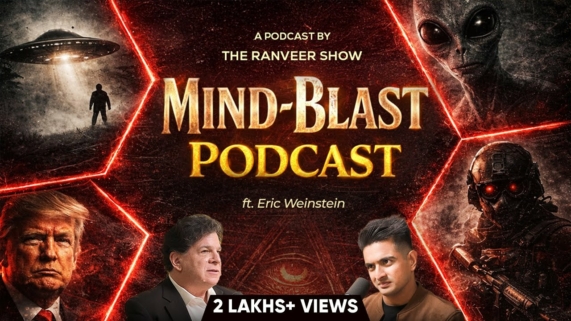
In this 459th episode of The Ranveer Show, Ranveer Allahbadia is joined by Dr. Eric Weinstein, a world-renowned mathematician and physicist. He shares deep insights on the existence of Aliens, the “Legacy Program,” Quantum Physics, the Deep State, and the future of Human Consciousness. This episode takes you into the hidden corners of science, government secrecy, and the mathematical fabric of our reality.
In this conversation with Eric Weinstein, we talk about the Mystery of UFOs, the Geometry of Waves, the “End of Physics” theory, and how AI is revolutionizing scientific discovery through tools like Alphafold.
This episode also covers the influence of Secret Societies, the role of figures like Elon Musk and Peter Thiel, the reality of Dark Matter and Dark Energy, the concept of “Times Travel” across multiple dimensions, and the secret history of anti-gravity research in the 1950s. We also discuss the significance of the Tata Institute of Fundamental Research (TIFR) in Mumbai and Eric’s unique perspective on the concept of God through the lens of mathematical degrees of freedom.
This podcast is a valuable resource for anyone interested in Theoretical Physics, Space Exploration, Geopolitics, Artificial Intelligence, Secret Government Programs, and the ultimate quest to understand the Universe.
Outline
(00:00) – Start of the episode
(03:09) – The Legacy Program: Recovered Alien Craft
(06:12) – Dr. Eric Weinstein on the Geometry of Waves
(10:07) – Are We at the “End of Physics”?
(12:41) – Dark Matter & The Mystery of Invisible Beings
(20:40) – How AI (Alphafold) Solved the Code of Life
(26:33) – Secrets of Peter Thiel & Jeffrey Epstein
(30:53) – Inside “Waved & Bigoted” Secret Programs
(36:55) – The Truth About the Deep State & Donald Trump
(45:03) – The Illuminati Rubric: Who Controls the Future?
(49:57) – Narrative Warfare: Why Podcasters are Targets
(56:13) – Global Repudiation: Trump, Modi, and Erdogan
(1:05:00) – Beyond Einstein: Pinch-to-Zoom the Universe
(1:11:30) – Elon Musk’s Secret Space Program: Grok AI
(1:22:18) – Is Elon Musk a Hero or a Supervillain?
(1:29:06) – 2026: The Nuclear Threat & Planetary Escape
(1:35:06) – The 1950s Secret Anti-Gravity Experiments
(1:41:47) – Is Mumbai the Birthplace of Quantum Gravity?
(1:47:11) – The North Sentinel Island Theory of Aliens
(1:52:48) – The Science of Time Travel (6 Dimensions)
(2:00:21) – Does God Exist? The 4 Degrees of Freedom
(2:08:12) – End of the episode
Transcript
00:00:00
Ranveer Allahbadia: Every time we do a geopolitics special, the Illuminati comes up
00:00:03
Eric Weinstein: You have no idea who’s in your phone, who’s in your laptop. The secret world is obviously there. I know the names of some secret societies that can’t be Googled. They exist.
00:00:14
Ranveer Allahbadia: Have you ever had an offer to join a secret society?
00:00:16
Eric Weinstein: Next question.
00:00:17
Ranveer Allahbadia: Ooh. Have you hung out with Elon Musk?
00:00:21
Eric Weinstein: Yeah.
00:00:21
Ranveer Allahbadia: Elon-
00:00:22
Eric Weinstein: Has a concern that none of the others had about multi-planetary survival. Clearly the most important problem is getting out of the solar system as fast as possible.
00:00:32
Ranveer Allahbadia: Why?
00:00:32
Eric Weinstein: Because we’re all gonna die here soon.
00:00:34
Ranveer Allahbadia: And you say that as a scientist?
00:00:36
Eric Weinstein: Yeah.
00:00:37
Ranveer Allahbadia: What are you up to?
00:00:38
Eric Weinstein: There’s only one thing I’m doing that changes everything, gravitational space time engineering.
00:00:43
Ranveer Allahbadia: A time machine?
00:00:44
Eric Weinstein: Yeah, because otherwise we’re trapped.
00:00:48
Ranveer Allahbadia: You think we’ll see a nuclear bomb explode in the next 10 years?
00:00:52
Eric Weinstein: You have no idea how much closer we got to that. And by the way, you guys have really good seats with your neighbors to the north.
00:00:59
Ranveer Allahbadia: Ooh.
00:01:01
Eric Weinstein: You’re in the middle of a narrative war and informational war. I think you have no idea how powerful you are. You’re the perfect target. So when the world turns on you, that’s a very powerful thing, and I’ve definitely seen coordinated attempts to destroy people.
00:01:17
Ranveer Allahbadia: But I wonder why target podcast hosts.
00:01:20
Eric Weinstein: Are you kidding me? I want you to think about how terrifying what you and I are doing right now actually is. You’ve lost control over your life. You just don’t know it yet.
00:01:33
Ranveer Allahbadia: Do you believe that aliens are present among us?
00:01:36
Eric Weinstein: There’s a crazy 1971 document which names American physicists who were supposedly working on UFOs that had been recovered and were real.
00:01:45
Ranveer Allahbadia: Oh, really?
00:01:46
Eric Weinstein: Yeah. This is a serious, serious place.
00:01:49
Ranveer Allahbadia: Because of what you’ve studied with respect to quantum theory, have you ever pondered upon the existence of God?
00:01:56
Eric Weinstein: Yeah.
00:01:56
Ranveer Allahbadia: So what do you think God is?
00:01:58
Eric Weinstein: If I gave you the answer, you wouldn’t be happy with it. [upbeat music]
00:02:23
Ranveer Allahbadia: Dr. Weinstein, I’m very, very pumped.
00:02:25
Eric Weinstein: Dr. Weinstein. Eric, please. Ranvir, I can’t believe I’m finally here, so this is, like, a huge thrill.
00:02:31
Ranveer Allahbadia: I’m just very happy to be sitting in front of you. Uh, I’m gonna have a lot of fun in this conversation, I know that, ’cause we’re gonna be speaking about aliens, but it’s with you. [laughs]
00:02:41
Eric Weinstein: I see. Not the H-1B kind.
00:02:43
Ranveer Allahbadia: Ah. No, no, no.
00:02:44
Eric Weinstein: All right. Very good.
00:02:45
Ranveer Allahbadia: Real aliens. We’ve, uh, spoken about this topic a lot on this podcast, and I think the podcast gets criticized a lot ’cause we keep bringing back aliens into these conversations.
00:02:56
Eric Weinstein: Now, criticized by Indians? Because I keep hearing that Indians don’t care about aliens because they only seem to land in the US.
00:03:03
Ranveer Allahbadia: [laughs] No, no, no.
00:03:04
Eric Weinstein: Okay.
00:03:05
Ranveer Allahbadia: I think, I think aliens are exploring the Himalayas as well.
00:03:07
Eric Weinstein: I, I would imagine, if they’re smart.
00:03:09
Ranveer Allahbadia: Yeah. I’ve had some military personnel on the show who haven’t denied having some secrets about UFOs.
00:03:16
Eric Weinstein: Oh, you’re kidding me.
00:03:17
Ranveer Allahbadia: Yeah. So-
00:03:18
Eric Weinstein: ‘Cause like the very… You, you know about the situation where the head guy in Israel in the, in the space program claims that we have a base on Mars.
00:03:26
Ranveer Allahbadia: You will have to enlighten us.
00:03:28
Eric Weinstein: Yeah. Well, this is something I got totally wrong. Uh, I thought that this was just a nonsense topic. I thought it was like Sasquatch or the Yeti, and it turns out I was massively wrong. Uh, this is some super serious weird real thing, and we’ve only been exploring it for a couple of years in the US. I assume you know about The New York Times article on this.
00:03:48
Ranveer Allahbadia: You’ll have to enlighten us.
00:03:50
Eric Weinstein: So The New York Times sort of, uh, broke the, the ice and allowed everyone to, to discuss aliens, when before it had been a forbidden topic. And, uh, what seems to be the case is that an enormous number of admirals and, uh, senators and, uh, and cabinet-level people believe that there’s a secret program called the Legacy Program that is focused, uh, on aliens, recovered craft, secret physics, and nobody can figure out [laughs] what’s going on because we don’t have any hard evidence that any of this is real, but it’s way too much circumstantial evidence to ignore.
00:04:33
Ranveer Allahbadia: Secret physics?
00:04:34
Eric Weinstein: Yeah.
00:04:35
Ranveer Allahbadia: Um, what are-
00:04:36
Eric Weinstein: Well, the-
00:04:36
Ranveer Allahbadia: Go on.
00:04:37
Eric Weinstein: Uh, look, I, uh, I don’t know if we’re, we’re drunk enough to have this conversation.
00:04:41
Ranveer Allahbadia: [laughs]
00:04:41
Eric Weinstein: Um-
00:04:42
Ranveer Allahbadia: Would you like a drink? [laughs]
00:04:44
Eric Weinstein: [laughs] You know, it’s funny. Uh, th- there’s this guy, uh, Joe Rogan, who’s seen as the, the Ranvir of America.
00:04:51
Ranveer Allahbadia: [laughs] Yeah?
00:04:52
Eric Weinstein: Um-
00:04:52
Ranveer Allahbadia: He’s my distant guru.
00:04:53
Eric Weinstein: Uh, yeah. [laughs] Well, he, uh, he and I have almost always dr- I think had a drink during the last hour of our conversation.
00:05:00
Ranveer Allahbadia: Ah.
00:05:00
Eric Weinstein: So let’s start slow.
00:05:01
Ranveer Allahbadia: Okay. Okay. Gotcha.
00:05:03
Eric Weinstein: There’s a crazy 1971 document out of the Australian Intelligence Service which details, um, all of these, and names names, because it wasn’t intended to be seen, uh, of American universities and American physicists who were supposed to be working, supposedly working on anti-gravity programs based on the idea that UFOs had been recovered and were real.
00:05:30
Ranveer Allahbadia: As in they’d extracted information from the parts of the UFOs they’d found?
00:05:33
Eric Weinstein: The way the document puts it, it says there’s no reason to suddenly put all this energy and our, our, some of our best people on an anti-gravity program or what was known as a gravity shielding program if there wasn’t some indication that there was something to do there, because general relativity, which is our theory of gravity, doesn’t support, um, thinking in these terms. It’s, it’s, it’s, it’s not beckoning us to put this kind of manpower. So the Australians figured out for the Americans to be putting this amount of energy into what was technically called the golden age of general relativity must mean that this is really a UFO program.
00:06:12
Ranveer Allahbadia: Hmm. I’d also love for you to very quickly, like, introduce yourself and what you’ve studied.
00:06:18
Eric Weinstein: Okay. So I’m a, a mathematician. Um, I was a postdoc at MIT, PhD from Harvard, and I specialized in the geometry that is underneath both general relativity and the model of quantum field theory that we call the standard model. So those are, are two basic un- un- models that give us an understanding of the world. And I studied the geometry, which was the language, um, in which these two theories were formulated.
00:06:48
Ranveer Allahbadia: Explain it to me like I’m five. [laughs]
00:06:53
Eric Weinstein: There is no explanation as if you’re five. You-
00:06:55
Ranveer Allahbadia: Oh, wow
00:06:55
Eric Weinstein: … you’re a wave. You know, you’re a wave in a medium.
00:06:59
Ranveer Allahbadia: Hmm.
00:06:59
Eric Weinstein: And if you think about, um, how different waves sound different, you know, depending on, let’s say, what instrument you have a wave on a string. So if it’s a violin versus a sarangi, you know, the bridge causes the string to vibrate in a way that, that ha- imparts a different sound. So under all circumstances, everything that you see in this room is not actually a solid object. It’s actually a wave, and the geometry of those waves determines what reality is. Okay, so we’re in India, we should talk about the tabla, uh, set with the tabla and the bayan. And when you move the heel of your hand on the bayan, I don’t know how to pronounce it exactly, you change the sorts of waves that can exist on the drum head. And so those different kinds of waves, under all circumstances, determine the particles that we sort of see and why, you know, we have different, uh, characters of the waves in my ice in, in the cup. So getting the geometry of these waves right unleashes power.
00:08:11
Ranveer Allahbadia: Hmm.
00:08:11
Eric Weinstein: Or if you think about the electromagnetic spectrum, uh, how is it that we can receive a picture, uh, of our cousin in Singapore on our phone? You know, it’s the electromagnetic vibrations in the same way that we can hear each other, um, through a different medium, which is the vibration of sound that reaches our ears. So understanding different media, different geometries, different vibrational patterns is the stuff of physics, and whoever can do that the best gets to unlock the powers of the universe. So it’s sort of a race to understand, um, how waves behave in media to see who wins.
00:08:49
Ranveer Allahbadia: Hmm. Okay. I’m trying to oversimplify everything you’re saying. Like, that’s where my muscle’s working. Uh-
00:08:56
Eric Weinstein: So let’s put it this way. Do you wanna visit the stars?
00:09:00
Ranveer Allahbadia: Yes.
00:09:01
Eric Weinstein: Okay. How are you gonna get out of here? No one knows.
00:09:05
Ranveer Allahbadia: Like a wormhole.
00:09:06
Eric Weinstein: Okay. [laughs] Well, exactly.
00:09:07
Ranveer Allahbadia: [laughs]
00:09:08
Eric Weinstein: It’s really, it’s really good. So, so for example, you know, if you imagine that the hole in my handle for this cup presents a wormhole connecting the top here to the bottom and a way to go from the bottom of the cup to the top, how do you do that in space time so that you can choose a destination from your telescope and go there? We don’t know that that’s possible, but if that is possible, you’d get there through geometry and physics.
00:09:35
Ranveer Allahbadia: Okay. Uh, let me get this straight, and I’ll link it to aliens, which is, like, the theme of this conversation.
00:09:40
Eric Weinstein: All right.
00:09:41
Ranveer Allahbadia: Uh, so the stuff you’ve studied contains, uh, the theory behind sci-fi concepts like wormholes-
00:09:50
Eric Weinstein: Exactly
00:09:50
Ranveer Allahbadia: … time travel-
00:09:51
Eric Weinstein: Exactly
00:09:52
Ranveer Allahbadia: … these kind of things?
00:09:53
Eric Weinstein: That’s it.
00:09:54
Ranveer Allahbadia: You’ve studied the theory of these?
00:09:55
Eric Weinstein: I’m trying to do the grown-up version, which is less fun, but if it ever works, hugely more important than the Star Trek, Star Wars version.
00:10:05
Ranveer Allahbadia: Hmm. Hmm. Uh, a lot of these ideas are currently not practical because of, uh, scientific and engineering limitation. But-
00:10:16
Eric Weinstein: Scientific is far more disturbing because you can engineer the hell out of a problem, but if science says you can’t go faster than the speed of light and the nearest star is four years a- light years away, you’re practically not gonna get there ever. So I’ve said, imagine that the universe is set up so that the solar system is an escape room, and we’re all going to die until some, unless somebody can figure out how to get out of here before the bombs go off.
00:10:44
Ranveer Allahbadia: Hmm.
00:10:44
Eric Weinstein: So no one knows how to get out. And what’s worse, Albert Einstein is sort of our jailer. He’s running the prison, and we can’t leave until we figure out how to defeat and trick the jailer. So that was what I was trying to do. I’m trying to jailbreak the universe so we don’t die here and we get to visit the stars.
00:11:02
Ranveer Allahbadia: Okay. Um, the next question’s a little elaborate, and it’s related to aliens.
00:11:07
Eric Weinstein: Perfect.
00:11:07
Ranveer Allahbadia: Hypothetically, if they’re even, like, 500 years older than us-
00:11:12
Eric Weinstein: Yeah
00:11:13
Ranveer Allahbadia: … it’s likely that they’re scientifically much more advanced than us.
00:11:17
Eric Weinstein: Hmm.
00:11:17
Ranveer Allahbadia: And if aliens do exist and they visit the Earth, then that means that they have cracked this wormhole problem that you have understood the theory of because of what you’ve studied.
00:11:28
Eric Weinstein: Okay.
00:11:29
Ranveer Allahbadia: Am I right in saying this?
00:11:30
Eric Weinstein: I’m gonna– Look, just to take issue and, and play some tennis back and forth.
00:11:34
Ranveer Allahbadia: Sure.
00:11:35
Eric Weinstein: What if the idea is that we have to play tic-tac-toe and one person is 500 years of tic-tac-toe theory ahead of the other one? It doesn’t matter. Once you can play perfect tic-tac-toe, it doesn’t matter how many hundreds of years somebody is in front of you. I think we’re almost at the end of physics. We’ve almost cracked the code.
00:11:56
Ranveer Allahbadia: Oh, really?
00:11:57
Eric Weinstein: Yeah. I think that this is much more like tic-tac-toe than it is like chess.
00:12:02
Ranveer Allahbadia: So you think human beings have almost reached the end of physics?
00:12:05
Eric Weinstein: Correct.
00:12:07
Ranveer Allahbadia: Wow.
00:12:07
Eric Weinstein: And, and people always make fun of that because people have always thought they were at the end, right? But at some point, the last landmass was found, so it was found off the north coast of Siberia- About 100 years ago. Nobody’s ever found a major land mass on Earth after that. Now, you could always say, “Oh, you think you found the last land mass on Earth.” No, no, we really did. It came to an end.
00:12:31
Ranveer Allahbadia: Hmm.
00:12:31
Eric Weinstein: Or checkers was solved as a puzzle. You can play, you can get a computer to play perfect checkers.
00:12:36
Ranveer Allahbadia: Hmm.
00:12:37
Eric Weinstein: I think we’re at the end of the rules of physical chess.
00:12:41
Ranveer Allahbadia: So what’s not discovered yet, or what’s not understood?
00:12:44
Eric Weinstein: Well, for example, there’s two things that we all sort of agree are out there called dark energy and dark matter. And we can detect, for example, that there are things that are sort of planet-like that don’t give off any light, but we can see that th- the objects behind them are sending light around them, and the light is distorted everywhere, even though we don’t see the object in the center. So th- this really freaked us out.
00:13:18
Ranveer Allahbadia: Okay. Uh, and these are out there in outer space?
00:13:21
Eric Weinstein: Yeah, like for example, imagine I started to see, uh, they’re in outer space. Imagine I started to see 13 different copies of Ranvir. That would be weird, because why should I get 13 copies of you? Well, it’s a lot like being in a hall of mirrors, where something is taking the light from you and spreading it and taking the same object and, and allowing the light to come to me in different ways.
00:13:49
Ranveer Allahbadia: What did you say? Dark matter and-
00:13:51
Eric Weinstein: Dark energy.
00:13:52
Ranveer Allahbadia: Dark energy.
00:13:53
Eric Weinstein: Yeah.
00:13:53
Ranveer Allahbadia: So these are two topics we’ve not understood in physics yet.
00:13:55
Eric Weinstein: Yeah.
00:13:56
Ranveer Allahbadia: Uh, and how big are these, uh, things that you said are like planets?
00:14:00
Eric Weinstein: Well, they- they’re, they’re huge.
00:14:02
Ranveer Allahbadia: They’re the size of planets?
00:14:03
Eric Weinstein: Oh my gosh. They’re the size of galaxies. They’re, they’re, they’re, they’re absolutely in- enormous clumps of matter.
00:14:10
Ranveer Allahbadia: We don’t know what they are.
00:14:11
Eric Weinstein: Right. Because they, they don’t have a, a… We can’t see them. They’re dark. They- they’re, they’re, they’re, they don’t scatter light.
00:14:20
Ranveer Allahbadia: Why is it important that we understand what they are?
00:14:24
Eric Weinstein: Because they make up most of our universe.
00:14:26
Ranveer Allahbadia: Oh.
00:14:27
Eric Weinstein: Like, we don’t know whether there are beings that are made out of dark matter.
00:14:32
Ranveer Allahbadia: Hmm. Hmm.
00:14:34
Eric Weinstein: Like, if there were a dark matter being in this room, yeah, I, I’m not doing a good job of telling you-
00:14:42
Ranveer Allahbadia: No, that’s-
00:14:42
Eric Weinstein: … just how crazy this is. Right now, it’s, it’s night here in Bombay, in, in Mumbai, yeah? And the sun is on the other side of the planet, and it’s sending a kind of almost dark matter called neutrinos screaming through planet Earth and penetrating your body. You’re being shot through with billions of neutrinos all the time, and the only reason, Ranvir, that you don’t die [laughs] is that the planet that’s failing to shield you, um, has the same characteristics as your body. So it’s not only passing through the planet, which should have shielded you, but it’s passing through your body and doing almost no damage. Once in a blue moon, one of these neutrinos interacts with your DNA and mutates you.
00:15:29
Ranveer Allahbadia: Hmm.
00:15:30
Eric Weinstein: But that’s an almost ki- that’s a kind of almost dark matter, nearly dark matter that we understand pretty well now. Not perfectly, it’s still kind of mysterious, but we only found it out, like, less than 100 years ago.
00:15:45
Ranveer Allahbadia: How did we find it out?
00:15:47
Eric Weinstein: It’s very interesting, because if you have, um, radioactive decay, you have, like, a neutron, and a neutron disintegrates at some point. It’ll just sit there, and then suddenly it’ll spontaneously turn into a proton and shoot out an electron. And there wasn’t enough energy in the proton together with the electron to represent the energy that was in the nu- neutron. So okay, things have to add up. It’s, it’s sort of like discovering that somebody is stealing money from you in your business.
00:16:21
Ranveer Allahbadia: Oh.
00:16:21
Eric Weinstein: There was a kind of a money going in, and then there was money going out, and there wasn’t enough money going out to match the money coming in, so somebody was skimming off the top.
00:16:30
Ranveer Allahbadia: Gotcha. So-
00:16:30
Eric Weinstein: And that turned out to be the, the neutrino, technically the anti-electron neutrino.
00:16:35
Ranveer Allahbadia: Okay. So a lot of mathematical equations that were explaining reality to us were indicating that a neutrino or this dark matter or-
00:16:44
Eric Weinstein: Something was carrying away energy and not telling us it was there.
00:16:48
Ranveer Allahbadia: Gotcha. Okay.
00:16:49
Eric Weinstein: Right? So it’s like, it’s like finding out that you’ve got a thief.
00:16:53
Ranveer Allahbadia: Gotcha. And nobody knows the exact nature of what this is, dark matter or-
00:16:56
Eric Weinstein: Well, we sort, we sort of know more and more, but we don’t know enough. So imagine you’re trying to discover the criminal organization, but you can’t just see it directly, so you, you discover it by its effects on the visible world. How does it distort the visible world? So there has to be s- you know, if you have a chore in your organization, you figure it out because you can’t account for some n- some number of, uh, of receipts, invoices in don’t mash- match invoices out.
00:17:29
Ranveer Allahbadia: I have to take you back to the occult a little bit.
00:17:32
Eric Weinstein: Please.
00:17:32
Ranveer Allahbadia: You said that, uh, maybe beings could be made of the same material.
00:17:38
Eric Weinstein: Yeah.
00:17:38
Ranveer Allahbadia: Like, living beings.
00:17:39
Eric Weinstein: Yeah.
00:17:41
Ranveer Allahbadia: Uh, over to you. What do you mean?
00:17:44
Eric Weinstein: Well, you, uh… Could these things form atoms? Not our kinds of atoms, because our kinds of atoms f- scatter light, so you can see them. Right? The only reason you and I can see each other is, is that you and I stop and reflect photons when they hit us. So maybe there are dark photons, there’s, like, dark light that falls on dark matter.
00:18:10
Ranveer Allahbadia: Hmm.
00:18:12
Eric Weinstein: Maybe there are dark planets. You, you have no idea what this stuff could be.
00:18:16
Ranveer Allahbadia: So within our universe, these objects and the, this- … uh, material-
00:18:24
Eric Weinstein: Yeah
00:18:24
Ranveer Allahbadia: … is hiding secrets in plain sight.
00:18:27
Eric Weinstein: And there’s more of it than there is of our stuff. Like, if you and I-
00:18:31
Ranveer Allahbadia: Right
00:18:31
Eric Weinstein: … are made of luminous matter, there’s more of the dark matter than there is the luminous matter. So we’re the minority. The dark stuff is the majority.
00:18:41
Ranveer Allahbadia: Do you think alien life would have figured out what the dark stuff is?
00:18:44
Eric Weinstein: I think we’re about to figure out what the dark stuff is.
00:18:47
Ranveer Allahbadia: When do you think we’ll figure it out?
00:18:49
Eric Weinstein: Any time.
00:18:51
Ranveer Allahbadia: Any time now?
00:18:52
Eric Weinstein: Look, man, I think that what is about to happen in general is so profound that none of us are ready for it. I think that we have led our lives in a very calm, very still, stagnant way, and we’ve confused the little ripples in the lake, uh, of our time, you know, the, the fluctuations in the economy, the minor border conflicts, all these sorts of things. We’ve called them wars. We’ve called these de- you know, depressions. No, no. The world is gonna get wildly chaotic, and it’s about to happen.
00:19:26
Ranveer Allahbadia: Why?
00:19:27
Eric Weinstein: Well, you can look at it. First of all, um, the AI is, uh, certainly probab- it’s, it’s the most profound thing that may have ever been invented. Not the version that we have, but what’s coming. The post-World War II era, um, had an order largely enforced by the United States, and the United States wanna get, wants to get out of the world policeman business under Donald Trump. So Donald Trump is probably the most consequential president of my lifetime.
00:19:59
Ranveer Allahbadia: Really?
00:19:59
Eric Weinstein: Um, yeah. The… You know, we have got m- multiple thermonuclear countries with very advanced scientific and engineering programs, so multipolar conflict is very different than two-player games, like the Soviet Union versus the US. Yeah. Think about the early 20th century with the level of craziness and its scientific advance and war and conflict and disease and opportunity. Now put that on steroids with modern toys. That’s what’s coming.
00:20:34
Ranveer Allahbadia: Is any good coming as well?
00:20:35
Eric Weinstein: Yeah.
00:20:36
Ranveer Allahbadia: Or-
00:20:36
Eric Weinstein: It’s gonna be a lot of fun
00:20:38
Ranveer Allahbadia: … scientific discovery?
00:20:39
Eric Weinstein: Oh my gosh.
00:20:40
Ranveer Allahbadia: What’s happening in the world of science right now because of the advancements in AI? Like, has AI helped further scientific discovery?
00:20:49
Eric Weinstein: Well, the big one is, is in protein. Uh, AlphaFold, uh, which is this program that… So proteins, we, we think about it like, “I need more protein in my diet-
00:21:00
Ranveer Allahbadia: Yeah
00:21:00
Eric Weinstein: … so I’m gonna order the chicken.”
00:21:01
Ranveer Allahbadia: Yeah.
00:21:02
Eric Weinstein: No. Protein is like tiny machines. So you imagine a Xerox, uh, photocopier. You imagine a pair of scissors. You imagine a zipper. All of these things are proteins. So they’re microscopic machines, and our DNA makes machines, so that’s sort of what life is. Life is all about you’re a library of plans for different tiny machines called proteins.
00:21:27
Ranveer Allahbadia: Hmm.
00:21:29
Eric Weinstein: We didn’t know how a piece of code would work when it was churned into a protein or a tiny machine. And I think the first great scientific advance was AlphaFold, to me, was AlphaFold, which was a, um, a program that figured out what, what machine, what the shape of a, a protein was likely to be just from the plans for the protein, which is tech- technically called its primary sequence.
00:22:04
Ranveer Allahbadia: Okay. I’ll have to rewind a little bit just to clear my concepts.
00:22:07
Eric Weinstein: Sure.
00:22:07
Ranveer Allahbadia: Uh, in, in India, when we’re taught about proteins for the first time in school, we’re taught that they’re the building blocks of life. Cells are the building blocks of life, and then proteins build up your body.
00:22:19
Eric Weinstein: Yeah, so what we, we, we would usually say is that there are four layers of life. Um, you would have anatomy, physiology, histology, and cytology. Histology would be tissue level. Cytology would be cell level. Then the cell has these, these sort of subunits like the Golgi apparatus, the nucleus, the mitochondria. But if you go into the nucleus or into the mitochondria, then you have this, this gorgeous nucleic acid, which is like the blueprints for making machines.
00:22:52
Ranveer Allahbadia: These are proteins?
00:22:53
Eric Weinstein: No, the proteins are… You translate that code that’s stored in the DNA or the RNA into machines made of amino acids using something called a ribosome. So a ribosome is a machine that reads code and builds strings of amino acids, and then when you allow those strings of amino acids to crumple up on themselves, they turn into a machine. And that was so mind-blowing that nobody knew how, what, what machine was going to result. Imagine you had a sequence of pearls. So you have 20 different kinds of pearls, and you put them on a string, and then you let go, and it becomes a Lamborghini, right? Or you let them go, and it becomes an electric guitar. So you’re looking at a string of pearls that is a string of amino acids, and you don’t know what it’s going to do when you let it go.
00:23:53
Ranveer Allahbadia: Is it like biological 3D printing?
00:23:56
Eric Weinstein: Yeah.
00:23:56
Ranveer Allahbadia: This is what you’re, the, what we’re getting towards.
00:23:59
Eric Weinstein: I love that. Yes. I wish I had thought of that.
00:24:02
Ranveer Allahbadia: You’re saying that we’ve understood more about this biological 3D printing that happens inside our own bodies?
00:24:07
Eric Weinstein: I’m saying our AI has started to figure this out, and it can’t explain it to us.
00:24:11
Ranveer Allahbadia: The AI has started to figure this out?
00:24:13
Eric Weinstein: That’s right.
00:24:13
Ranveer Allahbadia: But human scientists didn’t.
00:24:14
Eric Weinstein: We didn’t know how to do it. It’s so hard.
00:24:17
Ranveer Allahbadia: So w- what will this lead to for the average everyday human? How does it change my kids’ lives?
00:24:24
Eric Weinstein: Oh my God. You have kids?
00:24:25
Ranveer Allahbadia: No, I don’t.
00:24:25
Eric Weinstein: Aha.
00:24:26
Ranveer Allahbadia: But I will one day.
00:24:27
Eric Weinstein: Okay. God willing. [laughs]
00:24:30
Ranveer Allahbadia: [laughs]
00:24:31
Eric Weinstein: So w- what kind of drugs are we going to give them to protect them against, uh, viruses? Uh, how are we going to protect them against bacteria? Do you want your kids to be more intelligent than the, than the DNA in you, uh, would code for? Maybe you have an enemy that you want to destroy, and their cell has particular surface proteins on it, and you’ve got a map so you could release your own biological weapon. I mean, it’s just a tool that can do anything. Have you ever tried miraculin?
00:25:06
Ranveer Allahbadia: No.
00:25:07
Eric Weinstein: There’s a thing called the miracle berry, and if you eat it-
00:25:11
Ranveer Allahbadia: Sweet.
00:25:12
Eric Weinstein: Yeah.
00:25:12
Ranveer Allahbadia: Yeah. Gotcha. Like it turn– it makes every flavor sweet.
00:25:16
Eric Weinstein: Well, it makes sour things sweet. So it binds to the sweet receptors on your tongue, and then if you eat something sour like, I don’t know, vinegar or yogurt or a lemon, you can just eat a lemon like it’s candy.
00:25:29
Ranveer Allahbadia: Yeah, yeah.
00:25:30
Eric Weinstein: Well, this is about the miracle of proteins.
00:25:33
Ranveer Allahbadia: Hmm.
00:25:34
Eric Weinstein: Right? And so we, we call it flavor tripping as if it’s an LSD experience. But it’s just, it’s a harmless thing to do to your tongue. That thing could be engineered so that you could take any two– you could take any flavor that you like and turn it into another flavor.
00:25:52
Ranveer Allahbadia: So did human beings not understand this, uh, science of proteins completely because it’s too complex a science?
00:25:59
Eric Weinstein: It’s just too hard.
00:26:00
Ranveer Allahbadia: There’s too many factors.
00:26:01
Eric Weinstein: That’s right.
00:26:02
Ranveer Allahbadia: And AI was able to do it?
00:26:04
Eric Weinstein: Yeah, AI, and AI did it without understanding it.
00:26:07
Ranveer Allahbadia: And this happened recently?
00:26:09
Eric Weinstein: Yeah, within the last several years.
00:26:11
Ranveer Allahbadia: Gotcha. So and it’s going to lead us to a future where there’s a countless number of inventions because of this.
00:26:19
Eric Weinstein: Look, now we’re gonna get to the point where we can start inventing tiny nano machines to do anything.
00:26:27
Ranveer Allahbadia: How far are we from that?
00:26:28
Eric Weinstein: I don’t know, and it’s terrifying and wonderful.
00:26:31
Ranveer Allahbadia: In the next five years?
00:26:33
Eric Weinstein: Maybe. Maybe it’s happening now.
00:26:36
Ranveer Allahbadia: Nanobots.
00:26:37
Eric Weinstein: Right.
00:26:37
Ranveer Allahbadia: Right? Like for the sake of, uh, your body’s health, to collect data about your body.
00:26:43
Eric Weinstein: Or maybe there’s a, an evil genius, uh, holed up in a, in an island somewhere who’s going to kill us all. I don’t know.
00:26:50
Ranveer Allahbadia: Hmm.
00:26:51
Eric Weinstein: My point is, it’s just power.
00:26:54
Ranveer Allahbadia: Gotcha. You’re the MD for the Thiel Foundation, right?
00:26:58
Eric Weinstein: I am, uh, currently a consultant to it. I was.
00:27:01
Ranveer Allahbadia: You were?
00:27:02
Eric Weinstein: Yeah.
00:27:02
Ranveer Allahbadia: Okay. Uh, do you hang out-
00:27:04
Eric Weinstein: Peter, Peter’s a good friend.
00:27:05
Ranveer Allahbadia: Yeah, you hang out with Peter Thiel?
00:27:08
Eric Weinstein: He, he’s a good friend.
00:27:09
Ranveer Allahbadia: What do you guys talk about when y’all hang out?
00:27:10
Eric Weinstein: Oh my God. Well, here’s the thing I can say because I’m in India, and, uh, this will never get back to Peter. Peter is the most fun– I have laughed harder with Peter than with about anyone else, and nobody believes this-
00:27:23
Ranveer Allahbadia: Oh, really?
00:27:23
Eric Weinstein: … because they think of him as very cerebral and-
00:27:26
Ranveer Allahbadia: Yeah
00:27:27
Eric Weinstein: … but he’s just incredibly broad. Um, he’s a person that no one understands. They think of him as an arch capitalist, but he’s– He’ll, he’ll very often say, um, “Eric, I, I think the Marxist perspective is the correct one on this.”
00:27:45
Ranveer Allahbadia: [laughs]
00:27:45
Eric Weinstein: Just totally surprising h- as a human being.
00:27:48
Ranveer Allahbadia: Hmm.
00:27:48
Eric Weinstein: So he’s one of the smartest people I’ve ever encountered, and we can talk about almost anything.
00:27:53
Ranveer Allahbadia: Where does he spend most of his time?
00:27:55
Eric Weinstein: Depends what you mean. Sometimes it’s on science, sometimes it’s on religion, sometimes it’s markets.
00:27:59
Ranveer Allahbadia: Geographically, where does he spend?
00:28:00
Eric Weinstein: Los Angeles-
00:28:02
Ranveer Allahbadia: Okay
00:28:02
Eric Weinstein: … uh, London, Miami, places I won’t tell you about.
00:28:07
Ranveer Allahbadia: Fair.
00:28:08
Eric Weinstein: Yeah.
00:28:08
Ranveer Allahbadia: Uh, and do you guys ever have conversations like this about the near future? Do y’all ever talk about aliens? [laughs]
00:28:18
Eric Weinstein: Maybe.
00:28:20
Ranveer Allahbadia: Okay.
00:28:20
Eric Weinstein: I mean, all the time.
00:28:22
Ranveer Allahbadia: All the time?
00:28:23
Eric Weinstein: Well, anything that’s hot.
00:28:25
Ranveer Allahbadia: Hmm.
00:28:25
Eric Weinstein: Look, Pet- Peter’s got his finger on the pulse. What he wants to know is what’s gonna go now, what’s gonna go in five years, what’s gonna go in 25 years.
00:28:34
Ranveer Allahbadia: Hmm.
00:28:34
Eric Weinstein: Which c- which kernel of popcorn is ready to pop, and how far is each kernel? So he’s mapping at all different time scales.
00:28:41
Ranveer Allahbadia: How about you, Eric?
00:28:42
Eric Weinstein: Yes, sir.
00:28:43
Ranveer Allahbadia: Like, uh, you have so much data in your head. Like, I could have made this a geopolitical conversation. I could have made this entirely about science, yet I choose to talk about topics like aliens.
00:28:54
Eric Weinstein: Well, wherever you wanna go. How do you do this show, Rajveer?
00:28:58
Ranveer Allahbadia: I think that with people like yourself, the strangest questions about reality, questions related to the edges of reality, that’s what brings out the truth of that human being.
00:29:07
Eric Weinstein: Sure, but if, if I asked you, you know, “Can we talk about Bollywood?” you’d say, “Sure, let’s go.” Then if I asked you about travel, you’d tell me about your last several trips. If I asked you about dating in Ind- India, you’d talk about courtship. If I asked you about family, you’d talk about duty, uh, and history. You know, look, we’re all very broad, and we get famous for, i- if anything at all, one or two topics, and we’re stuck talking about that topic over and over again. So let’s go.
00:29:36
Ranveer Allahbadia: [laughs]
00:29:36
Eric Weinstein: Where do you wanna go, man? Anything.
00:29:38
Ranveer Allahbadia: How bored do you get when people ask you about Jeffrey Epstein?
00:29:41
Eric Weinstein: Depends. Do they have a new angle?
00:29:43
Ranveer Allahbadia: [laughs]
00:29:44
Eric Weinstein: Jeffrey Epstein’s just coming to India.
00:29:46
Ranveer Allahbadia: Ooh. Hmm.
00:29:49
Eric Weinstein: Right? And you’re gonna have all sorts of crazy things where everyone who’s important at a global level is going to end up attached to Jeffrey Epstein in one way or another because he was interacting with major institutions. He was interacting with the Trilateral Commission. He was interacting with the Council on Foreign Relations. He was acti- interacting with the US, the British royal fam, science. So anybody who’s interacting with all these organizations, everybody’s gonna show up in his email.
00:30:23
Ranveer Allahbadia: I feel like every time you’re on a podcast, the podcast host always preps this one question for you.
00:30:28
Eric Weinstein: Well, whatever. But you haven’t asked one yet.
00:30:31
Ranveer Allahbadia: I don’t wanna go there
00:30:32
Eric Weinstein: I love you.
00:30:33
Ranveer Allahbadia: [laughs] I mean, I’m so bored of, like, hearing about this topic from you when there’s so many other cool things to talk about.
00:30:39
Eric Weinstein: Well, that’s the thing. That’s the thing. We just don’t know what… Jeffrey F.C. is like dark matter, dark energy. Nobody knows what it is, and it’s just sitting there distorting everything around it. Let’s go somewhere else.
00:30:50
Ranveer Allahbadia: Okay. Uh, back to UFOs.
00:30:53
Eric Weinstein: Yeah.
00:30:53
Ranveer Allahbadia: That was the topic we planned for-
00:30:55
Eric Weinstein: Yeah
00:30:56
Ranveer Allahbadia: … when we were outside.
00:30:57
Eric Weinstein: Okay.
00:30:58
Ranveer Allahbadia: You said something about a New York Times article.
00:31:00
Eric Weinstein: Yeah.
00:31:00
Ranveer Allahbadia: What was the New York Times article?
00:31:01
Eric Weinstein: I think 2017, the New York Times has an article, and it, it indicates that there’s much more going on with UFOs, and I think it may have published three videos purported to be alien craft.
00:31:17
Ranveer Allahbadia: Hmm.
00:31:18
Eric Weinstein: The Go F- Go Fast, Gimbal, and I forget what the other one was. Tic Tac. So now there are all these videos. Nobody knows if they’re real, if they’re fake. You know, what’s going on? We can’t get straight answers. And, you know, I’m gonna just say very clearly, there’s an enormous USAP, which is a, an unacknowledged special access program that has to do with UFOs, and people seem to call it the Legacy Program.
00:31:50
Ranveer Allahbadia: I- it’s built by who?
00:31:52
Eric Weinstein: We don’t know.
00:31:53
Ranveer Allahbadia: It just exists.
00:31:54
Eric Weinstein: Well, that’s the thing. It’s an unacknowledged special access program. So a special access program is a secret program, an unacknowledged [laughs] p- This is gonna get really ridiculous.
00:32:06
Ranveer Allahbadia: That’s fine. Ridiculous conversations are-
00:32:09
Eric Weinstein: Let’s have them
00:32:10
Ranveer Allahbadia: … the most fun.
00:32:10
Eric Weinstein: Okay. So let’s talk about levels of secretness from a silly perspective.
00:32:16
Ranveer Allahbadia: From a silly perspective?
00:32:17
Eric Weinstein: Silly perspective.
00:32:17
Ranveer Allahbadia: Go on.
00:32:18
Eric Weinstein: All right. So you h- you ever hear this, this thing where somebody says, “That sounds like a conspiracy theory”?
00:32:23
Ranveer Allahbadia: Yeah.
00:32:23
Eric Weinstein: Okay. This shows you how ridiculous that is as a frame. First of all, we have something called a special access program, which is a conspiracy of some kind. It’s known to exist in the US. So please spare me the claim that, that you sound like a conspiracy, because we have a category for conspiracies called special access programs that you can look up. In that category, there’s a smaller category called unacknowledged special access programs, which are special access programs that are so secret that we won’t even let you know that they exist.
00:32:58
Ranveer Allahbadia: Hmm.
00:32:59
Eric Weinstein: It’s not that we’ll, w- that we have one and we won’t tell you what’s in it. We won’t even tell you that we have that one.
00:33:04
Ranveer Allahbadia: Hmm.
00:33:06
Eric Weinstein: Then there is waived special access pro- u- unacknowledged special access programs, which means that they don’t have to report, uh, except to a tiny group of people that the unacknowledged special access program even exists. And then we have a waived and bigoted unacknowledged special ac- So th- these are the levels of conspiracy that we know exist.
00:33:28
Ranveer Allahbadia: Where, where is all this information available?
00:33:31
Eric Weinstein: Uh, look up waived and bigoted unacknowledged special access programs, and you can find it because the category of conspiracies is not a conspiracy. You know, by presidential orders or law, this stuff is out in the open, the, the category.
00:33:48
Ranveer Allahbadia: The federal government-
00:33:49
Eric Weinstein: Yeah
00:33:49
Ranveer Allahbadia: … in the US releases-
00:33:50
Eric Weinstein: US federal government.
00:33:51
Ranveer Allahbadia: Gotcha.
00:33:51
Eric Weinstein: So looked up, look up USAP and waived and bigoted, where bigoted means that there’s a special list of people, and if you’re not on the list, you can’t even know a, a thing.
00:34:00
Ranveer Allahbadia: Like, could you give us a few examples of these?
00:34:02
Eric Weinstein: No. [laughs]
00:34:03
Ranveer Allahbadia: I mean, based on what was out there already.
00:34:06
Eric Weinstein: So, you know, in the middle 1970s, the, we found out that there were secret programs in the government that, for example, targeted Americans. So there was something called COINTELPRO, and COINTELPRO was a secret program that was discovered by a group of people who broke into the FBI’s office outside of Philadelphia in 1971 during the Super Bowl, and they stole some documents, and they had this word on the top of the documents that nobody knew, COINTELPRO. And so they asked, “Okay, well, what does this word mean?” And so th- these are thieves. They steal the documents, and the F- Freedom of Information Act forced the government to say it meant counterintelligence program, and it was a dirty tricks program where we tried to get Martin Luther King to kill himself.
00:35:01
Ranveer Allahbadia: Hmm. But how do you get someone to kill themselves?
00:35:04
Eric Weinstein: Well, you write to them and say, “You know, all of your philandering with, uh, with women is going to come out, and you’re gonna be disgraced as a man of the cloth.” Uh, we took a woman named Jean Seberg, who was a famous actress in Hollywood, and we made her life hell by accusing her… We planted a story in the Los Angeles Times. So just try to imagine this. The FBI of the United States plants a story with a wo- a journalist named Joyce Haber in the Los Angeles Times that one of Hollywood’s leading acts, uh, actresses is sleeping with a member of the Black Panthers militant African American group against the knowledge of her husband, and so she’s pregnant. She’s so stressed out from this. Like, you get disgraced in the world, and your life is turned upside down. And she miscarries her child, and then she keeps trying to kill herself every year on the anniversary of her child’s miscarriage, and finally succeeds just when the FBI is forced to reveal, “Yeah, we did that. We planted stories against our own citizens and drove them to madness and suicide.”
00:36:14
Ranveer Allahbadia: Hmm.
00:36:15
Eric Weinstein: S- so we found out all of this during hearings called the Church and Pike hearings in the mid-1970s, where we found out… Have you ever heard about the heart attack gun?
00:36:27
Ranveer Allahbadia: No.
00:36:27
Eric Weinstein: [laughs] We, we developed a gun where instead of a bullet, you’d shoot a tiny- … pin of a dart into somebody with some kind of poison that would induce them to have a heart attack, and I think that the little pin would dissolve. So, you know, we’ve been up to crazy things, and we know that we do these things, and we know which programs are allowed to do these things.
00:36:55
Ranveer Allahbadia: Y- you know, there’s two words that we use for all this in India.
00:36:58
Eric Weinstein: Tell me.
00:36:59
Ranveer Allahbadia: Deep state. Every time we do a geopolitics special in India, the deep state comes up, and the narrative is that, uh, a lot of the key decisions of the American government are decided upon by the deep state.
00:37:12
Eric Weinstein: Yeah. They are.
00:37:14
Ranveer Allahbadia: What is the deep state according to an American?
00:37:16
Eric Weinstein: Ah. Well, there’s two concepts. I mean, this is, this is good. There are two concepts of the deep state. One is the deep state is the permanent bureaucratic class, the people who don’t move during an election. So when, when there’s a new occupant of the White House, the deep state stays in its job. So these are people who basically are career federal employees. That’s the unsexy part of the deep state. The sexy part of the deep state is the massive structure that is not explained to the American public or to the world. And so these are all the three-letter agencies, the NSA, CIA, FBI, Geospatial Intelligence, Department of Homeland Security, all of the secret squirrel apparatus.
00:38:06
Ranveer Allahbadia: So an aspect of the deep state is the top-level bureaucracy in America?
00:38:10
Eric Weinstein: That’s one half of it.
00:38:11
Ranveer Allahbadia: Yeah. And there’s another part which is unexplained.
00:38:14
Eric Weinstein: Well, which doesn’t want to n- doesn’t wanna be known.
00:38:18
Ranveer Allahbadia: You know what we call that in India? The Illuminati.
00:38:20
Eric Weinstein: Ah. [laughs]
00:38:22
Ranveer Allahbadia: [laughs]
00:38:24
Eric Weinstein: Yeah. Well, we don’t know what it is. Nobody exactly knows what it is.
00:38:29
Ranveer Allahbadia: Who’s more powerful, the American president or the deep state collectively?
00:38:34
Eric Weinstein: You’re seeing that battle fought right now.
00:38:37
Ranveer Allahbadia: This is the first president who’s probably more powerful than the deep state?
00:38:40
Eric Weinstein: The way I read it is this is the first president who came from outside the system.
00:38:45
Ranveer Allahbadia: There’s a political system in America, and you have to climb the ranks in order to eventually become the president.
00:38:49
Eric Weinstein: There’s a secret political system in America.
00:38:51
Ranveer Allahbadia: A secret political system?
00:38:52
Eric Weinstein: Yeah. I mean, it’s a… You, you can figure out that it’s there. It’s not that hard. But we pretend that anybody can become president, and we have these primary elections, which aren’t really elections. They’re fake in a very strong sense.
00:39:08
Ranveer Allahbadia: You mean where the Democratic and the Republican candidate is decided?
00:39:11
Eric Weinstein: That’s right. But it’s really sort of decided by the party. It’s not decided by the election, but we pretend to have an election, and that’s how Donald Trump came through, is that they were pretending to hold a primary. But, um, look, Donald Trump is the first person to become president from, with no previous history in government or military. Full stop. We’ve never had somebody come in from outside, and since Millard Fillmore, we hadn’t, haven’t had anyone who was neither a Democrat nor, nor a Republican. So in other words, the system always has o- one candidate from each of two parties. That person always is a known quantity. The, the party really selects who the candidate will be in the general. In that way, uh, we have continuity, and Donald Trump is not continuous. He’s an anomaly. He’s the most unusual president and most unusual politician we’ve ever had.
00:40:14
Ranveer Allahbadia: You think he’s the kind of guy who doesn’t listen to the deep state?
00:40:17
Eric Weinstein: Oh, he better listen to the deep state, but he’s not necessarily gonna go along with it.
00:40:22
Ranveer Allahbadia: Hmm.
00:40:23
Eric Weinstein: I mean, you have to remember that there were two attempts that we know of on his life.
00:40:27
Ranveer Allahbadia: Hmm.
00:40:29
Eric Weinstein: And we don’t really understand… One of those is pretty… Uh, both of those are super suspicious in my opinion.
00:40:35
Ranveer Allahbadia: Hmm. Modern-day conspiracy theory.
00:40:38
Eric Weinstein: No.
00:40:39
Ranveer Allahbadia: Modern-day truth?
00:40:40
Eric Weinstein: No, we know something about this. What, what are the odds [laughs] one of the people who was trying to kill him was going to be, like, a construction worker wandering around Afghanistan looking for freedom fighters to send to Ukraine? Like, that’s not really a normal occupation, Ranvir. So I don’t know what’s going on with that.
00:41:05
Ranveer Allahbadia: Hmm. Gotcha. How do we reach the deep state? We reach the Illuminati.
00:41:10
Eric Weinstein: Yeah, sure. So who’s part of it?
00:41:13
Ranveer Allahbadia: Yeah.
00:41:14
Eric Weinstein: We don’t know who, who is in these secret… But I, I know that there are secret societies. So you have to realize that, you know, the Bohemian Grove was a secret society. Um, I know the names of some secret societies that can’t be Googled. Um, so they exist.
00:41:35
Ranveer Allahbadia: Have you ever had an offer to join a secret society?
00:41:38
Eric Weinstein: Next question.
00:41:40
Ranveer Allahbadia: Ooh. Okay.
00:41:43
Eric Weinstein: How, how do you think Israel pulled off this pager attack on Hezbollah, right? So clearly, you know, there are entire fake organizations, uh, providing, you know, support for [laughs] cell phones and walkie-talkies and, and things like this. So d- d- do you know who’s written all of the software in your phone? Do you know whose control it’s under?
00:42:08
Ranveer Allahbadia: Hmm.
00:42:10
Eric Weinstein: When you have a laptop, is there a plastic shutter over the camera lens?
00:42:16
Ranveer Allahbadia: [laughs]
00:42:17
Eric Weinstein: The little light that tells you whether it’s on or off, is that hardwired so that you know when it’s on or off, or can that be deactivated by software? You have no idea who’s in your phone, who’s in your laptop. You don’t know probably who’s sniffing packets on your network at the office. Look, the, the secret world is obviously there, and getting people to constantly feel embarrassed about wondering about it is fascinating.
00:42:54
Ranveer Allahbadia: I’m trying to think of a shepherd.
00:42:57
Eric Weinstein: Yeah.
00:42:57
Ranveer Allahbadia: A shepherd, you know, uh, makes sheeps go in the direction that he wishes.
00:43:02
Eric Weinstein: Hmm.
00:43:03
Ranveer Allahbadia: So if we compare the secret society members to shepherds-
00:43:07
Eric Weinstein: Yeah
00:43:08
Ranveer Allahbadia: … where are they trying to take human society?
00:43:11
Eric Weinstein: Well, for example, they tried to take Europe towards a United States of Europe in order to stop war in the European theater after World War II.
00:43:21
Ranveer Allahbadia: The EU.
00:43:23
Eric Weinstein: Yeah. The EU was a very light political config- uh, confederation, but the more important confederation was the euro. That was a hard cur- you know, that was a real currency. So we allowed the s- the states of the EU, and those using the euro, to issue their own debt, but we wouldn’t allow them to print their own currency. That meant we allowed them to get into trouble, but we didn’t give them the means of getting out of it if they-
00:43:51
Ranveer Allahbadia: Mm
00:43:51
Eric Weinstein: … got into trouble.
00:43:52
Ranveer Allahbadia: Hmm.
00:43:52
Eric Weinstein: And the hope was that we were gonna force them against their will into a political union called the United States of Europe.
00:44:00
Ranveer Allahbadia: Hmm. Taking… Keeping in mind that shepherd example again-
00:44:05
Eric Weinstein: Mm-hmm
00:44:06
Ranveer Allahbadia: … what’s the underlying will of the shepherd in this case? Like, what do these secret societies want?
00:44:12
Eric Weinstein: Good things and bad things. One thing they want is that they don’t like certain kinds of war.
00:44:19
Ranveer Allahbadia: They don’t like certain kinds of war.
00:44:21
Eric Weinstein: Right.
00:44:22
Ranveer Allahbadia: For example?
00:44:23
Eric Weinstein: Well, s- so we’re sitting here in Bombay. If there was a, a shooting war in which Bombay, New York, London, Berlin, Moscow, and Peking were all involved with hypersonic missiles raining it down on, you know, some with thermonuclear weapons, some with biological weapons, that’s bad for everybody. But they like some wars. They like wars that are far away where they don’t get hurt, where they know that you’re going to have a certain probability of something happening because they can sell into that.
00:44:58
Ranveer Allahbadia: There’s money to be made off certain kinds of war.
00:45:00
Eric Weinstein: If you know that something is going to happen, right, there’s always money to be made in rebuilding a place. So [chuckles] you know, anytime there’s a conflict, the question is, “Well, we need to get together a multilateral, uh, organization to rebuild X,” or, “We have to get arms to the, the freedom fighters that, that we support.” All of these things are knowable events. So j- j- here’s, here’s a simple rubric: If some group can know the future before it happens, they can always make money knowing that, and if they can make the future, then they always know the future, then they can always make money.
00:45:42
Ranveer Allahbadia: Hmm.
00:45:43
Eric Weinstein: So that’s the simplest rubric. If you wanna figure out, is there an Illuminati, which is a terrible term for a serious concept, it’s the people who know the future because they’re making the future so they can profit on the future.
00:45:59
Ranveer Allahbadia: Hmm. Do you think there are occult elements associated with the Illuminati?
00:46:05
Eric Weinstein: [laughs] Of course.
00:46:07
Ranveer Allahbadia: There are?
00:46:08
Eric Weinstein: Yeah. I mean, these rituals, in part, um… What is the purpose of ritual? To bond people together. So for example, if you and I go hunting together, and we do something a little bit over the line, like we take down some big game with, with enormous rifles, we’ll feel bonded to each other. We took life together, you know? Or if, for example, we hold some unbelievably over-the-top party like Burning Man, right? Burning Man’s a wonderful example of something which is basically the occult.
00:46:51
Ranveer Allahbadia: Really?
00:46:52
Eric Weinstein: Yeah, it’s a visual orgy. You’ve never been?
00:46:54
Ranveer Allahbadia: No.
00:46:55
Eric Weinstein: Oh, man. You should come.
00:46:56
Ranveer Allahbadia: Hmm.
00:46:56
Eric Weinstein: I’ve been once.
00:46:57
Ranveer Allahbadia: Hmm.
00:47:00
Eric Weinstein: But you’ve, you’ve never seen anything like it. So, you know, in part just, uh, understanding that, yeah, th- there are always going to be bacchanals and Dionysian feasts, and these things, you know, are always gonna then have a sort of edgy, rel- pseudo-religious cult-like feature to them.
00:47:26
Ranveer Allahbadia: So this particular group which is in charge of the world right now-
00:47:29
Eric Weinstein: [laughs]
00:47:30
Ranveer Allahbadia: What’s-
00:47:30
Eric Weinstein: Don’t say it like that, ’cause there are multiple groups.
00:47:33
Ranveer Allahbadia: Th- some of the most powerful of these groups.
00:47:35
Eric Weinstein: Right.
00:47:36
Ranveer Allahbadia: How long do you think they’ve been around?
00:47:38
Eric Weinstein: Different… I mean, I know one that’s been around, I think, since the ’50s.
00:47:43
Ranveer Allahbadia: Okay.
00:47:43
Eric Weinstein: So I can say what its founding is, you know?
00:47:47
Ranveer Allahbadia: Are there any that have been around for, like, hundreds of years?
00:47:50
Eric Weinstein: Undoubtedly.
00:47:51
Ranveer Allahbadia: Thousands?
00:47:53
Eric Weinstein: We don’t know.
00:47:54
Ranveer Allahbadia: Okay.
00:47:56
Eric Weinstein: I mean, look, the, the Catholic Church has been around for a very long time. You can look at all of its different offshoots. Um, you know, there, there are the, the lay societies, there are the priestly orders, the monastic orders. So the Catholic Church is a, is an excellent example of something that we know has been there for a very long time.
00:48:16
Ranveer Allahbadia: Hmm. These powerful groups today, do they decide who becomes famous and who becomes rich?
00:48:22
Eric Weinstein: Sometimes. Some, somewhat.
00:48:24
Ranveer Allahbadia: In some cases.
00:48:25
Eric Weinstein: Yeah.
00:48:25
Ranveer Allahbadia: Which musicians get quick success.
00:48:28
Eric Weinstein: I should ask you, Ranveer-
00:48:29
Ranveer Allahbadia: Sure
00:48:29
Eric Weinstein: … you seem to be, like, the biggest of the podcasters.
00:48:31
Ranveer Allahbadia: [laughs]
00:48:33
Eric Weinstein: Were you organic?
00:48:34
Ranveer Allahbadia: Yes.
00:48:35
Eric Weinstein: How do, how do we know?
00:48:37
Ranveer Allahbadia: Uh-
00:48:37
Eric Weinstein: How do we know that there wasn’t a secret meeting in Hyderabad-
00:48:41
Ranveer Allahbadia: [laughs]
00:48:41
Eric Weinstein: … that decided to put you on top of-
00:48:43
Ranveer Allahbadia: I wish
00:48:44
Eric Weinstein: … of the YouTube pile?
00:48:45
Ranveer Allahbadia: I feel like the Illuminati may not be as active in India, because I’ve never had an offer to join a secret society.
00:48:50
Eric Weinstein: Really?
00:48:51
Ranveer Allahbadia: Yeah.
00:48:51
Eric Weinstein: But, but wouldn’t… I- if you were a member of a secret society, wouldn’t you say exactly that?
00:48:57
Ranveer Allahbadia: I would
00:48:58
Eric Weinstein: Yes
00:48:58
Ranveer Allahbadia: … but I’m also super vulnerable with my audience, so
00:49:01
Eric Weinstein: But wouldn’t that be like you’re, you’re this clean, fresh-faced guy?
00:49:04
Ranveer Allahbadia: [laughs] I’m the ideal candidate.
00:49:07
Eric Weinstein: Yeah. Right? So in other words, what I’m drawing you into is it’s a no-win situation. If you deny that you’re part of it, then clearly you’re part of it, because that’s what you would say.
00:49:18
Ranveer Allahbadia: Hmm.
00:49:20
Eric Weinstein: So I’m trying to be responsible and, and hit a middle road. Yes, these societies exist. They may be less powerful than you’d think.
00:49:28
Ranveer Allahbadia: Okay.
00:49:28
Eric Weinstein: I don’t think that there’s one. They’ve been around for different lengths of time. Sometimes they have a fearsome reputation, they can’t actually do anything. Um, sometimes you’ve never heard of them and they’re incredibly powerful.
00:49:43
Ranveer Allahbadia: You know, this is one of the most nuanced explanations of the Illuminati that I’ve heard. I love this topic.
00:49:49
Eric Weinstein: Well, because we know it’s out there, and it’s not one thing.
00:49:56
Ranveer Allahbadia: Do you think they like Joe Rogan?
00:49:58
Eric Weinstein: That’s a really good question. I would say you’ve seen suddenly… Look, one of the things that’s fascinating is that the world will suddenly turn on an individual.
00:50:11
Ranveer Allahbadia: Yes.
00:50:11
Eric Weinstein: I’ve had this happen. So I have a hate community that follows me around. And everything I do, all they do is say, “My God, this is the worst person on Earth. Why does anyone listen to him?” Right? Is that organic? Is it partially organic? I don’t know. They seem to have a lot of time on their hands, and they’re very, very motivated. So Joe has been canceled multiple times, and it’s just never worked. Um, so when the world turns on you, that’s a very powerful thing, and I’ve definitely seen coordinated attempts to destroy people. I don’t know if you know about JournoList.
00:50:49
Ranveer Allahbadia: I don’t know, but I feel like it happened to me this year, so [laughs]
00:50:51
Eric Weinstein: What?
00:50:52
Ranveer Allahbadia: I feel like this is exactly what happened this year. It was a coordinated situation.
00:50:55
Eric Weinstein: Yeah. So th- this is the thing, is that you do something wrong and then the, the response is totally exaggerated.
00:51:03
Ranveer Allahbadia: That’s what I feel.
00:51:04
Eric Weinstein: Yeah.
00:51:05
Ranveer Allahbadia: Yes.
00:51:05
Eric Weinstein: So I’ve been through that.
00:51:07
Ranveer Allahbadia: Hmm.
00:51:07
Eric Weinstein: Right? And-
00:51:08
Ranveer Allahbadia: And we’re not the first or the last people to go through this
00:51:10
Eric Weinstein: … and you, you… you’ll go through it multiple times.
00:51:13
Ranveer Allahbadia: Hmm.
00:51:14
Eric Weinstein: You’ll, you’ll come to understand that you cannot control that you are a character in other people’s stories.
00:51:22
Ranveer Allahbadia: But I wonder why target podcast hosts.
00:51:26
Eric Weinstein: Are you kidding me?
00:51:28
Ranveer Allahbadia: ‘Cause they shape opinion?
00:51:30
Eric Weinstein: I want you to think about how terrifying what you and I are doing right now actually is. We’re having a conversation somewhere in Bombay where nobody can control what it is that we’re saying, and when you hit send, it gets published on a channel. Your YouTube channel is over 10 million. Wouldn’t you think that would be scary to anybody trying to direct a story? I think you have no idea how powerful you are, Ranveer. Yeah, you’re, you’re, you’re, you’re the perfect target. Joe is the perfect target. Everybody who gets to this position. Yeah, none of these people have figured out just how powerful they are. As soon as you start trying to tell a story that is different from an official story or different from one of these groups that… I don’t love using the word Illuminati, but you’ve chosen it. Yeah, suddenly your life will go wrong.
00:52:30
Ranveer Allahbadia: You know, when you play, like, a video game, there’s side quests, but then there’s also main quests.
00:52:34
Eric Weinstein: Okay.
00:52:35
Ranveer Allahbadia: Sometimes I feel like some of the main quest for key members of these secret societies are related to the world of geopolitics.
00:52:41
Eric Weinstein: Yeah.
00:52:41
Ranveer Allahbadia: Because effectively, there’s a lot of money to be made from global conflict because of everything you explained. Uh, and I also feel that to specifically answer that question about why Joe Rogan is targeted or why I got targeted this year, I personally feel it’s because I went a little too deep into the world of geopolitics.
00:53:01
Eric Weinstein: I think that’s probably true, and the longer you stay in this thing, the more times you will be canceled.
00:53:07
Ranveer Allahbadia: Hmm. It’s a bullet you need to be willing to bite.
00:53:13
Eric Weinstein: You’ve lost control over your life. You just don’t know it yet. But you also have a measure of control that they don’t control yet. So right now, this is a… [laughs] You’re in the middle of a narrative war, an informational war.
00:53:28
Ranveer Allahbadia: Hmm.
00:53:29
Eric Weinstein: And you’re a leading player, and mostly, to be entirely honest, you’re not bothering anybody.
00:53:36
Ranveer Allahbadia: How does one bother the world order?
00:53:40
Eric Weinstein: Well, there’s an old quote, very beautiful. I think the guy’s name is French theorist, maybe Renan, which is, “A nation is d- defined to be a group of people who have agreed to forget something in common.”
00:53:55
Ranveer Allahbadia: Ah. Wow.
00:53:59
Eric Weinstein: So what has India agreed to forget?
00:54:03
Ranveer Allahbadia: [sucks teeth]
00:54:05
Eric Weinstein: Right? So when, when, when Gandhi chose Hindi, he forgot the South, right? So all… You travel in Tamil Nadu or Kerala, and those people [laughs] say, “I don’t really know Hindi.” They could learn it. They don’t want to. Maybe the idea is that we for- we chose to forget Hindustan because the Hindu nature of India was not part of the sort of plan, uh, in the late ’40s. It was supposed to be a secular, multicultural society whi- with… which didn’t have a Hindu substrate. So these are, like, the dangerous things that you could start talking about. You could start talking about communalism. You could start talking about language. You could start talking about inequality, um, corruption You could start talking about the fact that very powerful people are suddenly targeted and their names turned to mud-
00:55:06
Ranveer Allahbadia: Hmm
00:55:06
Eric Weinstein: … overnight, and you could get really interested in how the press works. Yeah. I mean, look, if you, if you [chuckles] wanna cause trouble in India, let me know. I’ll tell you how to do it.
00:55:17
Ranveer Allahbadia: [laughs]
00:55:17
Eric Weinstein: But I’m gonna get myself the heck out of the country before you start.
00:55:21
Ranveer Allahbadia: I meant causing trouble on a global level.
00:55:23
Eric Weinstein: Yeah, well, but India’s a, a, a much more powerful player on a global level than she likes to admit.
00:55:29
Ranveer Allahbadia: Hmm.
00:55:30
Eric Weinstein: If you wanna do it on a global level, then the first thing you have to do is you have to connect to UK podcasts, US podcasts. What are the podcasts in our network? Like, I mean, look, it, it’s a little bit odd that I’m doing this podcast and doing… I’ve done five Indian podcasts. Uh, it’s crazy that we aren’t more networked, and it’s dangerous that we aren’t more networked. We need to know each other. This is our first time, the first day that you and I have met.
00:56:01
Ranveer Allahbadia: Hmm.
00:56:01
Eric Weinstein: I mean, we, we’ve, we’ve interacted before, but, you know, my feeling is, is that you essentially live in an ecosystem that my friends are unaware of.
00:56:11
Ranveer Allahbadia: Hmm. Good to, good to hear an opinion from another part of this Earth.
00:56:17
Eric Weinstein: Okay.
00:56:17
Ranveer Allahbadia: ‘Cause we hear a lot of opinions by Indian people about the Illuminati, about the deep state. Um, love hearing about, you know, something like Trump from an American. Uh, and then Trump from a very objective third-person lens. I think people get very passionate when they speak about Trump nowadays. American citizens. Everyone’s, like, very divided on their opinion about him.
00:56:40
Eric Weinstein: I find it very strange how people treat this, by the way.
00:56:43
Ranveer Allahbadia: The, the Trump conversation?
00:56:45
Eric Weinstein: Yeah. I mean… So, I’ll… Let me throw something to you and, and tell me what you think of this theory.
00:56:50
Ranveer Allahbadia: Yeah, sure.
00:56:52
Eric Weinstein: I think that we were dominated in many ways by mid-20th century idealisms in many of the major countries. So the US idealism was built around the New Deal and something called the Great Society, programs of Lyndon Johnson in the 1960s. Turkish society was built around Atatürk’s theory of the secular Muslim state that is the successor to the Ottoman Empire. India was built around Nehru and Gandhi and this kind of secular, uh, country that, uh, we were just discussing. Israel was built around David Ben-Gurion and the Labor Party and this sort of narrative of, uh, a people f- for a land with a, uh, and a land, a land without a people. And somehow all of these narratives are being repudiated at the same moment. Modi is, in some sense, a repudiation of the founding idealisms in, in, in the late ’40s. Uh, Erdoğan is the same thing to Atatürk. Trump is undoing the sort of Great Society idealism of Johnson. I think that this is a global phenomena. We’re all experiencing it locally. So we’re getting angry at Trump for the same reason that we’re getting angry at Erdoğan, for the same reason we’re getting angry at Modi.
00:58:17
Ranveer Allahbadia: Hmm.
00:58:17
Eric Weinstein: And we’re not noticing that it’s happening globally.
00:58:21
Ranveer Allahbadia: Hmm.
00:58:22
Eric Weinstein: What do you think?
00:58:23
Ranveer Allahbadia: There’s a shepherd making the sheep move in a certain direction.
00:58:27
Eric Weinstein: Or that it’s organic and emergent. Maybe the idea is that all of those idealisms were overreach.
00:58:33
Ranveer Allahbadia: But then why is it happening at the same time?
00:58:35
Eric Weinstein: Because of the phone.
00:58:37
Ranveer Allahbadia: Ideas are traveling.
00:58:38
Eric Weinstein: Yeah, it’s like the, somebody invented the printing press on steroids.
00:58:42
Ranveer Allahbadia: Hmm.
00:58:43
Eric Weinstein: And worse, the podcast revolution. I mean, the reason I got involved with this in part was I just couldn’t believe that this technology was allowed to exist. It’s a nightmare.
00:58:55
Ranveer Allahbadia: So do you think that these groups like Joe Rogan?
00:58:58
Eric Weinstein: [sighs] I think that they’ve established an uneasy balance with Joe.
00:59:04
Ranveer Allahbadia: They know he’s gonna do his thing, but they’re frustrated, yet they can’t do much.
00:59:09
Eric Weinstein: Well, let’s put it this way. Have you ever seen a story where somebody gets shot with a bullet and they don’t take the bullet out?
00:59:16
Ranveer Allahbadia: Hmm.
00:59:16
Eric Weinstein: ‘Cause it’s too dangerous to take the bullet out.
00:59:19
Ranveer Allahbadia: Yeah.
00:59:19
Eric Weinstein: Right? And so the bullet becomes encapsulated, and it’s just, it’s better just to leave it where it is lodged. Maybe they wouldn’t let Joe Rogan become Joe Rogan now, but to remove him? Then, uh, are you gonna get Theo Von, you know, filling that slot? Are you gonna get Tim Dillon? You know? So in a weird way, I, I have this feeling that they’re not thrilled about Joe Rogan, but they know that what would replace Joe Rogan might be much, much more dangerous.
00:59:50
Ranveer Allahbadia: Hmm. Hmm.
00:59:53
Eric Weinstein: And by the way, when you get canceled-
00:59:55
Ranveer Allahbadia: [laughs]
00:59:56
Eric Weinstein: … you’ll notice that you find yourself changing.
00:59:59
Ranveer Allahbadia: Yeah.
01:00:00
Eric Weinstein: You’ll start to self-censor.
01:00:02
Ranveer Allahbadia: Yeah.
01:00:03
Eric Weinstein: And you’ll say things like, “I’ll try to do better.”
01:00:05
Ranveer Allahbadia: Hmm.
01:00:07
Eric Weinstein: And in part, they teach you, and they train you. So you have to think about, “Well, okay, well what did I actually do that was wrong, and what am I being induced to do because I’m, I’m being piled onto?” You know, look, one of the reasons that I wanted to do this podcast changed. I originally wanted to do this podcast because, uh, it was the, India’s counterpart. Somehow the Indian market for ideas is underexplored. You have a huge number of people who are very good at English, um, over here, and we don’t treat I- India as an Anglophone country. And, you know, there you are up at the top, so immediately I, I checked you out. But when you got canceled, I got super excited to do the podcast-
01:00:56
Ranveer Allahbadia: [laughs]
01:00:57
Eric Weinstein: … because, you know, it was a brain fart, uh, you know, or, or shit testing, as the kids say.
01:01:04
Ranveer Allahbadia: [laughs]
01:01:04
Eric Weinstein: That, you know, suddenly, okay- It looked bad, uh, you know, s- sort of a thing that you thought of in your brain, you say it, and then you realize after the fact that was a mistake. But then the exaggerated immune response, um, I have this thing about standing up for people in trouble, and-
01:01:24
Ranveer Allahbadia: Thank you
01:01:24
Eric Weinstein: … I was super excited to do the show as a result.
01:01:27
Ranveer Allahbadia: [laughs] Thank you, Eric. Thank you. To go back to the start of the episode-
01:01:31
Eric Weinstein: Mm-hmm
01:01:32
Ranveer Allahbadia: … we were basically talking about the nature of reality.
01:01:34
Eric Weinstein: Mm.
01:01:35
Ranveer Allahbadia: Right? And then we’ve mentioned it a few times with the dark matter and, uh, a bunch of other things, proteins, et cetera.
01:01:43
Eric Weinstein: Yeah.
01:01:43
Ranveer Allahbadia: Um, this question’s gonna piss off so many people who, uh, hate-watch this show.
01:01:49
Eric Weinstein: Okay.
01:01:49
Ranveer Allahbadia: But that’s why I love the question even more.
01:01:51
Eric Weinstein: All right.
01:01:53
Ranveer Allahbadia: Do you think ghosts exist?
01:01:54
Eric Weinstein: Do I think ghosts exist? No.
01:01:56
Ranveer Allahbadia: No.
01:01:57
Eric Weinstein: But if they do exist, they would be made out of dark matter for sure.
01:02:00
Ranveer Allahbadia: I’d love to hear more. I’d love to hear more about both these tangents.
01:02:04
Eric Weinstein: Okay. So in terms of ghosts, my feeling about this is that we have needs, and you have to be honest about what your needs are. L- life isn’t enough. We want more. So we want there to be ghosts, and we want there to be, like, a secret world of dinosaurs under the surface.
01:02:21
Ranveer Allahbadia: [laughs]
01:02:21
Eric Weinstein: And we want there to be portals to other dimensions, and we wanna be able to call up Krishna and, and ask for advice, and all sorts of stuff. And just wanting those things isn’t enough to make them real, and that’s one of the lessons of science. So it’s not like I don’t wanna play. It’s that I don’t want to mess up my only opportunity for true magic. And the true magic is the stuff that you, allows you to make something that nobody’s ever made before or understand something that nobody’s ever understood before.
01:02:51
Ranveer Allahbadia: Mm.
01:02:51
Eric Weinstein: You know? And so I don’t believe in ghosts because I, I think that that’s a, that’s a desire.
01:02:58
Ranveer Allahbadia: But do you think that if they do some kind of scientific research where they’re able to prove it, you might shift that belief?
01:03:05
Eric Weinstein: I believe there are all sorts of ways I could construct things about life that would be inconceivable.
01:03:15
Ranveer Allahbadia: Hmm.
01:03:15
Eric Weinstein: Like dark matter life, that’s an inconceivable concept, but it’s possible. There are these claims about remote viewers that sound like total nonsense, that somebody’s, you know, taken on a submarine to the bottom of the sea where light can’t penetrate, and they, they get a vision of something else. Now, your phone is a remote viewing instrument. If you, if you were in the 1700s and you were communicating by FaceTime with Australia, it would be a miracle. There would be no explanation for it other than, okay, he has magical powers. So science is always magic before it’s understood. So I definitely believe in some sense that there are, there are things that we should be able to do. Okay, I think we can… Forget about ghosts. Here’s something I really believe. I believe we can reach the stars, and I believe that it’s possible quickly.
01:04:16
Ranveer Allahbadia: We can reach-
01:04:16
Eric Weinstein: Nobody, nobody agrees with me on this
01:04:17
Ranveer Allahbadia: … distant star systems?
01:04:19
Eric Weinstein: Yes. I am hopeful. I, I can’t prove it, but my work has been to ask the question, is it possible that maybe this is much easier than we’re making it out to be?
01:04:33
Ranveer Allahbadia: Really?
01:04:34
Eric Weinstein: Yeah.
01:04:34
Ranveer Allahbadia: Is this related to wormholes? Like, is your solution related to wormholes?
01:04:38
Eric Weinstein: Uh, no. In a certain sense, it’s the repudiation of wormholes. It’s saying wormholes is a concept of Einstein, and so all of our dreams have been sort of crushed by Einstein because he has this incredible theory that tells us what we can’t do. If we can go beyond Einstein, then we can talk about what we can do. So the metaphor that I like to, to, to use is pinch to zoom. So if you think about it, if, uh, if you have a surface like a, an iPad and you do this, the picture suddenly changes scale. Now, before, I don’t know, 2002, 2003, nobody’d ever done that before. So you, whatever image was on your, your television screen, you couldn’t do anything with it. What if nature has pinch to zoom in it? And if you wanna go to a distant star, what you should first do is do a motion like this and shrink the apparent distance. Then you do a couple of swipes, and then you expand it out.
01:05:47
Ranveer Allahbadia: Reality can be bent that way?
01:05:49
Eric Weinstein: That’s what my research is in part about, which is showing that there are these extra degrees of freedom, and that it may be that we don’t live in space time at all, so we don’t need wormholes, that we might have access to pinch to zoom-
01:06:04
Ranveer Allahbadia: So-
01:06:04
Eric Weinstein: … and we just don’t know it.
01:06:05
Ranveer Allahbadia: If we don’t live in space time, what do we live in?
01:06:08
Eric Weinstein: We live in something called the oberverse, is my claim.
01:06:12
Ranveer Allahbadia: Okay.
01:06:12
Eric Weinstein: So that’s my, my entrance in the horse race to go beyond Einstein is c- is called the oberverse.
01:06:20
Ranveer Allahbadia: So you think that we’d be able to build a device that would be able to pinch-
01:06:23
Eric Weinstein: That’s my hope.
01:06:24
Ranveer Allahbadia: But how do you build a device that big? Or do you even need a big device?
01:06:28
Eric Weinstein: Well, see, the problem with all the cool things that we wanna do in Einstein’s theory of relativity is it requires too much energy.
01:06:34
Ranveer Allahbadia: Hmm. To be able to travel that fast.
01:06:37
Eric Weinstein: Well, when you got up because you wanted to change the batteries, how did you do that?
01:06:44
Ranveer Allahbadia: Used the energy I gained from food and sunlight.
01:06:46
Eric Weinstein: Yeah, but what was pulling on the other side? So there’s everything that Ranveer has eaten, and the sunlight, and then there’s an entire planet going in the opposite direction trying to keep you in that chair, and you won. Doesn’t make sense. That’s so weak.
01:07:02
Ranveer Allahbadia: Hmm.
01:07:03
Eric Weinstein: So that means that in order to, to do something, in order to bend space and time, if you b- believe you live in an Einsteinian universe, you need more energy than you can possibly imagine, because an entire planet’s worth of energy isn’t enough.
01:07:17
Ranveer Allahbadia: Hmm. Hmm.
01:07:18
Eric Weinstein: So this is the idea that maybe we don’t need anything remotely like that. Maybe we can do things- That are cheap
01:07:27
Ranveer Allahbadia: For example?
01:07:28
Eric Weinstein: Pinch to zoom. That maybe if, w- I don’t know what the cost of pinch to zoom is, but imagine that in a new theory it’s energetically cheap to change the rulers by which we measure the distance to the stars.
01:07:43
Ranveer Allahbadia: Okay, I have a silly question which might actually help with the understanding of these answers.
01:07:47
Eric Weinstein: Please.
01:07:48
Ranveer Allahbadia: You know when someone says that they study mathematics-
01:07:51
Eric Weinstein: Yeah
01:07:51
Ranveer Allahbadia: … I’ve always questioned what they study specifically.
01:07:53
Eric Weinstein: Okay.
01:07:54
Ranveer Allahbadia: Like, what does the study of mathematics entail, and does it lead you to a better understanding of the universe? Because they say that math is the language of the universe.
01:08:04
Eric Weinstein: Yes, it does lead to a much better understanding of the universe.
01:08:08
Ranveer Allahbadia: That’s the ev- end goal?
01:08:09
Eric Weinstein: Yeah. But it’s not even the universe of physical things, it’s the universe of what is logically possible.
01:08:16
Ranveer Allahbadia: Gotcha.
01:08:17
Eric Weinstein: So it’s like our universe and every other universe you could possibly build.
01:08:22
Ranveer Allahbadia: Um, whenever I’ve hosted spiritualists on the show-
01:08:26
Eric Weinstein: Okay
01:08:26
Ranveer Allahbadia: … they use the term higher dimensions.
01:08:28
Eric Weinstein: Yes.
01:08:29
Ranveer Allahbadia: Okay? Now, we’re living in 3D right now. Is the fourth dimension time?
01:08:35
Eric Weinstein: No.
01:08:36
Ranveer Allahbadia: What’s the fourth dimension?
01:08:38
Eric Weinstein: So let’s think about your tongue, since we’re doing this in India. Flavor is very important to us.
01:08:44
Ranveer Allahbadia: Mm.
01:08:44
Eric Weinstein: Now, the famous receptors on your tongue are sweet, salty, sour, and bitter.
01:08:49
Ranveer Allahbadia: Mm.
01:08:51
Eric Weinstein: But you also have a pain receptor, and you have a temperature receptor. So you started off with, let’s say, three dimensions of sweet, salty, and sour. The fourth dimension wasn’t time, it was bitter. The fifth dimension was pain. The sixth dimension was heat. So dimensions are just degrees of freedom. If I have an electric guitar and I have treble, mid, bass, reverb, volume, that’s five dimensions, you know? So you have to understand that to a mathematician, yes, there’s a paradigm in which there are three spatial dimensions and one temporal dimension, and that’s how we build up spacetime. But there isn’t a, the fourth dimension.
01:09:43
Ranveer Allahbadia: Mm. So you can’t…
01:09:47
Eric Weinstein: Well, I’ve given you two examples where the dimensions… Ranveer, you’ve been very sweet, worried about my delicate Gora tongue, right?
01:09:56
Ranveer Allahbadia: [laughs]
01:09:57
Eric Weinstein: And so the thing is that you keep talking about, “Can you take the spice?”
01:10:01
Ranveer Allahbadia: Mm.
01:10:02
Eric Weinstein: So, you know, how do we measure that? We measure that on the Scoville s- scale. That’s a dimension.
01:10:08
Ranveer Allahbadia: Gotcha.
01:10:09
Eric Weinstein: Do you, do you enjoy, you know, Punjabi sweets? Well, that’s a question of how sweet, the intensity of the sweetness. These are measured on different dimensions. So it doesn’t, we don’t have to name the dimensions. We, we have access to them and in one problem you’re trying to set the sound levels, in another problem you’re trying to set the taste levels, and in another you’re trying to set the navigation system for, uh, interstellar travel.
01:10:36
Ranveer Allahbadia: Mm. Okay. This obserververse problem-
01:10:40
Eric Weinstein: Yeah
01:10:41
Ranveer Allahbadia: … is this your main concern in life right now?
01:10:43
Eric Weinstein: Sort of.
01:10:44
Ranveer Allahbadia: What are you up to?
01:10:45
Eric Weinstein: [laughs] None of your business. No, no, I’m just kidding.
01:10:49
Ranveer Allahbadia: [laughs]
01:10:49
Eric Weinstein: Um, this is the most important thing that I do.
01:10:54
Ranveer Allahbadia: Most of your time goes into this?
01:10:56
Eric Weinstein: No, but it is the most im- Look, w- this is all fun. I’m having a great time. The world is in deep trouble. I’d like to help it, you know?
01:11:06
Ranveer Allahbadia: Okay.
01:11:06
Eric Weinstein: That, that’s true. But there’s only one thing I’m doing that changes everything, and whether that’s true or that’s false has yet to be adjudicated. But I am up to one thing that really, really matters, that makes everything else insignificant by comparison, and that’s the obserververse, and that’s geometric unity, that’s this theory. Because otherwise we’re trapped here.
01:11:30
Ranveer Allahbadia: So what do you hope for it in the next 10 years, this piece of work?
01:11:34
Eric Weinstein: I hope that it will be seriously examined and found to be correct, and that humanity will work together to try to figure out how to colonize the cosmos. That’s really what I’m up to.
01:11:47
Ranveer Allahbadia: Have you hung out with Elon Musk?
01:11:49
Eric Weinstein: Uh, no. We interact via messages.
01:11:55
Ranveer Allahbadia: Okay.
01:11:55
Eric Weinstein: Elon is very mysterious in a way that some- somehow nobody seems to notice. One of his slogans is Ad Astra, to the stars, right? But you can’t get to the stars using SpaceX because it’s a chemical rocket company. So what the heck? He’s not investing in physics. He was gonna go into a physics grad school. I think he has a physics BA. So there’s something very, very strange about Elon, which is that he’s focused on getting to the stars. He doesn’t seem to have any interest in physicists, and he has a chemical rocket company. What’s going on? His real space company, I think, is not SpaceX. It’s, it’s xAI. It’s Grok.
01:12:43
Ranveer Allahbadia: Wow. Uh, let’s break this down a little more.
01:12:47
Eric Weinstein: Sure. Look at the logo for Grok. I think it’s, like, a black hole profile. Look at its slogan, “To understand the universe.” I think he’s given up on the corruption of science. He keeps talking about the fact that he doesn’t like the term researcher. He believes only in engineers. He’s constantly really running down scientists. Now, I don’t think he doesn’t believe in scientists. I think he thinks that science has gotten corrupted, and he doesn’t wanna deal with it. And I think what he’s doing is he’s building Grok to do science in a time when humans are too corrupt to be r- to be truthful and real
01:13:31
Ranveer Allahbadia: Could you share some thought bubbles related to the corruption of science?
01:13:35
Eric Weinstein: No.
01:13:35
Ranveer Allahbadia: Okay.
01:13:35
Eric Weinstein: Not right now.
01:13:36
Ranveer Allahbadia: You might get into trouble?
01:13:37
Eric Weinstein: No, no, no, it’s not that. It’s just you wanna talk about something inspiring.
01:13:42
Ranveer Allahbadia: Okay. But the world of science is basically corrupt for whatever reason.
01:13:46
Eric Weinstein: In part.
01:13:47
Ranveer Allahbadia: So the research that should be happening for the benefit of humanity may not be happening to its best degree.
01:13:53
Eric Weinstein: Look, a lot of science is not corrupt at all. It’s just fine.
01:13:57
Ranveer Allahbadia: Okay.
01:13:58
Eric Weinstein: But the science that will inspire you, that will change your life, that will– that changes everything is pretty corrupt-
01:14:09
Ranveer Allahbadia: Okay
01:14:09
Eric Weinstein: … because it’s power.
01:14:11
Ranveer Allahbadia: Hmm.
01:14:11
Eric Weinstein: You see, w- you’ve had, I think, three science projects in, roughly speaking, your time change everything. First one is 2009 with Bitcoin, where the Bitcoin whitepaper creates a currency where none– nothing like it has ever existed. Amazing. Distributed computing is born. The blockchain-
01:14:34
Ranveer Allahbadia: Hmm
01:14:35
Eric Weinstein: … uh, comes out of nowhere. Then there’s this proposal, I think called diffuse, that says, you know, we could put a furin cleavage site in spike protein in, in, uh, coronavirus. And whatever that is, if that came from a lab, then it shut down planet Earth for two years. Killed millions.
01:14:58
Ranveer Allahbadia: Hmm.
01:14:59
Eric Weinstein: The third one is that in 2017, there was a paper called “Attention Is All You Need,” and that is the paper that gave rise to the AI revolution. That’s what it’s like to live through a revolution. Do you have AI on your phone?
01:15:18
Ranveer Allahbadia: Yeah.
01:15:18
Eric Weinstein: Do you deal with like, I don’t know, ChatGPT and voice?
01:15:22
Ranveer Allahbadia: Yeah.
01:15:23
Eric Weinstein: It’s crazy. You know, you, you say, “Hey, write me a limerick.” And then you say, “No, actually, I want you to do it in Telugu.” Then you say, you know, “I, I want you to compare, uh, some Mexican dish to some, uh, dish from Thailand.” We’ve never had anything that can do this.
01:15:43
Ranveer Allahbadia: Hmm.
01:15:44
Eric Weinstein: This is a miracle that happened in our time together. What if we started having all sorts of miracles like that? Then you’d live in a transcendent world, which was a lot like the 20th century.
01:15:57
Ranveer Allahbadia: So this job which was assigned to scientists will now be assigned to artificial general intelligence-
01:16:02
Eric Weinstein: That’s-
01:16:03
Ranveer Allahbadia: … or artificial super intelligence.
01:16:03
Eric Weinstein: I don’t even think it requires artificial general intelligence or super intelligence. It’s already pretty good. This thing I said about Alpha, AlphaFold, if it’s that good already, you don’t know what’s gonna come. You don’t– You, you may be waiting for it to become like a human, but maybe it doesn’t need to be.
01:16:22
Ranveer Allahbadia: So I don’t think this is an Elon conspiracy theory conversation going on here.
01:16:27
Eric Weinstein: Yeah.
01:16:27
Ranveer Allahbadia: But effectively, if you’re saying that Grok is doing the job that scientists were supposed to do for Elon Musk, could there be a version of Grok that he’s using, which is being trained on all the usage of Grok globally, but this version is only accessible to Elon and his core team, and then they’re using that to forward science for the sake of all their businesses?
01:16:49
Eric Weinstein: Almost certainly, he has a private version of Grok that you and I don’t have.
01:16:54
Ranveer Allahbadia: Gotcha.
01:16:56
Eric Weinstein: I mean, if you go to Grok and you ask it to do– uh, to take a photo and turn it into… Well, you can ask it from a prompt to create a photo, and then if you ask to animate that photo, it gives you spicy mode, right? And then sometimes it will say, “Sorry, w- we can’t show you the video you created because the AI moderator says that it’s, it’s too spicy.”
01:17:24
Ranveer Allahbadia: Hmm.
01:17:26
Eric Weinstein: I don’t think Elon has that toggle switch set for him.
01:17:29
Ranveer Allahbadia: Hmm. Hmm.
01:17:30
Eric Weinstein: That just sh- That’s a proof that he has a, a private version, and I know that some of the other AI companies have private versions because in part, sometimes they’ll return racist answers.
01:17:41
Ranveer Allahbadia: Hmm. Hmm.
01:17:43
Eric Weinstein: Right? And so the, the researchers have to have a jailbroken copy that’s different from the public released one, and that’s why Gemini got into trouble because it kept lying in order to be politically correct.
01:17:55
Ranveer Allahbadia: Hmm. Uh, you know, there’s a rumor that Elon’s gonna announce flying cars soon. Have you heard of this?
01:18:02
Eric Weinstein: I couldn’t care less.
01:18:03
Ranveer Allahbadia: You couldn’t care about flying cars?
01:18:05
Eric Weinstein: No.
01:18:06
Ranveer Allahbadia: Why?
01:18:07
Eric Weinstein: Because I think what Elon’s… Look, I have c- crazier beliefs than this. I believe that maybe Grok already knows stuff.
01:18:17
Ranveer Allahbadia: About?
01:18:18
Eric Weinstein: The universe.
01:18:20
Ranveer Allahbadia: That could– stuff that could help science?
01:18:24
Eric Weinstein: I think it’s possible that Grok already has a fairly complete picture.
01:18:31
Ranveer Allahbadia: Grok is the equivalent of God?
01:18:35
Eric Weinstein: No. No, no, no. Look, the rules of science are just the rules. Like, you can know all the rules of chess, and you’re not necessarily going to be the world’s best chess player. There’s a difference between knowing the rules, being able to play with the rules, and having the wisdom not to blow yourself up doing… I, I can teach you enough about chemistry that we could blow all those fingers off of your hands right down to your wrist, you know?
01:19:08
Ranveer Allahbadia: Hmm.
01:19:10
Eric Weinstein: You have to be really careful with knowledge.
01:19:13
Ranveer Allahbadia: Hmm.
01:19:14
Eric Weinstein: And my feeling is, is that… See, here, here’s the thing that nobody wants to talk about. Grok can read the trash. So you can say, c- c– read all the published books that are out there. Okay. Well, what about all the books that didn’t get published? It can read those too It can read everything that you throw out. What if the answer is not in the libraries? What if it’s in the waste basket?
01:19:46
Ranveer Allahbadia: When you’re saying Grok, you also mean the other competitors, right? ChatGPT-
01:19:50
Eric Weinstein: Yeah, but I-
01:19:50
Ranveer Allahbadia: … Gemini
01:19:51
Eric Weinstein: … I really believe Elon is different. Elon, I believe, has a concern that none of the others had. All the other ones read what is done and try to guess the completion of a sentence based on what other people think. What happens when everyone’s wrong?
01:20:10
Ranveer Allahbadia: Hmm.
01:20:13
Eric Weinstein: Then you don’t want it to guess the completion of the sentence based on what every-
01:20:17
Ranveer Allahbadia: Grok works differently?
01:20:19
Eric Weinstein: Elon is very fo- One of the interactions I’ve had with Elon, and I don’t wanna say too much, is that Elon cares about not being trapped by groupthink. That’s different. Elon knows that he doesn’t want Grok to be politically correct. That’s why he makes Grok capable of producing pornographic images and video.
01:20:45
Ranveer Allahbadia: Hmm.
01:20:46
Eric Weinstein: He doesn’t want it to be safe. He wants it to be able to tell a dirty joke.
01:20:51
Ranveer Allahbadia: Hmm.
01:20:52
Eric Weinstein: So you remember Elon, uh, being asked about, “Well, what happens if you lose your advertisers?” What did he say? “Gfy.” Elon believes that freedom pays a dividend, and Elon believes that everyone can be wrong and he can be right, and that’s why I think he doesn’t trust science, and he uses SpaceX to make money and to inspire people to want to colonize different worlds, and it’s a giant head fake at the same time. I think Grok is the space program.
01:21:29
Ranveer Allahbadia: Hmm.
01:21:31
Eric Weinstein: And so every time I try to talk to him, I say, “Look, man, you know, you’re this rich. You care about physics, clearly. You care about the light of human consciousness not going out. Why don’t you throw some, some loose change and buy a physicist, put them in a, an institute, and do great physics where these people can afford not to listen to their colleagues if, if groupthink is the problem?” And he won’t answer. And I think I didn’t understand why he wouldn’t answer. It’s not like he doesn’t understand the problem. He doesn’t wanna get involved in a political conflict about science. He’s gonna go around the scientists.
01:22:14
Ranveer Allahbadia: Hmm. [chuckles] He’s the one human being that’s actually capable of being a super villain. I hope he doesn’t become one. I don’t think he’ll become a super villain.
01:22:28
Eric Weinstein: I could be wrong about who he is. I don’t know him, really.
01:22:32
Ranveer Allahbadia: Fair.
01:22:33
Eric Weinstein: But I think he’s the only adult.
01:22:36
Ranveer Allahbadia: The only adult-
01:22:37
Eric Weinstein: Yeah
01:22:38
Ranveer Allahbadia: … in the world?
01:22:39
Eric Weinstein: Yeah.
01:22:41
Ranveer Allahbadia: ‘Cause he’s got this one superpower called Grok, which is an un-
01:22:44
Eric Weinstein: No, no, no, no, he’s the only one who’s trying to take care of everyone.
01:22:48
Ranveer Allahbadia: Oh, okay. He’s thinking about-
01:22:51
Eric Weinstein: He’s dad.
01:22:52
Ranveer Allahbadia: He’s thinking about the future.
01:22:52
Eric Weinstein: He’s a badly behaved dad.
01:22:55
Ranveer Allahbadia: [chuckles] That’s an interesting one.
01:22:58
Eric Weinstein: Yeah, uh, I could make a decent… Look, I think he lies about some stuff. I think he’s wrong about stuff. But I think he’s the only person who’s actually planning for our… Y- you wanna know why I think everything’s screwed up? Because we lost our indefinite human future. If you think about, like, in India and tradition and the idea that everyone is just a link in a chain and you’ve gotta do your duty, you know, as per the Mahabharata, right? We don’t believe that anymore. We don’t think that… We, we, we intuit that this thing is not gonna go on for that long. So why don’t we get tattooed? Why don’t we just live together before marriage? Why do we have to have children? All of these questions come from the idea that we don’t have a future.
01:23:48
Ranveer Allahbadia: Hmm.
01:23:48
Eric Weinstein: And Elon is trying to force our future back into our lives.
01:23:53
Ranveer Allahbadia: You think we subconsciously-
01:23:54
Eric Weinstein: Yeah
01:23:54
Ranveer Allahbadia: … are going towards dystopia, and this is the one human being that’s saying, “No, no, hold on.”
01:23:58
Eric Weinstein: Yeah.
01:23:58
Ranveer Allahbadia: This is how the human race survives.
01:24:00
Eric Weinstein: Yeah, and partially, exactly.
01:24:02
Ranveer Allahbadia: Hmm.
01:24:02
Eric Weinstein: Including the fact that he just doesn’t wanna be focused on problems all day long. Like, let’s have fun.
01:24:10
Ranveer Allahbadia: Hmm.
01:24:10
Eric Weinstein: Let’s get excited.
01:24:12
Ranveer Allahbadia: So hypothetically, if he has the secret version of Grok, what’s he doing with it right now, according to you? He’s trying… Because it effectively becomes like a really– You’ve seen, uh, Dracula and Igor?
01:24:25
Eric Weinstein: Yeah.
01:24:26
Ranveer Allahbadia: So this becomes like a really smart Igor that helps Dracula, which is Elon Musk.
01:24:30
Eric Weinstein: Okay. My theory of Elon is he’s told you exactly what he’s doing, and no one is really listening. His whole thing is, “I’m going to build a bunch of companies. I’m not gonna do nonprofits because it needs to be self-sustaining, and I don’t have enough money to do it as nonprofits.” In their early stages, they’re gonna do some relatively boring thing in a cool way. But the ultimate aim is m- multiplanetary survival well beyond Mars. The only part of it that’s really a lie is Mars.
01:25:03
Ranveer Allahbadia: You think they wanna inhabit other planets?
01:25:06
Eric Weinstein: That– For sure. The Moon and Mars are possible with chemical rockets, but they’re the only two spheres that are.
01:25:13
Ranveer Allahbadia: Okay. So to get to the other planets, you need higher levels of science.
01:25:16
Eric Weinstein: That’s… Exactly.
01:25:18
Ranveer Allahbadia: Hmm.
01:25:18
Eric Weinstein: In other words, engineering can get you to the Moon and to, and to Mars. It can also get you to Titan and Venus, but you’re not gonna live there. But these robots are gonna be the things that are going to build the structure. So the Optimus robot is gonna be what he sends to do work in an h- inhospitable environment
01:25:40
Ranveer Allahbadia: I’ve had this theory since I was a kid. Um, we obviously see a lot of garbage in the oceans or beaches or whatever.
01:25:47
Eric Weinstein: Sure.
01:25:47
Ranveer Allahbadia: I always thought that science would reach a point where robotics gets advanced enough for the robots to do this garbage cleaning for us.
01:25:54
Eric Weinstein: Sure.
01:25:54
Ranveer Allahbadia: And I think we’re almost there. We’re like five, 10 years away maybe.
01:25:57
Eric Weinstein: I don’t know. But, you know, Jim Tour would be a good person to talk to. Come to, come to Texas.
01:26:02
Ranveer Allahbadia: Okay.
01:26:02
Eric Weinstein: He does nano machines. You know, maybe the robots are gonna be tiny. You’re, you’re not gonna be able to see them with the naked eye because microplastics.
01:26:11
Ranveer Allahbadia: Yeah. I mean, the, the larger conversation like that’s going on in my head here is that AI is advancing in the way that we all know. Robotics is advancing. Robotic butlers seem to be a nearby possibility now. Uh, I think robotic butlers are the metaphor for a much larger revolution that’s gonna happen.
01:26:30
Eric Weinstein: Imagine microscopic airborne micro butlers.
01:26:34
Ranveer Allahbadia: [laughs]
01:26:34
Eric Weinstein: No, I’m not kidding. Like-
01:26:35
Ranveer Allahbadia: Like things just float and your c- your coffee cup just floats and arrives in front of you.
01:26:40
Eric Weinstein: Maybe you breathe them and it cleans out your lungs.
01:26:43
Ranveer Allahbadia: Mm.
01:26:43
Eric Weinstein: I mean, you ever seen these old, um, ideas for a washing machine, which it like it’s got a suction cup, cup and a plate-
01:26:51
Ranveer Allahbadia: Yeah, yeah
01:26:51
Eric Weinstein: … and it goes around like this-
01:26:52
Ranveer Allahbadia: Yeah
01:26:52
Eric Weinstein: … with an arm?
01:26:53
Ranveer Allahbadia: Yeah, yeah.
01:26:53
Eric Weinstein: It’s nothing like what a washing machine is. Our notion of a robot is r- ridiculously like us.
01:26:59
Ranveer Allahbadia: Mm, mm.
01:27:00
Eric Weinstein: I think when we think robots, we don’t think protein level machines.
01:27:04
Ranveer Allahbadia: Mm, gotcha. They could be biological. They could be really tiny. That’s … God-
01:27:09
Eric Weinstein: Waterborne, airborne. They, they could be virtual.
01:27:13
Ranveer Allahbadia: Small like tangent away from this. This is why I wanna be in America and I wanna run my show in America because people who are at the cutting edge of these things are sitting in America.
01:27:22
Eric Weinstein: Sure, and this is in part why I wanna come to India.
01:27:25
Ranveer Allahbadia: Why?
01:27:26
Eric Weinstein: Because nobody has fully tapped what’s here.
01:27:30
Ranveer Allahbadia: You think the subject experts are here as well?
01:27:32
Eric Weinstein: No. I think that the brains are here, but that they’re so focused on the wrong things. Y- y- you know, it’s a little bit like tapped oil fields versus fresh oil fields.
01:27:43
Ranveer Allahbadia: Mm.
01:27:44
Eric Weinstein: So in the US, most resources get tapped, and in India you’re sitting on vast quantities of-
01:27:52
Ranveer Allahbadia: Intellectual
01:27:52
Eric Weinstein: … of, yeah, of neurons.
01:27:54
Ranveer Allahbadia: Mm, yeah. This-
01:27:55
Eric Weinstein: And India c- India can’t get out of its own way, so the idea is like there’s much more oil and gold under the, under the ground metaphorically in India. So I, I think a lot about unlocking India.
01:28:08
Ranveer Allahbadia: Uh, I love what you said about how he’s probably using that cowboy version of Grok to build out the scientific future of humankind to fuel his personal dream, which is interplanetary travel beyond just Mars and the moon.
01:28:25
Eric Weinstein: It should be everyone’s. He’s– I think he’s totally mystified why he’s the only person on this kick.
01:28:31
Ranveer Allahbadia: What other locations in our solar system-
01:28:34
Eric Weinstein: They’re not in our solar system.
01:28:36
Ranveer Allahbadia: Okay. Gotcha.
01:28:38
Eric Weinstein: This is why pinch to zoom-
01:28:40
Ranveer Allahbadia: Mm
01:28:40
Eric Weinstein: … the observer science. He and I have two different ideas how to go about it. I am in a race with Elon Musk, and I’m happy if either one of us win. I don’t really care.
01:28:53
Ranveer Allahbadia: Mm.
01:28:53
Eric Weinstein: But I don’t know of anyone else who’s, who cares about this topic. So to me… Okay, I’ll say something crazy.
01:29:00
Ranveer Allahbadia: Yeah.
01:29:00
Eric Weinstein: Clearly, the most important problem on planet Earth is getting out of the solar system as fast as possible.
01:29:06
Ranveer Allahbadia: Why is it the most important problem?
01:29:07
Eric Weinstein: Because we’re all gonna die here soon, and I don’t want it to be depressing.
01:29:12
Ranveer Allahbadia: How soon?
01:29:13
Eric Weinstein: Pretty soon.
01:29:14
Ranveer Allahbadia: Because of what?
01:29:15
Eric Weinstein: Because we developed thermonuclear weapons in November of 1952, and we haven’t used them yet against each other, and the order that keeps those things from being used just broke down in January of 2025 with Donald Trump’s repudiation of the post-World War II responsibilities of the United States. You should be very, very aware of what that means. When JD Vance went to Europe and said, “You’re on your own, guys.”
01:29:39
Ranveer Allahbadia: You think we’ll see a nuclear bomb explode in the next 10 years?
01:29:43
Eric Weinstein: You have no idea how much closer we got to that. And by the way, you guys have really good seats with your neighbors to the north.
01:29:52
Ranveer Allahbadia: It might happen here.
01:29:54
Eric Weinstein: What was that in, in Kashmir? What the heck was that? Are they mad?
01:30:00
Ranveer Allahbadia: Has this narrative reached the world?
01:30:03
Eric Weinstein: I– Everybody’s lost their mind, Ranvir.
01:30:06
Ranveer Allahbadia: Mm.
01:30:08
Eric Weinstein: I, I know exactly what I’m doing. I know what Elon’s doing. I don’t really know what anybody else is doing.
01:30:14
Ranveer Allahbadia: So you’re saying that the main problem to be solved for the human race in the 2020s is to figure out-
01:30:22
Eric Weinstein: Is to spread out. We are all, all of us are eggs in one basket called Earth, and it’s not the land masses that matter, it’s the atmosphere. We all share an atmosphere. There’s no such thing as the Indian atmosphere and the United States atmosphere. It’s all one atmosphere.
01:30:39
Ranveer Allahbadia: You know, I’m visualizing our great-grandchildren coming back to the Earth and going like, “This is so beautiful. Why did you leave?”
01:30:45
Eric Weinstein: Why did you screw it up?
01:30:47
Ranveer Allahbadia: Why’d you screw it up?
01:30:48
Eric Weinstein: Why’d you screw it up?
01:30:48
Ranveer Allahbadia: ‘Cause it’ll be a ball of fire at that point.
01:30:51
Eric Weinstein: Look, man, I came to Bombay and I couldn’t see it.
01:30:54
Ranveer Allahbadia: Mm.
01:30:55
Eric Weinstein: And then the other day it was very, very clear, but h- how is it that it looks like Delhi? I, I… You know, atmosphere carries three things that matter: pathogens, radiation, and climate, and we can’t afford to all share an atmosphere.
01:31:16
Ranveer Allahbadia: Let’s go back to the scientific discovery thing again.
01:31:18
Eric Weinstein: Yeah, sure. [laughs]
01:31:19
Ranveer Allahbadia: Because a lot of the things we’re speaking about are related to scientific discovery. So before the world of AI, this is what I understand, that scientists were given different problems to solve or chose different problems to solve.
01:31:30
Eric Weinstein: Yeah.
01:31:30
Ranveer Allahbadia: And then it takes about 50 years-ish for the engineers to catch up and figure out the application.
01:31:34
Eric Weinstein: It really depends. Sometimes yes, sometimes no.
01:31:37
Ranveer Allahbadia: But it takes some time.
01:31:39
Eric Weinstein: Takes some time.
01:31:40
Ranveer Allahbadia: But because of artificial super intelligence or even the AI we have now-
01:31:44
Eric Weinstein: Right
01:31:45
Ranveer Allahbadia: … scientific discovery and engineering have become quicker.
01:31:48
Eric Weinstein: Hard to say. You know, you– people keep looking to organize this stuff. If you think that in 1902 we just get powered flight with the Wright brothers, and before the century is out, we send a probe to Saturn’s moon, Titan, and land and send back a picture. Unbelievable. You know, i- as I always tell people, it’s 10,000 years between 1902 and 1952, and except for computers, there’s barely any time at all between 1975 and now, and it’s the same 50-year time stretch.
01:32:29
Ranveer Allahbadia: Hmm.
01:32:30
Eric Weinstein: Everything happened in the first half of the 20th century. It was crazy. Tons of miracles, all this understanding. I have an aunt who just turned 100 this year. Shout out to Aunt Judy. She’s older than the neutron. Can you believe that?
01:32:50
Ranveer Allahbadia: Like, you’re saying science has become exponentially faster than it’s ever been in the history of humankind.
01:32:55
Eric Weinstein: It was until around 1970, and it runs into this strange slowdown.
01:33:02
Ranveer Allahbadia: Caused by the Illuminati?
01:33:03
Eric Weinstein: No.
01:33:04
Ranveer Allahbadia: [laughs] Caused by the deep state?
01:33:07
Eric Weinstein: I don’t think so. I don’t know, though.
01:33:09
Ranveer Allahbadia: It just slowed down.
01:33:10
Eric Weinstein: Well, there was a guy… Look, the-
01:33:12
Ranveer Allahbadia: There was a?
01:33:14
Eric Weinstein: I want everything to be entertaining enough for your audience. There’s a guy named Derek de Solla Price who predicted that it was going to collapse.
01:33:22
Ranveer Allahbadia: What does that mean?
01:33:23
Eric Weinstein: In the 1950s, a guy plotted every indication of how fast science was going, and it was all going off exponentially. And he said, “Look, an exponential can’t be continued. It grows too quickly.” So he predicted in the 1950s that we were gonna get this massive scientific stagnation in a book called “Science Since Babylon.” So India, if you’re still a nation of readers, which you seem to be because you have lots of bookstores and book stalls and libraries and things, go find an old, old book called “Science Since Babylon.” It’ll change– it’ll rock your world.
01:34:00
Ranveer Allahbadia: But what actually, what was the logic of it slowing down?
01:34:03
Eric Weinstein: That every person, in order for science to keep continuing on an exponential, every human being would need to get four PhDs before very long.
01:34:11
Ranveer Allahbadia: Ah, okay, to keep the speed going.
01:34:12
Eric Weinstein: Then the amount of money would, would, would collapse the world’s economy. You know, if you look at, for example, how much it takes to put more energy into a particle accelerator, the particle physicists keep saying things like, “Our next par- particle accelerator should be as big as the solar system.”
01:34:29
Ranveer Allahbadia: Okay. I’m just gonna simplify what you said.
01:34:31
Eric Weinstein: Yeah.
01:34:31
Ranveer Allahbadia: I think I got what you said. You’re saying that basically to keep science going at that same speed, you need a lot more horsepower and/or human power.
01:34:39
Eric Weinstein: You need resources, man. You need people, you need money, you need energy, and there was no way to keep it going.
01:34:44
Ranveer Allahbadia: Until AI has become this good.
01:34:47
Eric Weinstein: Well, maybe now AI allows you to go back on an exponential.
01:34:50
Ranveer Allahbadia: So from 1970 to 2024-ish, uh, things slowed down, and now things are gonna pick up again.
01:34:58
Eric Weinstein: Sometime in the early ’70s and sometime around now, it’s been pretty slow except for computers.
01:35:05
Ranveer Allahbadia: Tiny conspiracy theory tangent.
01:35:08
Eric Weinstein: Let’s go.
01:35:09
Ranveer Allahbadia: Tesla.
01:35:10
Eric Weinstein: What about it?
01:35:12
Ranveer Allahbadia: Do you think Tesla discovered-
01:35:14
Eric Weinstein: Tesla the man?
01:35:15
Ranveer Allahbadia: Yeah, the sci- yeah, Tesla the man.
01:35:16
Eric Weinstein: Okay.
01:35:18
Ranveer Allahbadia: Do you think Tesla the man discovered a lot more-
01:35:24
Eric Weinstein: I don’t
01:35:24
Ranveer Allahbadia: … do you think what all the scientific discoveries were published?
01:35:28
Eric Weinstein: No, I th- look, uh, I don’t love the Tesla conspiracy, but I have my own conspiracy theory.
01:35:33
Ranveer Allahbadia: Which is?
01:35:35
Eric Weinstein: I think one of my biggest concerns is that the United States used two gentlemen as a proxy for the US government. One was named Roger Babson, the other was named Agnew Bainson. They were both rich, and they funded anti-gravity projects, and that led to something called the Golden Age of General Relativity, and I think that’s one of the most mysterious aspects of current physics and science history. It was like the Manhattan Project. So if you think about the Manhattan Project, it was a conspiracy. You take all these smart people, you put them in a boys school in the middle of New Mexico. They’re working on the ultimate doomsday weapon, and the US learned how to do a great science conspiracy.
01:36:24
Ranveer Allahbadia: Hmm.
01:36:25
Eric Weinstein: That was a great science conspiracy. I think that they may have done one after that.
01:36:31
Ranveer Allahbadia: Which years was this in, roughly?
01:36:34
Eric Weinstein: Los Alamos was like 1942 to ’45 or something like that, ’41 to ’45.
01:36:39
Ranveer Allahbadia: Okay.
01:36:40
Eric Weinstein: And that was, that resulted in the atomic bomb.
01:36:42
Ranveer Allahbadia: Uh, no, no, uh, the, the anti-gravity one.
01:36:45
Eric Weinstein: Would be around 1952 to 1970… ’73.
01:36:53
Ranveer Allahbadia: What do you mean by an anti-gravity project?
01:36:56
Eric Weinstein: What if the US federal government decided that we needed to engineer gravity? You see, we, we know how to engineer… We have four forces. We have electromagnetism, gravity, the weak force, and the strong force. So you and I are able to put out a podcast because we know how to engineer with one of those forces called electromagnetism. That’s what provides the light. That’s what flips the magnetic particles on the materials that store the episode. In 1950– in, in 1945, we got access to the strong force together with electromagnetism, and we blew up two Japanese cities called Hiroshima and Nagasaki. And then in 1952, we learned how to fuse rather than s- cleave atoms. And we got further access to the strong force. Okay, so that leaves two forces. We have never shown that we know how to do gravitational engineering nor weak force engineering. You would imagine that a government would think that. I would imagine that India and Pakistan and Russia and China have th- have thought this. But I would imagine that between 1952 and around 1973, the US government probably had a special access program that resulted in the golden age of general relativity. That was its public face, and the private face was probably to see whether or not there were national interest applications.
01:38:35
Ranveer Allahbadia: Explain this in sci-fi terms.
01:38:38
Eric Weinstein: We tried to warp space and time.
01:38:42
Ranveer Allahbadia: A time machine.
01:38:43
Eric Weinstein: We tried to do something inconceivable to see whether it was possible. We did this in part through a company called Glenn L. Martin, which became Martin Marietta, which became Lockheed Martin. So the Martin after Lockheed is, I think, where we did it. I think we did it in Baltimore, Maryland, at a place called the Research Institute for Advanced Study, which almost no one has ever heard of unless they listened to me and now Jesse Michaels.
01:39:13
Ranveer Allahbadia: But do you think that’s what it was, a time machine?
01:39:16
Eric Weinstein: I think they were trying to do gravitational space-time engineering.
01:39:22
Ranveer Allahbadia: [laughs] So they were trying to bend space-time.
01:39:25
Eric Weinstein: Look, these guys had just unleashed the power of the sun. I think India was trying to do this. I think that the reason that the Tata Institute for Fundamental Research dates from 1952 is that India figured it needed to get on the thermonuclear bandwagon ASAP, and I don’t think that India recognizes that South Bombay Navy Nagar is the birthplace of quantum gravity. Nobody knows this.
01:39:54
Ranveer Allahbadia: Yeah. This is the first time hearing about this.
01:39:56
Eric Weinstein: Y- because you’ve all gone mad, and everybody’s forgotten everything, and no one knows how to think, and so anybody who does is treated like a lunatic.
01:40:03
Ranveer Allahbadia: Mm.
01:40:04
Eric Weinstein: Yeah. I think that the most beautiful place in Bombay is TIFR, and it is the birthplace of quantum gravity. And a guy named Bryce DeWitt and his wife, Cecile DeWitt Morette, took a postdoc here and had their child here, and 1952 is the exact start date of when India got super serious about physics.
01:40:25
Ranveer Allahbadia: Mm.
01:40:26
Eric Weinstein: And that’s why you guys are the blinding outpost of genius in this region.
01:40:30
Ranveer Allahbadia: Why do you think they didn’t talk about that particular government project related to the time machine?
01:40:36
Eric Weinstein: Whoever gets there first, it’s like Los Alamos all over again. How long did the US have the atomic bomb with no one else having an atomic bomb?
01:40:44
Ranveer Allahbadia: Mm.
01:40:45
Eric Weinstein: I want you just to think about it like this. You have four forces. There was a horse race with respect to electromagnetism, you know, Michael Faraday, James Clerk Maxwell. I, I have to imagine that the British Empire got a lot of power out of being first in that race. Then you had a race with the strong force, and the United States got there first, but the Soviet Union had a spy inside of our conspiracy. Our conspiracy was called The Manhattan Project. It took place at Los Alamos at a boys school, and it created an engineering product that was delivered to Japan. And then in 1952, it was upgraded to 2.0 with the Teller-Ulam devices that e- ushered in the thermonuclear era. You’ve got two more forces, ladies and gentlemen. Do you really think the governments just said, “Okay, enough”? I don’t. I think it would be madness to consider that they were that dumb.
01:41:43
Ranveer Allahbadia: I love these little anecdotes where science meets history and also meets the future.
01:41:49
Eric Weinstein: And meets India.
01:41:50
Ranveer Allahbadia: [laughs]
01:41:51
Eric Weinstein: I’m not kidding around, you know?
01:41:54
Ranveer Allahbadia: Mm-hmm.
01:41:54
Eric Weinstein: This is a serious, serious place.
01:41:57
Ranveer Allahbadia: As a scientist, do you think they would’ve figured how to time travel?
01:42:00
Eric Weinstein: Do I think that they did? No.
01:42:03
Ranveer Allahbadia: You don’t think they– it went anywhere?
01:42:05
Eric Weinstein: I wouldn’t say that. I don’t think that they succeeded in their ultimate goal. I think that the secret program existed. I can tell you that I think it involved John Archibald Wheeler, Bryce DeWitt, Richard Feynman, Dessar Arnowitt, Freeman Dyson. I can tell you the names. I can tell you the places. I can tell you that I think that they created two what, what are called cutouts, sort of, uh, government organizations that are represented by front companies or people, you know. So I think Jeffrey Epstein is a g- an example of a cutout. But I think that the two cutouts were Roger Babson and Agnew Bainson, and that they funded the golden age of general relativity, and it’s right out there in the open, and it’s just that people are uno- unaware of how special access programs work.
01:42:57
Ranveer Allahbadia: Maybe Elon will open it again with his cowboy. Yee-haw. [laughs]
01:43:01
Eric Weinstein: Yeah, I think so. Well, um, Elon’s funny because he doesn’t seem to be a member of the club.
01:43:08
Ranveer Allahbadia: Of a secret society.
01:43:10
Eric Weinstein: Well, did, did you notice the way that they snubbed him at the electrical v- [chuckles] electric vehicle summit on the-
01:43:16
Ranveer Allahbadia: Mm
01:43:16
Eric Weinstein: … White House lawn? They invited everyone other than Tesla Motors.
01:43:20
Ranveer Allahbadia: Hmm.
01:43:21
Eric Weinstein: I think Elon’s got a totally different strategy. I think Elon is the most American guy I know. He’s a cowboy. He’s gonna go it alone, and if it kills him and– He’s w- look, the, the man’s willing to take his life in his own hand. He’s willing to lose all of his money.
01:43:35
Ranveer Allahbadia: Where does this leave Mark Zuckerberg, Sam Altman?
01:43:37
Eric Weinstein: I don’t know. I think everybody’s too worried about money and balance sheets.
01:43:42
Ranveer Allahbadia: Mm. Mm.
01:43:44
Eric Weinstein: And Elon has to worry about that, or he doesn’t get to keep playing. But there’s a question about courage and learning how to ignore everyone and the scorn of every last human being on Earth, and I think that only Elon has that. I think Mark’s– I, I, I don’t know Mark at all. I know Sam decently.
01:44:02
Ranveer Allahbadia: Oh, really?
01:44:03
Eric Weinstein: Yeah.
01:44:04
Ranveer Allahbadia: What’s it like hanging out with him?
01:44:06
Eric Weinstein: Sam’s very neurodivergent, very smart, and very fun. Love talking to him.
01:44:11
Ranveer Allahbadia: Yeah?
01:44:12
Eric Weinstein: Yeah. Sam and Peter Thiel are sort of people who, if they were academicians, I think would probably be first tier. They’re very strange human beings in a, in a really positive and good way. Um, I know Dario a little bit from before. Uh, again, super intelligent human being. Um, but again, I think it’s a little bit– If I can just make a complaint, why do we keep representing these companies by their CEOs? When I told you that, you know, this paper, “Attention Is All You Need,” is the thing that changed the AI world forever, there were eight names on that paper, and we don’t know any of them, except we know the names of the CEOs of the company where the paper was written. So I think that in some sense, I’m just gonna say it’s time for the CEOs to get– to stop eclipsing all of their scientists and all of their researchers. We need to know the names of the people inside the companies doing the work.
01:45:17
Ranveer Allahbadia: [sighs] All my podcasts-
01:45:19
Eric Weinstein: Yeah
01:45:19
Ranveer Allahbadia: … I just ask the questions that are flashing in my head.
01:45:22
Eric Weinstein: Okay.
01:45:22
Ranveer Allahbadia: So I’m just gonna ask you one of those.
01:45:23
Eric Weinstein: All right.
01:45:24
Ranveer Allahbadia: It’s not completely related to what we’re speaking about.
01:45:26
Eric Weinstein: All right.
01:45:27
Ranveer Allahbadia: We had the ISRO chairman on the show a year ago, uh, and he was very open about the fact that he believes in the, in the existence of aliens, and, uh, in the fact that aliens are probably present among us in human society. Kind of like a very Men in Black plot.
01:45:45
Eric Weinstein: Okay.
01:45:47
Ranveer Allahbadia: He didn’t believe in the Men in Black plot, but he believed in the fact that aliens exist in society along with us.
01:45:52
Eric Weinstein: Huh.
01:45:54
Ranveer Allahbadia: Which brings me to my next conspiracy theory.
01:45:56
Eric Weinstein: Yeah.
01:45:56
Ranveer Allahbadia: Uh, do you believe in this reptilian leaders conspiracy theory?
01:46:01
Eric Weinstein: [laughs] No.
01:46:04
Ranveer Allahbadia: But do you believe that aliens are present among us?
01:46:07
Eric Weinstein: Maybe. But not as, like, you know, that engineer over there or this waiter or… No.
01:46:14
Ranveer Allahbadia: He moves different. Scratches himself differently.
01:46:17
Eric Weinstein: [laughs]
01:46:18
Ranveer Allahbadia: No? [chuckles]
01:46:19
Eric Weinstein: Have you heard my, uh, North Sentinel Island theory?
01:46:23
Ranveer Allahbadia: No, but go on.
01:46:24
Eric Weinstein: Okay. So there’s this island, uh, in the Andaman Nicobar chain, which has a bunch of people on it who don’t know they’re Indians.
01:46:34
Ranveer Allahbadia: Hmm.
01:46:35
Eric Weinstein: Because the, the island is claimed by India, but India won’t let anyone land there.
01:46:40
Ranveer Allahbadia: You think the Earth is a North Sentinel Island?
01:46:42
Eric Weinstein: Correct.
01:46:43
Ranveer Allahbadia: Hmm.
01:46:44
Eric Weinstein: And I think that we’re Indians in a s- in a galactic sense, and we don’t know what India is.
01:46:49
Ranveer Allahbadia: Hmm.
01:46:49
Eric Weinstein: So you know the history of North Sentinel Island?
01:46:51
Ranveer Allahbadia: Yes. Yeah. Yeah.
01:46:52
Eric Weinstein: What do, what do you know about it?
01:46:54
Ranveer Allahbadia: Um, what’s told to us here is that, uh, they’re like a time capsule of how humankind used to be. Um-
01:47:02
Eric Weinstein: I believe there was a guy who was active and maybe buggered the natives and was not being… There’s some history of contact in the a- in the region.
01:47:11
Ranveer Allahbadia: Yeah. They’re very private, and if you go close to North Sentinel Island, they start attacking. That’s what is told to, like, every Indian.
01:47:17
Eric Weinstein: Yeah, but I don’t think that that’s even as true as it’s claimed.
01:47:21
Ranveer Allahbadia: So you think they-
01:47:22
Eric Weinstein: I believe that there are two things about this story that need to be checked out. And again, if I’m wrong-
01:47:26
Ranveer Allahbadia: Yeah
01:47:26
Eric Weinstein: … it’s, it’s okay.
01:47:27
Ranveer Allahbadia: Sure.
01:47:28
Eric Weinstein: One, I believe that there is a story of contact between I think the British and people in the Andaman Nicobar chain. And whether the North Sentinelese or not, I don’t know. And two, I think that there are actually videos of them behaving non… in a non-hostile fashion with the exchange of coconuts which aren’t native to the island or something like that. So you can check me out. But it is in general the case that they treat people who land on the island as if they’re hostile. We don’t know what their language is. We don’t know how many of them there are. We don’t know how they live. But yet India claims it. I think there’s a significant possibility that we are, we are the North Sentinelese and that we sent a message when we exploded the atomic weapons that we’re getting ready to leave.
01:48:21
Ranveer Allahbadia: Ooh, okay.
01:48:23
Eric Weinstein: I think that very shortly before you crack the code of the universe, one of the last acts is that you set off an atomic weapon.
01:48:32
Ranveer Allahbadia: Hmm.
01:48:33
Eric Weinstein: And I think that something in the universe might know that.
01:48:36
Ranveer Allahbadia: Hmm. I’m curious about what 2045 will be like, ’cause it’ll mark 100 years. Would we be-
01:48:43
Eric Weinstein: Remember what I said about there were 10,000 years between 1902 and 1952?
01:48:48
Ranveer Allahbadia: Hmm.
01:48:49
Eric Weinstein: I think things could accelerate very quickly very soon.
01:48:51
Ranveer Allahbadia: Hmm. Hmm. And you say that as a scientist?
01:48:55
Eric Weinstein: Yeah.
01:48:56
Ranveer Allahbadia: Hmm.
01:48:57
Eric Weinstein: I say that very much as a scientist. I think that, I think that what I already believe about the universe is that there’s not that much left to figure out. Not, not at the level of, you know, uh… There are an infinite number of puzzles, but in terms of the rules of the universe, the physical rules, I think we’re almost at the end.
01:49:18
Ranveer Allahbadia: Hmm.
01:49:19
Eric Weinstein: And then I think that we’re going to accelerate very, very quickly when we get the last pieces.
01:49:23
Ranveer Allahbadia: Have you ever explored the concept of time travel through the theoretical work that you studied? And is time travel possible theoretically?
01:49:32
Eric Weinstein: So I am obsessed with this question. In fact, I don’t even think it’s the right question. It’s times travel.
01:49:40
Ranveer Allahbadia: ‘Cause there’s multiple timelines.
01:49:42
Eric Weinstein: Yeah. In other words, in only, only in a world in which time has one dimension a-a-allocated to it can you talk about time travel. There is no arrow of time if there are two dimensions of time. And I believe that in total, there are either five or seven dimensions of time So in other words, there are either four or six additional dimensions of time that we don’t know anything about.
01:50:08
Ranveer Allahbadia: You mean four or six additional timelines?
01:50:13
Eric Weinstein: No. I mean that every dimension in physics has to be allocated to either being space-like or time-like. So if you ever read a book called Flatland, it’s a book in which there are two dimensions of space, right? And so you can think about if you’re in New York, you can think about streets versus avenues. So the streets are one kind of hash, and then perpendicular th- to them are avenues. You can be on 2nd Avenue, 3rd Avenue. You can be on 54th, 53rd, 56th Street.
01:50:51
Ranveer Allahbadia: It’s like the world of an ant.
01:50:53
Eric Weinstein: The world of an ant. But now, if you get to a very tall building that might be at the corner in some city of, you know, 53rd Street and 2nd Avenue, you can ask, “What floor should I meet you on? The 11th floor? The 56th floor?” That’s another dimension. So that would be another spatial dimension. So if you’ve never seen a high-rise building, it might confuse you that you have to specify the floor that you’re supposed to meet at. Okay. So that’s what an additional spatial dimension is like. What happens if there are additional temporal dimensions? We can’t even think about this.
01:51:33
Ranveer Allahbadia: What is a temporal?
01:51:34
Eric Weinstein: Time-like dimension.
01:51:36
Ranveer Allahbadia: Okay.
01:51:37
Eric Weinstein: So you’re not that old, sir, but you might have run across a, a cassette tape. Have you ever?
01:51:42
Ranveer Allahbadia: Yeah.
01:51:43
Eric Weinstein: So if you play a cassette tape way back when, and you got to the end and you wanna go back to your favorite song, you have to go back through every single song in order to play it. So that’s what we mean by time travel. Can you go back in time? Can you go back through the cassette tape of things that happened? But if you had a record player and you had a, a stylus on a phonograph-
01:52:09
Ranveer Allahbadia: Hmm
01:52:10
Eric Weinstein: … you could just pick it up, not play the other songs in reverse, and put the needle wherever you want it to begin.
01:52:16
Ranveer Allahbadia: Gotcha.
01:52:17
Eric Weinstein: So that’s like multiple dimensions so that you don’t have to play through everything. Well, what if in time, imagine you’re in a dog fight and you’re about to get killed and you hit some button and suddenly you loop back in time to go to the place that you wanna be without playing back through time. So-
01:52:37
Ranveer Allahbadia: Hmm
01:52:37
Eric Weinstein: … I believe you’ll be able, potentially, to go back in time without going back through time.
01:52:45
Ranveer Allahbadia: Gotcha.
01:52:45
Eric Weinstein: And therefore, it’s times travel.
01:52:47
Ranveer Allahbadia: Hmm. Usually, the way people visualize time travel is that from 2025, they’ll first go to ’24, ’23, and what you’re saying is you can directly go to 1995 or 1810 or wherever.
01:53:00
Eric Weinstein: Or wherever by going into these four or six… It, it has to be, in my opinion, either four or six additional dimensions of time.
01:53:10
Ranveer Allahbadia: This is what the mathematics indicates about possible time travel.
01:53:14
Eric Weinstein: Exactly.
01:53:15
Ranveer Allahbadia: Now it’s up to Elon and Cowboy Grok to, like, figure-
01:53:18
Eric Weinstein: No. I’m racing these guys, and I’ll, I’ll-
01:53:22
Ranveer Allahbadia: Are you?
01:53:22
Eric Weinstein: … stay in the… Yeah. Now, look, when you invite a crazy person on your show-
01:53:28
Ranveer Allahbadia: I love it
01:53:29
Eric Weinstein: … yeah, you have to understand what motivates them. What motivates me is I want us all to go on forever.
01:53:37
Ranveer Allahbadia: Yeah.
01:53:37
Eric Weinstein: I want our children, our descendants, I want our species to evolve, not to go extinct, right?
01:53:43
Ranveer Allahbadia: This is also related to your obserververse angle?
01:53:46
Eric Weinstein: Yeah, the o- the obserververse-
01:53:48
Ranveer Allahbadia: Obserververse
01:53:49
Eric Weinstein: … has 10 additional dimensions that we don’t recognize. Four of them are going to be spatial and six of them temporal, or six of them are going to be spatial and four of them temporal. Those are the only two possibilities. It’s set by the mathematics.
01:54:06
Ranveer Allahbadia: And the use case for the obserververse is that you’ll be able to jump-
01:54:10
Eric Weinstein: You’ll be able to do all the stuff I was talking about with pinch to zoom.
01:54:14
Ranveer Allahbadia: You’ll be able to go from one star system to another one very easily.
01:54:17
Eric Weinstein: Well, potentially. Again, non-science people always wanna get to, like, “Let’s get to the engineering case.”
01:54:24
Ranveer Allahbadia: [laughs]
01:54:25
Eric Weinstein: Science people have to tell you guys, “No, don’t do that.” It’s a guess about what the world actually is before it’s an engineering plan.
01:54:34
Ranveer Allahbadia: Hmm.
01:54:34
Eric Weinstein: But there’s no way you’re gonna go to these star systems using current science. So the, the, the hope is that new science opens up possibilities that will make your head spin.
01:54:47
Ranveer Allahbadia: I’ve always wanted to ask a scientist who’s still active about what they feel about these advancements in AI. And I think you’ve indirectly answered that question through the course of this conversation.
01:54:55
Eric Weinstein: I have someone to talk to now that doesn’t exist.
01:54:59
Ranveer Allahbadia: Hmm. I’ll help you solve the problem quickly.
01:55:01
Eric Weinstein: It’s not that. I, I, I have no idea what happened, Ranvir. It’s like the world got stupid. If you take COVID, the most obvious guess in the world is, is that this came out of a lab in Wuhan, China. And everyone in, that I knew who said, “Clearly, we have to put this on the table,” was told that they were a lunatic, that they were a conspirac- that they’d lost their mind. We need to get the, the national interest infrastructure, the intelligence communities, the hell out of science. They’re ruining science. Look, of course there are conspiracies, you idiots. We, we [chuckles] literally have names for the kinds of conspiracies you come up with. Are, are you really gonna just keep destroying the career of everyone who tries to figure something out because you don’t want Tony Fauci to be responsible? Come on, man. Tony Fauci was almost certainly a bioweapons czar. He wasn’t the kindly doctor who was trying to cure your allergies. We’re being made to live in a fairy tale, Ranvir. That’s what’s going on. And in the fairy tale, if you try to break out of the fairy tale, you’re called names. You’ve been through a version of this. Now, in, in– to be fair, I haven’t done the thing that you did, which was to say something s-stupid like that.
01:56:19
Ranveer Allahbadia: [chuckles]
01:56:21
Eric Weinstein: I, I kept my nose clean, I did all the right things, and I expected the right to be able to say things like, “Obviously, we have to look whether the Wuhan Institute of Virology caused the problem with American help.” But nobody wants to talk about, you know, how many million people died from [censored]. So we’re not allowed to do science. Well, F that, you know? We have to be able to do science, and the, the national interest people need to get the hell out of the way.
01:56:50
Ranveer Allahbadia: Do you ever think about what the Chinese government feels when they download this kind of information on these kind of podcasts from people like yourself, or when they observe what Elon Musk is up to? What are Chinese labs up to right now?
01:57:04
Eric Weinstein: China’s gonna eat our, all of our lunch. China hasn’t lost its mind, which makes me think that in part China may be inducing some of the madness through TikTok or who knows what.
01:57:15
Ranveer Allahbadia: Yeah.
01:57:16
Eric Weinstein: Because China isn’t, isn’t as chaotic and disorderly as the rest of us. So I’m worried that China and Russia and some other actors are messing around in our ability to think.
01:57:29
Ranveer Allahbadia: Hmm.
01:57:30
Eric Weinstein: But I definitely believe the United States is doing this, and I wish we would stop.
01:57:34
Ranveer Allahbadia: Hmm.
01:57:35
Eric Weinstein: And this is one of the reasons for the importance of other centers. Like, I want Australia and Canada and the UK to go in different directions. We can’t all afford to go crazy around here, that’s the issue.
01:57:47
Ranveer Allahbadia: Do you think the moon has secrets that we’re not told?
01:57:50
Eric Weinstein: Well, this is what Haim Eshed keeps telling us. So the, the [chuckles] head of the Israeli space program, um, as I understand it, believes that we have bases on Mars and on the moon where we meet with people.
01:58:04
Ranveer Allahbadia: Meet with beings?
01:58:05
Eric Weinstein: Beings.
01:58:07
Ranveer Allahbadia: This is another conspiracy theory.
01:58:09
Eric Weinstein: Yeah.
01:58:11
Ranveer Allahbadia: Okay.
01:58:11
Eric Weinstein: It sounds ridiculous, don’t you think?
01:58:13
Ranveer Allahbadia: I mean, I don’t know what’s ridiculous anymore.
01:58:15
Eric Weinstein: Okay, so that’s the thing. It sounds ridiculous to me.
01:58:19
Ranveer Allahbadia: Okay.
01:58:19
Eric Weinstein: But on the other hand, what’s going on is so completely ridiculous that you have to think, “Well, why are so many smart, sober people saying things that are so crazy?” And I don’t know which of them is completely insane. I think there’s a lot of disinformation in the system.
01:58:36
Ranveer Allahbadia: So there are some conspiracy theories that are actually just conspiracies, and there’s some that could contain truth.
01:58:42
Eric Weinstein: I think some of them are seeded by… Look, if you’re going to try to smuggle a hay- a, a needle, you’re gonna want a haystack.
01:58:50
Ranveer Allahbadia: Hmm. Hmm.
01:58:51
Eric Weinstein: So if I were, if I had some truth that I was going to s- try to stop from being understood, I might not be able to keep the truth from getting out. But I’d probably come up with 1,000 different theories, and then you’d never know what was true. That’s why I asked you, like, “Well, do you think that this is credible?” “I don’t know what to believe.” Okay, well, that’s the goal.
01:59:10
Ranveer Allahbadia: Hmm. Hmm.
01:59:12
Eric Weinstein: Every time that they get you to throw up your hands… Look, when, when I say s- to you something which is, I’m very happy being on this show and saying there will be found to be four or six extra dimensions of time. That’s very specific. Now, I know that because that’s in my calculations. I know that because it’s in… I can see it on the page. I have no idea what to make of some guy in Israel making some ridiculous claim that makes no sense, but who seems to be very, very senior. I know that [censored] didn’t make any sense. And I can tell you as a scientist, no scientist starts by taking things off of the table. Our first act was to say, it’s crazy to imagine that the Wuhan [chuckles] Institute of Virology might be at the heart of the Wuhan pan-pandemic. That, that’s a tell. That’s like, you know, somebody’s just saying, “The one thing we know is that you shouldn’t look right there.” Of course everybody’s gonna look right there. So you wanna know what it’s really like to be a scientist in the age of AI. At least I can talk to Grok.
02:00:20
Ranveer Allahbadia: [chuckles] Because of what you’ve studied with respect to quantum theory-
02:00:26
Eric Weinstein: Yeah
02:00:27
Ranveer Allahbadia: … have you ever pondered upon the existence of G-O-D, God?
02:00:33
Eric Weinstein: Yeah.
02:00:34
Ranveer Allahbadia: So what do you think God is?
02:00:37
Eric Weinstein: It depends. If I gave you the answer, you wouldn’t be happy with it, because you have an, a different idea of what God is.
02:00:44
Ranveer Allahbadia: I want to hear what you say.
02:00:45
Eric Weinstein: Mm, I think you’re gonna be unhappy with it, but let’s give it a shot.
02:00:48
Ranveer Allahbadia: No, no, there’s, there’s, there’s no unhappiness.
02:00:49
Eric Weinstein: Okay.
02:00:50
Ranveer Allahbadia: Like, I, I could have sat and debated that ghost thing with you if I really wanted to, but I’m here to access your mind during the time that I have with you.
02:00:58
Eric Weinstein: I appreciate that. I don’t know what to assign. It, l- and let me use the Jewish name, Hashem. Shem means name, Ha means the, so we just say the name.
02:01:10
Ranveer Allahbadia: Hashem.
02:01:11
Eric Weinstein: Hashem. There are different things that Hashem could be to me. One thing Hashem could be is four degrees of freedom and a prescription for self-actualizing the multiverse, observerse, universe, whatever you wanna call it. Hashem could be a consciousness that brought those four degrees of freedom into being. Hashem could be nothing at all. Hashem could be something that communicates through the consequences of those four degrees of freedom. But my life’s work has been to ask, how could you get all of this, the miracle of this conversation, out of the assumption that there were simply four degrees of s- freedom to begin with? You know, that treble, mid, bass, and reverb are enough to create everything you’ve ever loved, every emotion you’ve ever felt, every hope, every dream, every life form, every star that you’ve looked up at. Lying on your back during a meteor shower. And it’s been to take Hashem seriously, to not… To, to treat it abstractly the way Muslims and Jews tend to, which is to say, I don’t wanna say too much. You know, Hinduism is very multilevel. You can access it at every level of sophistication. Same thing with Christianity. But there’s a particularly depictive version that says, okay, this is, you know, an avatar where Hashem is an abstraction and does- we, we don’t tend to… We say that, you know, maybe God was interested in making man in his own image, whatever that means. I think it’s really four degrees of freedom. I think that really all you need is four degrees of freedom to birth everything that you see in this room and in this world, and I think that that miracle has been what I’ve been trying to do with my life.
02:03:14
Ranveer Allahbadia: What’s the four degrees of freedom?
02:03:16
Eric Weinstein: They don’t have any name. They’re not time and space by the time I’m talking about. They’re, they’re, they’re before that. You ever see somebody get pregnant from a in vitro fertilization, from IVF, and they’ll show you a picture of a bunch of eggs that got implanted? At some point, you and I started life as fertilized eggs. How did that happen? Some egg gets fertilized, and it divides, and divides, and divides, and suddenly you’re here with thoughts. And I have different ones, and we have speech. That is a miracle beyond all miracles, but the point is, the fertilized egg auto-catalyzed a human being in some sense. The four degrees of fertum- freedom are like a fertilized egg. That’s what produces the majesty and mystery of everything.
02:04:08
Ranveer Allahbadia: The universe began with the Big Bang?
02:04:10
Eric Weinstein: No.
02:04:11
Ranveer Allahbadia: No?
02:04:12
Eric Weinstein: No.
02:04:12
Ranveer Allahbadia: What did the universe begin with?
02:04:14
Eric Weinstein: Four degrees of freedom. The observerse begins with four degrees of freedom. That’s… You’re asking me, because I’m your guest, so I’m not giving you the Neil deGrasse Tyson answer. I’m giving you what I believe is true, is, is that this structure began with four degrees of freedom that cannot be explained.
02:04:32
Ranveer Allahbadia: Your higher level math points towards four variables. That’s why you called it the four degrees of freedom?
02:04:40
Eric Weinstein: You would know them later as X, Y, Z, and T, where T is time. Remember where you-
02:04:46
Ranveer Allahbadia: Ah
02:04:46
Eric Weinstein: … asked me the four… Is time the fourth dimension?
02:04:49
Ranveer Allahbadia: Gotcha, gotcha, gotcha.
02:04:50
Eric Weinstein: So this is before they get their labels.
02:04:53
Ranveer Allahbadia: Okay. And this is a scientific concept-
02:04:55
Eric Weinstein: Yes
02:04:55
Ranveer Allahbadia: … what you, what you speak of?
02:04:56
Eric Weinstein: Yes. We would, we would say a four-dimensional manifold.
02:04:59
Ranveer Allahbadia: Wow. So one of them is time.
02:05:01
Eric Weinstein: No.
02:05:02
Ranveer Allahbadia: One of, one of them is T.
02:05:03
Eric Weinstein: They begin before they get their labels.
02:05:07
Ranveer Allahbadia: Mm.
02:05:07
Eric Weinstein: You see, you could have gotten X, Y, T1, and T2, where there, there’s no Z, but they’re two dimensions of time. Or you could have said, “I’m gonna call X, Y, and Z, T1, T2, and T3, three dimensions of time, and I’m gonna have only one dimension of space. And in that world, space will function as time.” In other words, the problem that we’re having is normally speaking, we don’t actually talk what our scientific beliefs are with a podcaster. We just say what everyone always says, and it’s boring as hell. What I’m trying to tell you is it could have been two dimensions of time, two dimensions of space, could have been four dimensions of space and we’d be frozen. This is before time and space get their form. You think… And you know, if you read the Judeo-Christian Bible, you have to separate the heaven from the Earth. You separate the light from the darkness. You separate man from woman. Okay, well, something separated those four degrees of freedom later into time and space.
02:06:20
Ranveer Allahbadia: Hmm.
02:06:21
Eric Weinstein: And it chose one and three. So one possibility what Hashem is, is it’s the thing that took four degrees of freedom that weren’t present, created them, separated three from one, and then let this miracle of bootstrapping work the way a fertilized egg becomes a human being.
02:06:41
Ranveer Allahbadia: [inhales]
02:06:43
Eric Weinstein: It’s all pretty mind-blowing because we don’t think in these terms. But again, I’m the only person who believes this whole hook, line, and sinker, but I think I’m right.
02:06:51
Ranveer Allahbadia: I’ve read some parallel things in Hindu philosophy, and-
02:06:54
Eric Weinstein: Tell me
02:06:55
Ranveer Allahbadia: … in India, uh, we as a country like to believe that a lot of globally renowned scientists have turned to Indian scripture at some point, or at least it’s a narrative that we get. Uh, I don’t know how true that is.
02:07:10
Eric Weinstein: Somewhat.
02:07:11
Ranveer Allahbadia: Somewhat true?
02:07:12
Eric Weinstein: Yeah. B- Buddhism and Hinduism are frequently sought when people get frustrated with the Abrahamic vision, ’cause we want different perspective. But, you know, look, these are the, these are the deep wells of archetype. If you went back to, like, a Jordan Peterson version of it, um, it’s worth knowing what the wells… You know, like, the, the, uh, what is it? Brahman and, uh, Atman. You know, like, the division between the instantiation of something and the well of it.
02:07:48
Ranveer Allahbadia: Wow.
02:07:49
Eric Weinstein: You know?
02:07:49
Ranveer Allahbadia: Yeah. You know, at some point in the future, I would love to do a whole Hindu philosophy episode with you.
02:07:55
Eric Weinstein: Love it.
02:07:56
Ranveer Allahbadia: Th- th- these kind of conversations are the reason I started this job.
02:07:59
Eric Weinstein: Oh, yeah?
02:07:59
Ranveer Allahbadia: Yeah. This is what I live for. This is not work. I don’t care how this episode performs. This was just one of the most stimulating evenings I’ve ever had.
02:08:07
Eric Weinstein: You took so much pressure off my shoulders with that. Thank you very much.
02:08:11
Ranveer Allahbadia: I mean, honestly, Dr. Weinstein-
02:08:14
Eric Weinstein: [laughs]
02:08:15
Ranveer Allahbadia: … I’m really sorry if this episode doesn’t do too well. This was just for me.
02:08:20
Eric Weinstein: It’s okay. I, I, I’d come out if there were only three people who were listening.
02:08:23
Ranveer Allahbadia: Yeah. I don’t know how it was for you because, uh, f- I, I don’t know how it was for you. I don’t know the kind of minds you’re exposed to. This was literally me just sitting and learning from you.
02:08:34
Eric Weinstein: Oh, it was, uh-
02:08:34
Ranveer Allahbadia: Yeah
02:08:35
Eric Weinstein: … great fun. Fantastic.
02:08:36
Ranveer Allahbadia: It was all right?
02:08:37
Eric Weinstein: Yeah.
02:08:38
Ranveer Allahbadia: Okay. Um, hope to speak to you many, many more times in the future. You know?
02:08:42
Eric Weinstein: Looking forward to it.
02:08:43
Ranveer Allahbadia: Yes.
02:08:43
Eric Weinstein: Thanks for having me on, Ranveer.
02:08:44
Ranveer Allahbadia: Yes. Thank you. Thank you so much. Uh, and, like, just looking forward to feeding you some great Indian food now. [laughs]
02:08:50
Eric Weinstein: Let’s get to it.
02:08:51
Ranveer Allahbadia: Thank you, doctor. Thanks. [upbeat rock music]